

[비즈한국] The frustration of individual investors is reaching a boiling point over the Lee Jae-myung administration's tax policy reversal, which contradicts its previous rallying cry for a "KOSPI 5000." Following the disappointment over the tax reform proposal announced on the 31st of last month, the domestic stock market recorded its largest drop since the launch of the new administration on the 1st.
The KOSPI closed at 3119.41, down 126.03 points (3.88%) from the previous trading day. The KOSDAQ also closed at 772.79, down 32.45 points (4.03%). Foreigners and institutions, in particular, dumped their holdings in disappointment. Foreigners net sold over 1 trillion won in KOSPI stocks and futures, while institutions net sold over 1 trillion won in spot stocks.
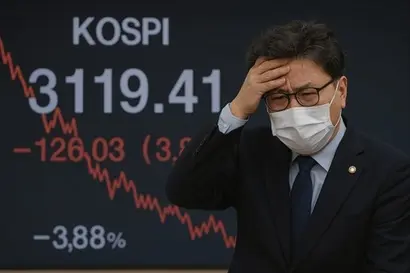
The core issue is the rollback of the threshold for major shareholders regarding stock capital gains tax. The market is concerned that tightening the criteria for major shareholders will increase pressure on stock prices to fall at the end of every year, as major shareholders sell stakes to avoid capital gains taxes.
However, the Ministry of Economy and Finance maintains that the market's reaction is excessive. It has even presented statistics suggesting there is no clear correlation between the major shareholder threshold and stock prices. It pointed out that when the threshold was tightened to 1 billion won in 2017, stock prices actually rose, whereas they fell in late 2023 under the Yoon Suk-yeol administration when the threshold was relaxed to 5 billion won.
The government also claims it is unclear whether tightening the major shareholder criteria will directly lead to an "end-of-year selling bomb." In fact, it emphasized that while net selling increased compared to the previous year when criteria were tightened in 2017 and 2019, net selling also increased in years when criteria were relaxed, such as 2023. The interpretation is that market returns have a greater impact on selling decisions. On the 2nd, Jin Sung-joon, Policy Committee Chair of the Democratic Party of Korea, said via his social network service (SNS), "Many investors and experts speak as if our stock market will collapse if the stock capital gains tax requirements are rolled back," adding, "Precedents suggest otherwise."
However, the market is more sensitive to "uncertainty" than to numbers. Suspicions are growing that the government has shifted from an investor-friendly stance to one of "tax strengthening."
Jeong Hae-chang, a researcher at Daishin Securities003540, pointed out, "They announced a tax reform plan that contains exactly what the market was worried about," adding, "As tax rates related to the stock market were reverted, doubts have intensified regarding the government's will to achieve the 'KOSPI 5000 era'." Na Jeong-hwan, a researcher at NH Investment & Securities005940, also said, "Unlike the stock-friendly policies pursued after the presidential election, this tax reform plan is a tax-hike measure that is unfriendly to the stock market, which has triggered doubts about the government's stock market boosting policy," but added, "Given the current market situation, there is a possibility that some content could be modified during the plenary session discussion process."
Criticism has also emerged from within the Democratic Party. Supreme Council member Lee Un-ju stated, "The biggest problem with this tax reform is that it has cracked the trust of 'Donghak Ants' (individual investors) who decided to invest in the domestic market for the long term, believing in the new government's will to resolve the 'Korea Discount'," adding, "It seems they overlooked how sensitive investors are to the government's sincerity and will regarding the market." Party spokesperson Kim Hyun-jung also noted, "There are aspects where the tax revenue increase effect is not significant when lowering the major shareholder capital gains tax threshold from 5 billion won to 1 billion won, and there is also the question of whether 1 billion won can even be considered a major shareholder," adding, "Adjustments are possible after further discussion."
Of course, policy risks are sufficient to shock the market in the short term. However, this reform plan is still at the "announcement stage," and there is a possibility that it may be partially adjusted during future National Assembly discussions. In fact, there have been several cases in the past where negative factors for the stock market were eased during the legislative process. There are prospects that the "realism of the major shareholder threshold" could be re-examined during the political discussion process of this reform plan as well.
In addition, with other previously promoted bills such as the mandatory share buyback and cancellation (Commercial Act amendment) still being pushed for August-September, some say the policy stance friendly to stocks has not been completely reversed.
Researcher Na Jeong-hwan predicted, "The current government's policy stance is still focused on resolving the concentration of household assets in real estate and making stocks an alternative investment vehicle to real estate, so policies to enhance shareholder value will continue to be pushed in the second half of the year."
Ultimately, experts advise that as market volatility increases in the short term, investors need to respond with stocks that show earnings improvement based on fundamentals. The market can be shaken at any time, but investment criteria should not be. This is a time when one needs to review their investment philosophy and strategy, and make cool-headed judgments about policy directions and supply-demand cycles.