

[비즈한국] The 'Just Transition Special Zone,' for which the Yoon Suk-yeol administration failed to even establish designation criteria, shows signs of moving forward under the Lee Jae-myung administration. For regions facing the impending closure of coal-fired power plants, it is expected that the designation of these special zones will provide a much-needed boost to the local economy.
The Just Transition Special Zone, specified in the Carbon Neutrality Basic Act enacted in 2021, is a system designed to support industries and regions experiencing deepening social and economic inequality, such as job losses and local economic stagnation, during the transition to a carbon-neutral society. Once designated as a special zone, the region receives benefits such as the establishment of a 'Just Transition Support Center (Transition Center),' support for businesses and small merchants, re-employment support for workers, and the attraction of investment in new industries. It is regarded as a vital project for local residents who will be impacted by the carbon neutrality process, including the shutdown of coal-fired power plants.
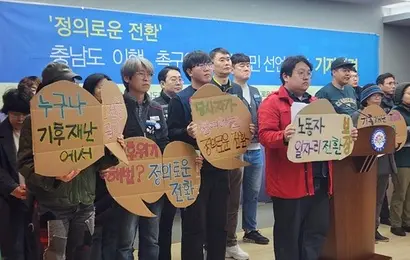
The Yoon Suk-yeol administration did not designate a single special zone during its more than three years in office since the Carbon Neutrality Basic Act took effect. At the '2nd Regular Meeting of Central and Local Governments on Carbon Neutrality' held by the 2050 Carbon Neutrality and Green Growth Commission on November 28, 2022, it was announced that a notification regarding the designation of special zones would be issued in the first half of 2023. In July 2023, the government announced the 'Economic Policy Directions for the Second Half of 2023' and stated it would designate around two special zones. However, this promise was not kept, and the government still has not notified the criteria or support methods for designating these zones.
The situation is similar for the Transition Centers. According to the enforcement decree of the Carbon Neutrality Basic Act, local government-level Transition Centers can be established by the mayor or provincial governor in areas designated as special zones. At the national level, they can be housed within the Korea Institute for Advancement of Technology (KIAT) under the Ministry of Trade, Industry and Energy, and the Korea Employment Information Service (KEIS) under the Ministry of Employment and Labor. Since the special zone designations were never implemented, the local Transition Centers could not be established either.
The centers established within KIAT and KEIS are also failing to operate properly. Although founded in 2023 and 2022 respectively, most of their work has been limited to research projects related to the criteria for special zone designation. In the case of KIAT, operations have been halted as it did not receive related budget allocations for 2024 or this year.
Budget execution has also been sluggish. While an initial budget of 1.6 billion won was allocated in 2023, plans were changed and only 400 million won was actually spent. In 2024, the entire project budget of approximately 2.4 billion won went unused. Ultimately, this year, the funding was reduced to 220 million won as it was incorporated into the budget for a similar project, the 'Industry and Job Transition Analysis Center.' Lee Sung-hyun, a senior researcher at the Nara Institute for Economic Justice, analyzed, "Budget execution has been lackluster for years for the same reason—that criteria for special zone designation were never established," adding, "The government's genuine will to push forward with the project is questionable."
However, with the launch of the Lee Jae-myung administration, the atmosphere surrounding projects related to a just transition has shifted. Park Ji-hye, a National Assembly member of the Democratic Party of Korea and a special advisor for the Economic Subcommittee of the State Affairs Planning Committee, stated, "It is necessary for the designation of special zones and the establishment of transition centers to proceed in line with the purpose of the law," and added, "Moving forward, we plan to promote a just transition centering on new legal systems regarding support for regions where coal power is being phased out."
KIAT has included the Transition Center budget in its 2026 government proposal. A KIAT official said, "Since the closure of aging coal-fired power plants is scheduled to begin this year, we are reviewing special zone designations starting next year," and added, "We submitted the plan considering the budget requirements once the special zone designation is implemented."
The Ministry of Employment and Labor is also preparing related projects. KEIS also stated that it has plans for additional activities for the designation of special zones. A Ministry of Employment and Labor official noted, "We are planning to commission research to define the criteria, procedures, and methods for designating special zones," adding, "It seems that things have started to gain momentum under the new administration."
Regions like Chungnam and Gyeongnam, which face the sequential closure of coal-fired power plants, are urging the government to designate these special zones quickly. Chungnam, where 14 out of the 28 coal-fired power generation units slated for closure are concentrated, has continuously requested designation from the Ministry of Trade, Industry and Energy and the National Assembly's Environment and Labor Committee at the provincial level.
In Gyeongnam, where 12 units are set to close, the provincial council passed a recommendation to the government this January urging the designation of a special zone. Provincial Council Member Kim Gu-yeon of the People Power Party said, "It is regrettable and frustrating that the government has not yet even established concrete criteria for designating special zones," and added, "I hope the new government shows a strong will to respond to the climate crisis and realize carbon neutrality."