

[비즈한국] The tariff negotiations between South Korea and the U.S. have been concluded. The 25% tariff rate that the U.S. had planned to impose on all South Korean products starting August 1 (local time) has been finalized at 15%, just two days before it was set to take effect. While higher than the rate for the UK (10%), it matches the level applied to the EU and Japan, who concluded their tariff negotiations earlier, and remains lower than those for the Philippines (19%) and Vietnam (20%). Amid generally positive feedback, forecasts suggest the shipbuilding industry will be the biggest beneficiary of this agreement.
U.S. President Donald Trump announced the news of the trade agreement between South Korea and the U.S. on his social media platform, Truth Social, on the 31st. President Trump wrote, "I am pleased to announce that the United States has reached a full trade agreement with the Republic of Korea," adding, "Korea is completely open to trade with the U.S. and has agreed to accept American products including automobiles, trucks, and agricultural goods."
President Lee Jae-myung also commented on Facebook, "Through this negotiation, the government has eliminated uncertainty in the export environment and, by aligning U.S. tariffs to a level equal to or lower than our major export competitors in the U.S., has created conditions where we can compete on equal or superior terms with major nations."
The Presidential Office announced the specific details of the negotiation in a briefing that day. South Korea plans to establish a U.S. investment fund totaling $350 billion (487 trillion KRW). The U.S. will receive 90% of the profits generated from the investment fund, which is the same level as Japan. Previously, Japan had agreed to create a $550 billion investment fund in its tariff negotiations with the U.S. and, like South Korea, agreed to let the U.S. take 90% of the investment returns.
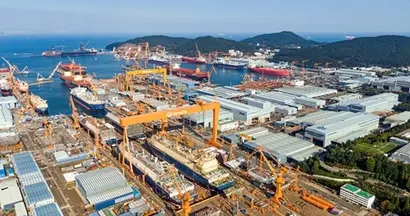
The shipbuilding industry is expected to be the biggest beneficiary of this tariff agreement. This is because $150 billion, over 40% of the investment fund, is slated to be utilized in the shipbuilding sector. Kim Yong-beom, Secretary to the President for Policy, stated in the briefing, "The $150 billion Korea-U.S. shipbuilding cooperation fund covers the entire shipbuilding ecosystem, including vessel construction, MRO (maintenance, repair, and overhaul), and shipbuilding equipment and materials."
Shipbuilding is one of the areas that the U.S. showed the most interest in during this tariff negotiation period. Accordingly, the government negotiation team proposed the 'MASGA' project—a multi-trillion won scale initiative—to U.S. Secretary of Commerce Howard Lutnick on the 25th, which includes domestic private shipbuilders' investments in the U.S. as well as financial benefits such as guarantees and loans to support them. MASGA stands for 'Make American Shipbuilding Great Again.'
As of last year, South Korea is the world's second-largest country by share of new shipbuilding orders, following China. In contrast, the U.S. holds less than 1% of the market share, leading the Trump administration to set the reconstruction of the shipbuilding industry as a primary goal. This tariff agreement provides momentum for the domestic shipbuilding industry to enter the U.S. market.
Kim Yong-min, a researcher at Yuanta Securities, forecast, "U.S. local shipyards, including Philly Shipyard acquired by Hanwha, are in dire need of large-scale CAPEX (capital expenditure) due to aging facilities; thus, support from state-run banks could accelerate the modernization of these old shipyards," adding, "Companies under HD Hyundai267270, which have maintained a relatively conservative stance toward investment in the U.S., also have high expectations for future entry into the U.S. shipbuilding market."
The remaining $200 billion of the investment fund will be established for sectors such as semiconductors, nuclear power, secondary batteries, and bio. Separately from the investment, it is reported that the U.S. will purchase $100 billion worth of LNG (liquefied natural gas) and other energy commodities over the next three and a half years. This is being evaluated as having no major burden as it involves shifting purchasing sources from the Middle East to the U.S. for volumes already being imported.
The 15% tariff rate concluded in this agreement will be applied uniformly to general export items. As the mutual tariff is settled, attention is now focusing on what level of tariffs will be applied to sectors that have separate item-specific tariffs.
First, a 15% tariff rate is expected to be applied to automobiles, one of the primary export items. As a 25% tariff rate had been in effect since April 3, the automotive industry can breathe a sigh of relief.
However, compared to the 0% tariff rate applied since the signing of the KORUS FTA, a weakening in the price competitiveness of South Korean cars appears inevitable. Although they will be subject to the same 15% tariff as Japan, Japan had previously received a 2.5% tariff rate under its past trade agreements with the U.S., meaning South Korean cars will now face a 2.5% higher tariff burden than Japan compared to the past.
For semiconductors and pharmaceuticals, the rates are expected to be decided at levels similar to other nations. Secretary Kim explained, "It was specified that the item-specific tariffs for semiconductors and pharmaceuticals will receive Most-Favored-Nation treatment." Initially, President Trump had stated he could impose 25% on semiconductors and up to 200% on pharmaceuticals, but later agreed on a 15% rate with the EU. Therefore, the maximum tariff rate is expected to be 15%.
Regarding agricultural products, a subtle difference in perspectives between South Korea and the U.S. was revealed. President Trump mentioned the complete opening of agricultural markets, but the Presidential Office stated that an agreement was reached not to further open the rice and beef markets.
Secretary Kim added, "99.7% of domestic agricultural products are already open, with only about 10 items reserved," and "Although rice and beef are reserved, the U.S. side showed great empathy regarding the fact that we are their No. 1 importer of American beef."
Aside from this, existing tariff rates of 50% are expected to be maintained for the steel sector, including iron, copper, and aluminum.
The securities industry has provided a positive assessment of the tariff negotiation results. Jung Yeo-kyung, a researcher at NH Investment & Securities, forecasted, "Based on the amounts for U.S. investment and purchases of American products, South Korea can be interpreted as having negotiated well," adding, "Not only have the factors unfavorable to domestic exports been removed by applying the same tariff rate as the EU and Japan, but the reduction in the automobile item tariff will also lessen the decline in car exports." However, she observed, "As 5%p (percentage points) are added to the base tariff of 10% for other items, exports in the second half of the year may slow down compared to the first half."
Researchers Lim Jae-kyun and Lee Jung-wook of KB Securities also expressed the outlook that, "With the tariff negotiations finished and uncertainty alleviated, it will have a positive impact on consumption and corporate sentiment."