

[비즈한국] The trade negotiations led by U.S. President Donald Trump resemble nothing less than war. While he may not be firing guns or launching missiles at opposing nations, the pressure applied to force them into submission is no different from any war. Tariffs are his most potent weapon. The approach—granting access to the U.S. market in exchange for "something" from the counterpart—might look like a transaction, but in reality, it is closer to extortion.
Having succeeded in his re-election, Trump is pushing this strategy even harder than before. As a result, countries around the world are being summoned to the table one after another in the name of "negotiations." These are no longer the mutually beneficial transactions of the past. It is a fight to see who can escape with the least amount of damage.
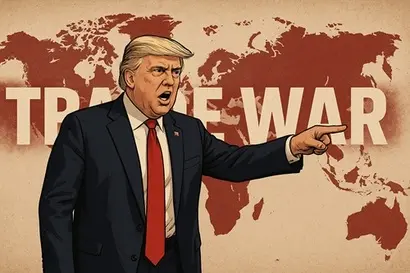
Recently, Japan concluded its tariff negotiations with the U.S. In signing agreements concerning automobiles, semiconductors, and pharmaceuticals, Trump secured a $550 billion (approx. 720 trillion KRW) investment package from Japan in return. While it is labeled as an "investment" on the surface, it is effectively a structure where Japanese government agencies are stepping in to subsidize U.S. companies. Furthermore, the U.S. takes 90% of the profits generated from these investments, leaving Japan with only 10%. Although the Japanese government claimed to have "secured low tariffs for key industries," they essentially paid a staggering amount of money to the U.S. just to save face.
It is not just Japan. The EU, Mexico, and South Korea are in the same boat. Under U.S. pressure, they are forced to increase imports, raise defense spending, and may even be required to alter their domestic policies. Today, the world is not negotiating to gain something, but moving to prevent greater harm. The goal is not profit, but loss mitigation.
However, we often forget this absurd reality. Regarding our own impending deal, it is a mistake to make direct comparisons, such as insisting that "under no circumstances should we settle for less than Japan did." What matters is not the comparison, but understanding the underlying structure. Success in this game depends on how little you can get hurt while walking away. If public pressure forces the government to treat Japan’s deal as a benchmark, it will only weaken our own negotiating leverage.
Trade is no longer just an economic issue; it is intertwined with security and politics. Industries like semiconductors, electric vehicles, and batteries have moved into the realm of "national security." Trade has become a tool for changing the rules whenever necessary, rather than following them. This trend is not merely the result of one man, Trump; the entire U.S. political landscape is shifting in that direction.
The U.S. was not always this way. Just 20 years ago, it was the strongest advocate for free trade. Entering into an FTA with South Korea was an extension of that stance. Yet, over time, frustration grew within the U.S., with claims that "free trade took away our jobs" and "China took all the benefits." Particularly in the Midwest, where manufacturing jobs vanished, this discontent transformed into political power. Trump became president by representing these voices, and from that point, U.S. trade policy began to change.
The world is now learning a completely new order. It is no longer safe to trade with the U.S. alone. The lesson that the rules can change at any moment is spreading. China and Russia are creating financial networks that bypass the U.S., and Europe is strengthening its own supply chains. Everyone is preparing for the "next Trump." While the U.S. remains the most powerful nation, if this behavior continues, it may eventually lose its credibility.
Beyond trade, diplomacy is also increasingly resembling war. Negotiations have ceased to be win-win processes and have become defensive battles to minimize losses. Even at this very moment, the world is restructuring itself to counter U.S. pressure. Trump-style negotiations might work for now, but the price will surely be paid. Unilateralism from a superpower always invites a backlash. Eventually, the U.S., too, will have to pay for its choices, one way or another. History has always flowed in that direction.