

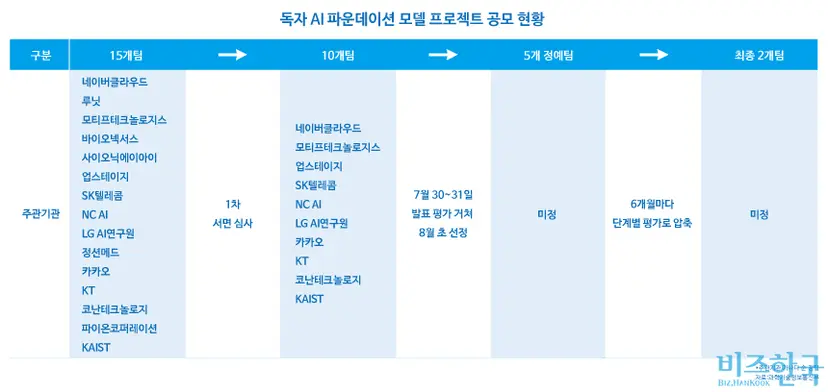
[비즈한국] The 10 teams that passed the preliminary round for the national representative Artificial Intelligence (AI) selection have moved on to the next stage to prove their technical prowess. The 5 elite teams that emerge victorious from the presentation evaluations, held over two days on the 30th and 31st, will enter the race for the final selection list. Subsequently, a "survival" assessment will follow, where one team will be eliminated every six months based on performance metrics such as AI model development, with government support for the final two elite teams scheduled to begin in 2027. The two final selected teams will enjoy the privilege of receiving concentrated support for core resources, including GPUs, data, and talent, as well as a budget totaling 200 billion won. With the curtain rising on a development race in which the government will officially grant the "K-AI" title, an all-out war for AI technological leadership is on the horizon.

The "Independent AI Foundation (Basic Model) Project," spearheaded by the Ministry of Science and ICT with a total investment of 213.6 billion won, is a plan to develop a globally competitive domestic Large Language Model (LLM) and build a "Sovereign AI" based on it. The standard set by the government is an AI model with performance at least 95% comparable to the latest top-tier global models released within the last 6 months.
In the public offering, which attracted many companies focused on Sovereign AI, the government evaluated the business plans of 15 participating teams in writing and narrowed the list down to 10 on the 25th. The teams that cleared the first hurdle include Naver035420 Cloud, Motif Technologies, Upstage, SK Telecom017670, NC AI, LG AI Research, Kakao035720, KT030200, Konan Technology, and the Korea Advanced Institute of Science and Technology (KAIST). They participated in the selection process by forming consortia to consolidate the technical capabilities of institutions with different areas of expertise.
The formation of diverse coalitions, ranging from universities and research institutions to various government entities that act as actual user organizations, is notable. Previously, the government made the participation of university and graduate students a mandatory requirement to underscore the goal of fostering talent and the growth of the overall AI ecosystem. The evaluation criteria include technical capability and development experience (40 points), development goals, strategy, and technology (30 points), and ripple effects and contribution plans (30 points).
Naver and LG Add Weight with Technical Prowess and Policy Alignment
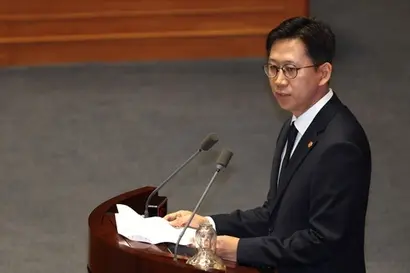
The most attention is focused on Naver Cloud and LG AI Research, which respectively produced the new Chief AI Advisor Ha Jung-woo and the new Minister of Science and ICT Bae Kyung-hoon. Naver possesses the HyperCLOVA series, while LG holds the EXAONE series. Both are evaluated as having diverse strengths in infrastructure, data foundations, and networks.
As Advisor Ha and Minister Bae both designed and executed AI development directions and strategies within their respective companies, their transition to positions with policy-making authority is interpreted as a signal that the technology and vision of these two organizations largely align with the government's strategic roadmap, or are highly likely to be coordinated that way moving forward.

The competitiveness of both companies stems above all from their experience in developing hyper-scale AI models. Following three lightweight HyperCLOVA X models released in April, Naver released its self-developed lightweight inference model "HyperCLOVA X Seed 14B Sync" as open source on the 22nd. Naver explained that the training cost for this model is 1/100th that of overseas models of the same size, signifying high cost-efficiency.
On the same day, LG AI Research held an "LG AI Talk Concert" and unveiled the "EXAONE Ecosystem." Along with Korea's first hybrid AI "EXAONE 4.0," precision medical AI "EXAONE Path 2.0," and the multimodal AI (which exchanges information via images, sound, etc.) "EXAONE 4.0 VL," the company presented its latest AI technologies, services, and strategies for diversifying B2B business models.
Upstage is also consistently proving its technical prowess on the global stage. Upstage’s next-generation LLM, "Solar Pro 2," was recently selected as the only domestic "frontier" (top-tier) model in performance evaluations by an independent global analysis agency. In indicators assessing 7 representative benchmarks such as inference, general knowledge, math, and coding, it outperformed big tech LLMs such as Mistral Small, GPT-4.1, Llama 4 Maverick, and GPT-4o, as well as Chinese models like DeepSeek. It drew attention after Elon Musk made remarks expressing concern over Upstage's performance. Last month, the company announced plans to collaborate with AI semiconductor fabless firm FuriosaAI to mount the domestic LLM "Solar" onto domestic NPUs.
Naver has formed a consortium with video multimodal AI startup Twelve Labs and major domestic university research institutions, while LG is competing with a consortium centered on affiliates such as LG Uplus and LG CNS. Upstage has not disclosed its consortium composition.
Collaboration Among Startups, Academia, and Major Institutions Stands Out
Telecom companies, having entered the AI leadership race based on infrastructure and real-world user data, are also participating with diverse consortia. SK Telecom is cooperating with Krafton, Korea's largest listed game company, autonomous driving solution developer 42dot, and AI inference NPU developer Rebellions. On the 24th, while the selection competition was ongoing, it released its own LLM, "A.X 3.1," as open source. The model is specialized in mathematical and coding inference beyond Korean language conversation capabilities.
In the case of the KT consortium, which possesses "Mi:dm AI," collaboration with actual user organizations is noteworthy. In addition to companies that can create technical synergy, such as Saltlux, the provider of the LLM "Lucia 3," participants include the National Police Agency, Korea University Medical Center, the Korea Coast Guard, the Constitutional Court, and leading domestic law firms.
NC AI is showing confidence in its own technical capabilities based on the prowess and development experience of its "VARCO LLM." NC AI is an AI-specialized subsidiary launched by NCSoft036570 this February. Although its history as a corporate entity is short, it started from a dedicated research department organized at the headquarters in 2011. It was the first among domestic game companies to create AI, and it plans to apply its self-developed VARCO to various industries such as content production, gaming, and fashion.
Konan Technology, which is collaborating with public institutions using its own LLM, has joined forces with AI-specialized SMEs and startups like Synapsoft and Alchera, as well as 12 AI-major professors from 4 domestic universities. Motif Technologies is competing alongside its parent company, AI infrastructure firm More, Samil PwC, and Seoul National University, representing the legal and academic sectors. Motif is developing an AI model based on AMD GPUs rather than NVIDIA's. Kakao is also known to have formed a consortium centered on university laboratories.
A representative from a participating company stated, "Each company has distinctly different technical philosophies and approaches to the ecosystem," adding, "The focus is not just on technical competition, but also on how collaborative an ecosystem they can build." A startup official remarked, "This project serves as a symbolic milestone that provides direction to the entire domestic ecosystem. It will act as a turning point that raises not only companies' technical development but also their collaborative structures and overall industrial capabilities."
The 5 elite teams selected will receive support for resources such as GPUs, data, and talent from the government for three years. To enjoy the benefits of "K-AI," they must prove their initial achievements as early as the end of December.
The government's policy is to make the AI models created through this project available as open source. Minister of Science and ICT Bae Kyung-hoon stated the purpose of the project during his parliamentary confirmation hearing on the 14th, saying, "The key is to secure excellent domestic foundation models and create an environment where startups, SMEs, and academia can utilize them in various fields."