

[비즈한국] Using data from the James Webb Space Telescope (JWST), a piece of the largest cosmic map in history has been completed. And anyone can now explore every corner of this map. At first glance, it might look like an unremarkable, boring photo. But if you look closely, your opinion will likely change.
Do you remember the first deep-field image released from James Webb's observations in July 2022? The area of the sky that photo captured was truly small. It targeted a patch of sky so narrow that it could barely be covered by a single grain of sand held at arm's length. James Webb’s field of view is extremely narrow in this way. Filling a map of the entire universe with a field of view no larger than a grain of sand would take an immense amount of time.
However, this latest piece of the cosmic map covers an area large enough to fill a full moon and then some. Considering how narrow the view is for each of James Webb's observations, you can grasp just how much observational data was required for this single map segment. This newly released image alone contains over 800,000 galaxies. Anyone can view the high-resolution photo and explore its various parts, so I encourage you to check it out yourself.
When taking deep-field images, it might seem like you can just point the telescope in any direction, but that is not the case. Even when aiming at a patch of empty black sky that appears to have nothing, extremely precise targeting is required. This is because the sky around us is filled with all kinds of obstacles that block the faint light from the universe 13 billion years ago.
First, the galactic disk of our own Milky Way, where we live, is the most annoying obstacle. We reside on the outskirts of a massive galactic disk with a diameter of 100,000 light-years. The Milky Way we see is essentially a cross-section of this disk viewed from the side. This Milky Way obscures about 20–30% of our entire night sky field of view. The region hidden by the Milky Way is even mockingly called the "Zone of Avoidance." To capture a clear deep field, one must first aim at a part of the sky not blocked by the Milky Way.
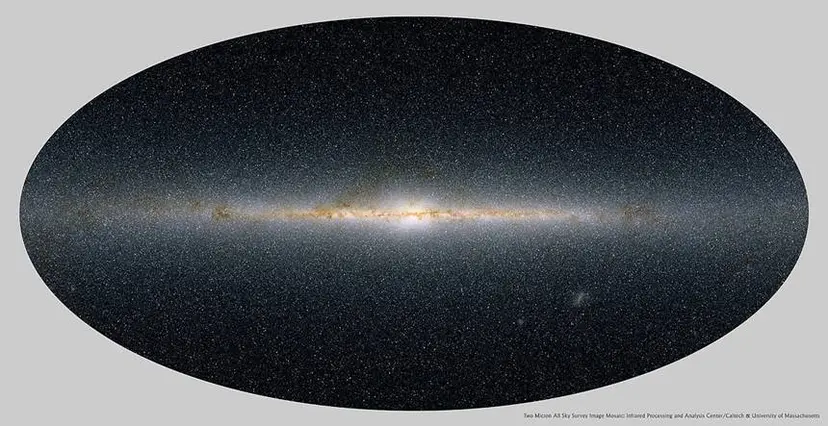
There is one more thing to be mindful of when taking deep-field images with James Webb. James Webb observes the universe in the infrared spectrum. However, gas and dust clouds containing hydrogen float everywhere in outer space. These clouds, warmed by the light of nearby stars and galaxies, emit bright infrared light. If a massive gas cloud is spread out, blocking the background universe, the faint infrared light coming from the more distant universe hidden behind it will be buried. Therefore, the areas James Webb can target for deep fields must be in directions unobstructed by gas clouds.
In fact, when the Hubble Space Telescope captured its historic deep-field images, it also carefully considered these diverse conditions to determine its aiming direction. As a result, it targeted a small patch of sky near the Big Dipper and discovered thousands of galaxies in a sliver of sky as small as a pinhole.
However, Hubble has its limits. It primarily observes in the visible light spectrum. Thanks to updates where astronauts went up to install new equipment, it can also observe some infrared and ultraviolet light. But this is not enough to look at the "Epoch of Reionization," the time when the first stars and galaxies in cosmic history began to emit light following the Big Bang. Because the universe has expanded uniformly over the past 13.8 billion years, the wavelengths of light traveling from the distant universe have stretched more dramatically. To see the light from the distant past, shortly after the Big Bang, one must look at longer mid-infrared light. James Webb is doing just that.
The cosmic map released this time was created using Cycle 1 data from the first year of the James Webb Space Telescope. One of James Webb's main goals is to directly observe the Epoch of Reionization, a period during which the dazzling first stars and galaxies are estimated to have ionized the entire universe. This period occurred when the universe was only 300 to 500 million years old. This means we are looking at the universe as it was 13.5 billion years ago, when it was effectively only 1–2% of its current age.
To achieve this, astronomers are conducting a project called the Cosmic Evolution Survey, or COSMOS for short. In this project, James Webb targets a desolate, empty black patch of space without any significant galaxies or gas clouds. Consequently, it points toward the constellation Sextans, a very small constellation seen in the southern sky, which is a bit more plain compared to the northern sky that has much more to offer. (Unfortunately, the COSMOS field region cannot be seen from Korea.)
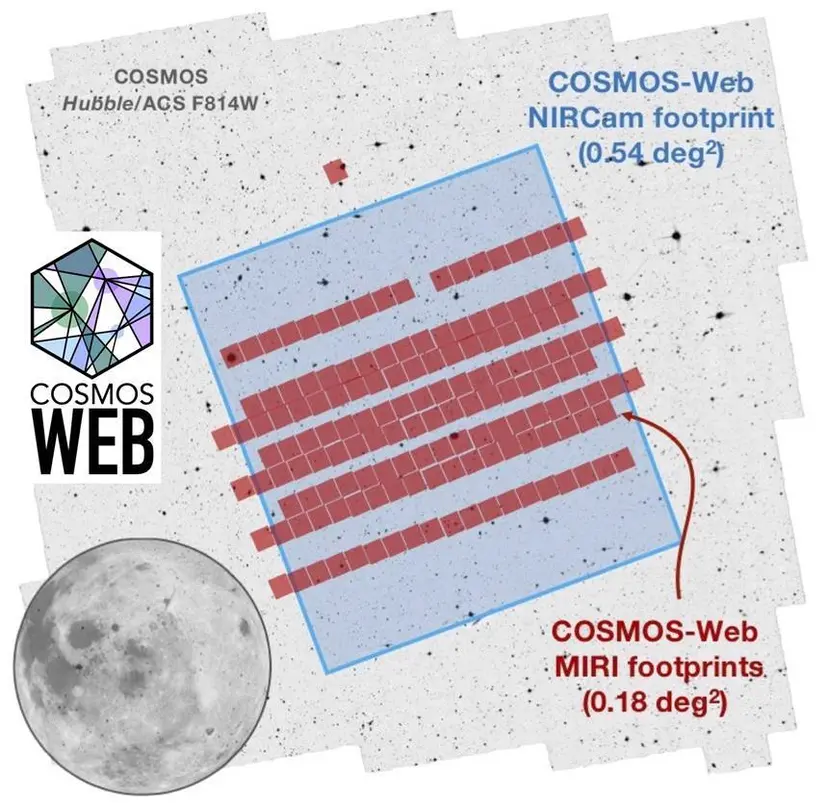
Over the past year, James Webb has periodically collected the light of the primeval universe from a small patch of sky near Sextans. The total exposure time for gathering this light reaches 255 hours. Using James Webb's NIRCam, color images were created using light from different infrared wavelengths (F115W, F150W, F277W, F444W). The field of view that James Webb can see at once is truly tiny—only about 0.18 square degrees, much smaller than a full moon. It is a patch of sky as small as a grain of sand. By meticulously stitching these small patches together, they filled a map of a much larger area totaling 0.54 square degrees. They drew a map as large as the full moon by collecting tiny pieces the size of grains of sand.
This is the deepest and largest piece of a cosmic map ever created by humanity. In this single image alone, over 800,000 galaxies at varying distances are identified. Among them, the faint light of galaxies that have preserved the light from over 13 billion years in the past is mixed in. This is a tremendous result compared to the existing Hubble deep fields. Even in the largest segment of the Hubble deep field, the number of galaxies contained was at most around 10,000. Yet, James Webb captured the light of over 800,000 galaxies in this small patch of sky.
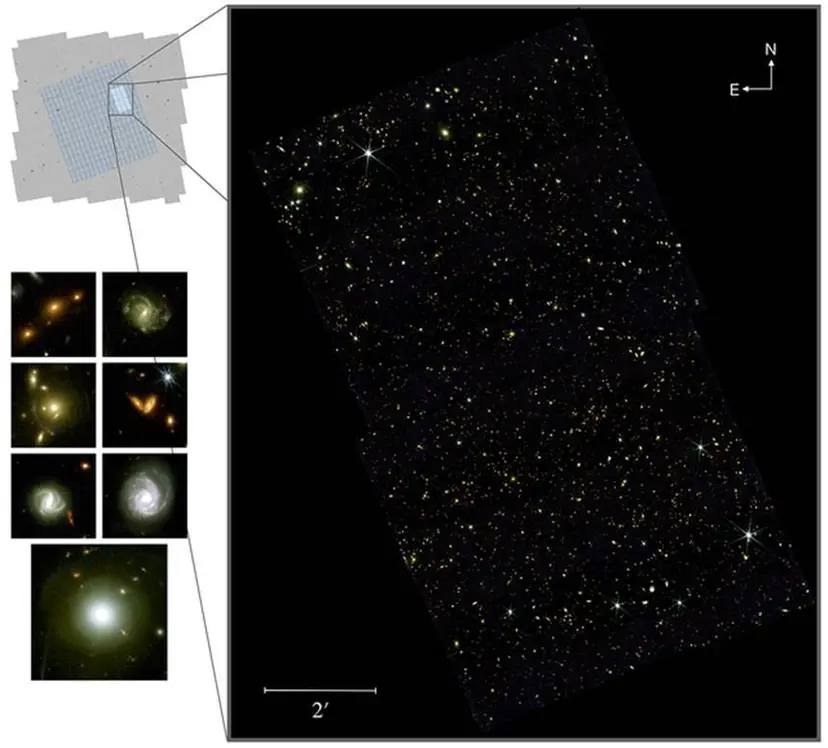
Because they chose the most desolate direction where the view is barely obstructed by stars and gas clouds of our own galaxy, there are almost no dazzling Milky Way stars in the photo. Instead, if you look closely, you can see gravitational lens images where space-time is minutely distorted in every corner. Anyone can easily explore this beautiful sight themselves. I hope readers will use the link below to explore the first piece of James Webb's cosmic puzzle. Even if you zoom in endlessly, you will encounter a feast of new, faint galaxies appearing one after another.
With the launch of James Webb, we realize that the universe has possessed its current beauty from a much earlier point than we originally thought. The early universe viewed by James Webb shows nearly 10 times more galaxies than we initially expected. Moreover, these are not small, amorphous dwarf galaxies, but mostly mature ones with distinct bar structures and spiral arms. We even find supermassive black holes in the early universe as heavy as those living in the centers of today's galaxies. An overly precocious universe, looking as if it were 10 billion years old when the universe was less than 1 billion years old, has been revealed.
In fact, the full moon doesn't take up a very large area in the night sky either. It looks small enough to be covered by a single finger held up at arm's length. And only now have we filled one small puzzle piece that can barely cover that full moon. Think of the vast sky spread out above us. How many full moons would it take to cover the entire sky? A simple calculation shows that about 210,000 full moons are needed. Out of 210,000 puzzle pieces, we have finally completed just one.
The depth of this small puzzle piece holds 13.8 billion years of time. And between the bright, shining galaxies we can see, there is, unfortunately, plenty of dark matter and dark energy that we cannot see with our eyes. In the 17th century, the Italian astronomer Galileo looked up at the night sky with a telescope for the first time in history and meticulously recorded the stories told by starlight. He published his findings in a book called "Sidereus Nuncius." It is a beautiful name meaning "Starry Messenger." Yes, isn't that exactly what astronomy does?
We are now delivering the news of stars that have traveled through a long period of 13.8 billion years. How many stories must the light of the night sky, accumulated over such a long time, want to tell us? A small puzzle piece taken from the night sky has condensed the long story of the universe.
References
https://cosmos.astro.caltech.edu/page/cosmosweb
https://cosmos2025.iap.fr/fitsmap/?ra=150.1203188&dec=2.1880050&zoom=1
https://ui.adsabs.harvard.edu/abs/2023ApJ...954...31C/abstract
About the author, Ji Woong-bae: Loves cats and the universe. After watching "Galaxy Express 999" as a child, he dreamed of sharing the beauty of the universe. He currently researches the evolution of galaxies through their interactions at the Yonsei University Galaxy Evolution Research Center and the Near-Field Cosmology Lab, and is engaged in various science communication activities including lectures and writing. He is the author of books such as "The Flirting Observatory," "Thinking About the Universe All Day," and "Stars, the Science of Light."