

[비즈한국] This is a story from an acquaintance. They went to a golf course in Yeoju for a round. That day, the restaurant outside the golf course happened to be closed for its regular holiday, so they had no choice (?) but to eat at the golf course clubhouse. Naturally, I wasn't thrilled. I already knew the food prices at that golf course. Looking at the menu at the table, the breakfast prices lived up to my dismal expectations. A bowl of seafood kimchi bean sprout soup was 32,000 won. A bowl of small clam and mugwort soup was 33,000 won, and an American-style breakfast—without the option to take coffee to go—was 37,000 won. These are hotel restaurant prices. It’s not that the interior or ambiance is as good as a hotel restaurant, nor is the space private. When you eat at a hotel, don't you have time for meaningful conversation and the leisure to relax without rushing out the moment you finish your meal?
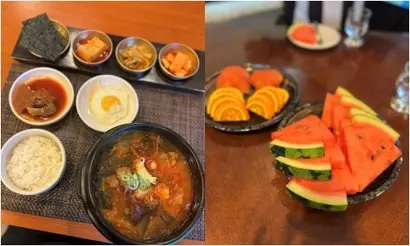
Before a round, especially in the morning, it is common to meet 40–50 minutes before the tee time, finish a meal in a rush, and hurry out to the course. The fact that breakfast at the clubhouse mainly consists of hangover-style soups suggests an intent for golfers to "slurp" them down and leave. My companions, shocked by the absurdly high prices, said, "This is truly too much. Do we really have to eat this at this price?" But since we were already seated and had no real alternatives, we had no choice but to bite the bullet and pay for the expensive breakfast.
When discussing why food at golf courses is expensive, people often say that since the golf course doesn't operate the restaurant directly but leases it out for high rent, the operating company has no choice but to set high prices. Another factor that always comes up is rising labor costs. What is clear is that places with expensive food attract fewer customers to the clubhouse restaurant, and since there are fewer people, it paradoxically leads to a vicious cycle where prices must be raised to maintain revenue. There is a term that sounds rather unpleasant because it feels like putting a price tag on golfers: "average transaction value per customer." In the case of group bookings, it is the amount a golfer is forced to spend. At some golf courses near Gyeonggi-do, close to Seoul, this mandatory spend can reach nearly 100,000 won. Golfers are forced to meet this high mandatory spend at courses that already have expensive green fees.
It’s not just the clubhouse restaurant where food is expensive. The prices at the "start house," where you stop for a break after the first nine holes, also make you gasp. There are places where makgeolli that costs less than 2,000 won at a mart is sold for 13,000 won, and tteokbokki and sundae, common items at any local street snack stall, are sold for 40,000 to 50,000 won with just a few extra ingredients. If nothing else, having to pay more than the price of a pork stir-fry dish for tteokbokki—which we ate for a few thousand won in front of school as children—is a shock that feels like it’s destroying childhood memories. In the summer, they name it "watermelon steak" and charge a premium for it. "Watermelon steak"—what a creative idea and a devious marketing ploy. I also remember an acquaintance venting about how an order of mango shaved ice cost 80,000 won. There are even sinister rumors that some places deliberately extend the break time at the start house to boost their revenue.
In South Korea, whenever the word "golf" is attached to something, the price shoots up like a high-trajectory ball. This applies to golf apparel and golf course food alike. Of course, there are places where the food is delicious and the atmosphere is pleasant enough to justify the price. However, I feel that they are setting blatantly brazen prices, holding customers who have no choice but to eat at the golf course as hostages. In Japan, many golf courses include lunch in the green fee, and those prices are extremely cheap compared to Korean golf courses. US golf course restaurants are also practical spaces where you can eat a burger or sandwich at a reasonable price. Many Korean-Americans living in the US even bring their own food to eat during their rounds. While some South Korean golfers also bring their own food to eat during rounds, they are often met with red-lettered warning signs somewhere in the start house that say "No Outside Food Allowed."
It is said that the number of people visiting golf courses has been declining for four consecutive years since 2022. The rise in green fees is slowing down, and unlike during the COVID-19 era, we are receiving quite a few promotional texts from golf courses. The golf market is clearly changing. If golf courses do not change the perception that their food is unconditionally expensive—leading people to avoid clubhouse restaurants or start houses whenever possible—their food and beverage businesses will face a serious crisis. I wish we could eat simple gimbap and cup noodles at golf courses. Having a small convenience store would be nice, too. A golf round shouldn't be a grand, flashy outing where you burn through piles of money. Just like the phrase "Shall we go get some exercise?", golf in South Korea should return to being a form of exercise.
About the author, Kang Chan-wook?
An advertiser and author. Starting as a copywriter at Cheil Worldwide, he is currently the CEO of the video production company "Sidaeui Siseon" (Gaze of the Times). A golf enthusiast, he earned a USGTF teaching professional certification, and out of a love for writing, he has published books on golf: "The Joy of Golf," "Bad Golf," "Sincere Golf," and "Golf Thoughts, Thinking Golf." He operates the YouTube channel "Bad Golf," sharing various stories and thoughts about golf with readers and viewers.