

[비즈한국] At the ‘Aerospace Weapon System Technology Development Conference’ held in Daejeon on July 28, 2025, the ‘Electronic Warfare Aircraft Block-1’ currently being proposed by KAI was unveiled for the first time. In this project, where KAI is competing against the team of Korean Air003490 and LIG Nex1079550 in partnership with Hanwha Systems272210, KAI, as the only domestic manned aircraft system developer, is taking on the challenge of ‘converting civilian aircraft into military aircraft’ to achieve airworthiness certification for the first time in Korea.
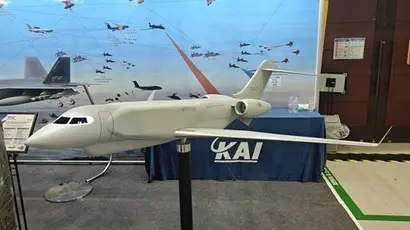
The Electronic Warfare Aircraft Block-1 is a stand-off jammer aircraft development project conducted domestically under the supervision of industry players. With a budget of 1.7775 trillion won to produce two Block-1 and two Block-2 units, the purpose of this project is to ‘neutralize enemy integrated air defense networks and wireless command and control systems.’ Simply put, it serves to deceive, jam, and disable enemy anti-aircraft radars so that ROK Air Force fighters can penetrate enemy air defenses without threat, and to jam, deceive, and manipulate enemy wireless communication equipment, either preventing them from communicating or paralyzing enemy command and control by sending fake communications. Such tasks are commonly referred to as ‘jamming,’ which is a type of neutralization technology formally known as Electronic Attack.
In addition, the electronic warfare aircraft is equipped with Communications Intelligence (COMINT) capabilities to gather information for attacking enemy wireless communications; specifically, it identifies which wireless frequencies the enemy is using and then renders those frequencies unusable.
Electronic warfare aircraft are not converted from combat aircraft or military transport planes, but from civilian business jets, as they require space for a large volume of electronic equipment—such as communication and signal jamming devices—and operational personnel. In this project, the competing teams—Korean Air-LIG Nex1 and KAI-Hanwha Systems—will both propose modifying Bombardier’s Global 6500 aircraft.
The Electronic Warfare Aircraft Block-1 model unveiled this time is the proposal from KAI and Hanwha Systems, while the opposing team, Korean Air-LIG Nex1, had already showcased their model at the KADEX defense exhibition held in Nonsan in October 2024.
While both KAI and Korean Air are modifying the same aircraft, there are slight differences in their conversion methods and content. The biggest difference lies in the placement of the ‘conformal antenna,’ the core of an electronic warfare aircraft. While both include two large conformal antennas on the sides of the fuselage, KAI is considering adding one more conformal antenna to the bottom of the fuselage.
A conformal antenna involves mounting various communication antennas directly onto the fuselage. While it is more difficult to manufacture than the ‘pod’ type—which requires separate mounts on the wings or fuselage—it is superior in terms of aircraft structure and causes less degradation in flight performance. The challenge is that electronic warfare aircraft must be equipped with antennas for various frequencies; while pod-type mounts are easier to manufacture, they tend to cause structural stability issues and reduced flight performance.
In fact, Turkey’s Hava SOJ electronic warfare aircraft, which began development before ours, has experienced delays due to issues arising from such structural changes. Therefore, how companies mount and arrange antennas on business jets and whether the modified aircraft can fly safely without performance degradation are the keys to this electronic warfare aircraft project.
In that regard, KAI, having unveiled their model for the first time, expressed great confidence in their ‘airworthiness certification’ capabilities. Airworthiness certification confirms that an aircraft is safe and capable of flight; this project requires certification for converting civilian aircraft into military-grade assets. Although we have previously converted civilian business jets for military use in Korea—such as the 701, known as the ‘Baekdu reconnaissance aircraft’—past projects effectively relied on foreign firms for airworthiness certification.
KAI showed strong confidence in this area, based on their experience with airworthiness certification for various training aircraft, fighters, and helicopters, including the KC-100 trainer, regarding this first-of-its-kind attempt at military aircraft certification in Korea. Indeed, through preliminary research before the project, KAI identified the characteristics of the Global 6500 and is independently researching efficient antenna placement and the addition of a ventral fin to ensure stable flight.
Furthermore, KAI’s partner, Hanwha Systems, also promoted their own electronic warfare capabilities. Hanwha Systems unveiled the core equipment of the electronic warfare aircraft: the ‘Smart Multi-Beam High Power Transmitter.’ As the main device for emitting jamming signals, this technology allows for the simultaneous emission of jamming waves to multiple locations, utilizing cutting-edge Gallium Nitride (GaN) components—the same type used in the KF-21 AESA radar—to achieve high output.
The Electronic Warfare Aircraft Block-1 project saw its initial bid notice posted by the Defense Acquisition Program Administration on July 15, and the bidding is expected to take place during September.