

[비즈한국] The South Korean real estate market is at a crossroads of fundamental change. The "Jeonse" system, which has dominated the residential leasing market for decades, is rapidly declining, and a new rental ecosystem centered on monthly rent is emerging. This represents more than just a change in market trends; it signifies a fundamental shift in the paradigm of South Korean real estate investment.
As of 2025, the proportion of monthly rent in nationwide lease transactions has reached 61.6%, surpassing the 60% mark for the first time. In Seoul, the figure stands at 63.9%, illustrating the accelerating collapse of the Jeonse system. This is a dramatic shift compared to 2020, when Jeonse accounted for 70.5% of transactions.
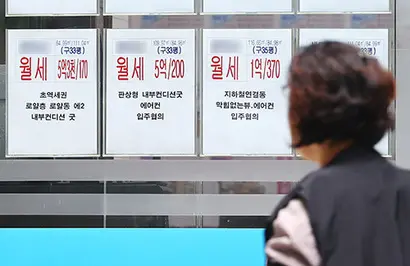
The rapid expansion of the monthly rent market is the result of a combination of structural factors. First, the persistence of high-interest rates has increased the burden of Jeonse-related loans, leading tenants to prefer monthly rent, which requires less initial capital. Second, the prevalence of Jeonse fraud cases has eroded social trust in the Jeonse system. Third, the continuous increase in one- and two-person households has expanded the demand for housing that favors monthly rent over large, lump-sum Jeonse deposits.
From the landlords' perspective, the preference for monthly rent is also clear. With the slowdown in real estate price appreciation reducing expectations for capital gains, monthly rent has emerged as an attractive investment tool for generating stable monthly cash flow. In particular, landlords prefer monthly rent as it allows them to avoid the risk of returning large Jeonse deposits while securing steady income.
The pace of the transition to monthly rent varies by region. In Seoul and the metropolitan area, high real estate prices are exacerbating the burden of Jeonse deposits, accelerating the shift. Conversely, in provincial areas, fears of "reverse Jeonse" (where landlords cannot return deposits due to price drops) are driving landlords to favor monthly rent over Jeonse. Notably, the proportion of monthly rent for non-apartment properties in the provinces has exceeded 83%, signaling a rapid transition.
The appeal of investing in apartment monthly rentals is also improving significantly. Traditionally, apartments were viewed primarily as vehicles for capital gains, but with rental yields recently reaching significant levels, their value as income-generating real estate is being re-evaluated. In Seoul, the rental yield for small apartments is around 3–5% per year, and in the outskirts of the metropolitan area, yields of 5–7% can be expected.
In particular, as the Jeonse-to-price ratio declines, the attractiveness of "gap investing" for the purpose of monthly rental income is increasing. With the ratio of Jeonse prices to sales prices falling to the 50–60% range, a structure has been formed that allows investors to secure stable rental income with less personal capital.
Tax optimization is essential for successful monthly rent investment. Registering as a rental business entity can yield significant tax savings. Registered business owners can apply a 60% expense deduction rate (compared to 50% for unregistered ones), and the deduction amount is expanded to 4 million KRW (2 million KRW for unregistered). Furthermore, they can benefit from income tax reductions ranging from 30% to 75%, significantly lowering the tax burden.
In particular, registered business owners with annual rental income of 10 million KRW or less owe no taxes, allowing them to secure rental income with effectively no tax burden. This is a highly favorable condition for small-scale monthly rent investors.
For larger-scale investments, establishing a corporation can be a viable option for tax optimization. Corporations are subject to lower tax rates (9–25%) compared to individuals and allow for easier processing of various expenses. However, starting in 2025, the corporate tax rate for small corporations whose primary business is real estate leasing will be raised to 19%, so careful consideration is required.
While monthly rent investment offers more stable cash flow than Jeonse, it carries its own risks. Vacancy is the primary risk; to minimize this, selecting locations with excellent transit accessibility and high job density is key. To mitigate the risk of falling rental prices, investors must maintain competitiveness through continuous facility improvements and upgraded management services.
Risks related to increasing maintenance costs and tax burdens can be largely mitigated by establishing an efficient management system and registering as a rental business. Policy change risks should be addressed preemptively through continuous monitoring.
Diversifying your portfolio is crucial for stable monthly rental income. By spreading investments across different regions, unit sizes, and tenant types, investors can minimize exposure to specific market changes. Additionally, diversifying into various property types, such as apartments, officetels, and commercial spaces, can enhance income stability.
The growth of the monthly rent market is expected to continue for the time being. Demographic shifts, the diversification of housing patterns, and the structural limitations of the Jeonse system suggest that a rental market centered on monthly payments is likely to become the standard. In particular, as global investors take note of South Korea’s monthly rent market, the investment environment is expected to improve further alongside the growth of the corporate-led rental housing market.
The impact of the government’s policy to expand the supply of public rental housing on the private monthly rent market must also be considered. Public rental housing, supplied at lower rates than market prices, can act as a factor for price stabilization in the private sector. However, due to limited supply and restrictions on residency eligibility, it is unlikely to fully replace demand in the private market.
The South Korean real estate market is undergoing a structural transition from a Jeonse-centered system to one centered on monthly rent. This change is creating new investment opportunities that go beyond simple market trends. Apartment monthly rent investment is emerging as an attractive alternative that offers both stable cash flow and reasonable yields.
Successful investment requires thorough market analysis, accurate profitability calculations, systematic tax optimization, and efficient risk management. In particular, the importance of leveraging tax benefits through rental business registration and selecting the right location cannot be overstated.
The monthly rent market is expected to evolve into a more mature and professionalized sector. For investors who read the currents of this change and prepare systematically, a new field of opportunity will open. As with any investment, however, thorough research and a cautious approach are prerequisites.
If the government’s public rental supply expansion and a sound competitive landscape for the private rental market are established, a virtuous cycle that benefits both tenants and landlords can ultimately be created. From this perspective, apartment monthly rent investment is a meaningful activity that contributes to building a sound rental market ecosystem, going beyond mere profit-seeking.
Kim Hak-ryul, head of the Smart Tube Real Estate Research Institute and famous by his pen name "Pasyong," previously served as a team leader at the Real Estate Research Division of Gallup Korea. He operates the Naver blog "Pasyong's World Tour" and the YouTube channel "Stew TV." He is the author of books including "The Power of Gyeonggi Real Estate (2024)," "Absolute Principles of Seoul Real Estate (2023)," "The Future of Incheon Real Estate (2022)," "Kim Hak-ryul’s Absolute Principles of Real Estate Investment (2022)," "Future Map of South Korean Real Estate (2021)," "From Now On, Only Places That Rise Will Rise (2020)," and "South Korea Real Estate User Manual (2020)."