

[비즈한국] As the financial sector releases its first-half report cards, IBK024110 has posted its largest-ever net profit for the first half of the year. This was achieved by improving non-interest income even as interest income declined. However, analyses point to disappointment in the details, such as a drop in the net interest margin (NIM) and deteriorating financial soundness. Furthermore, having received a 'B' grade for the first time in the 2024 management performance evaluation, the bank is struggling to celebrate despite its record-breaking performance.
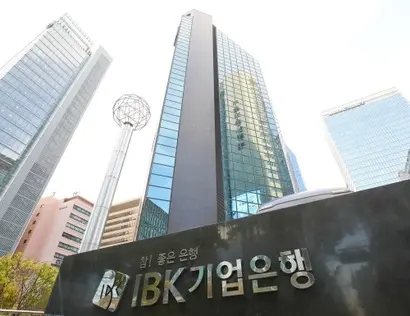
IBK announced its first-half results on July 24. Consolidated net profit, including its subsidiaries, stood at 1.5086 trillion won, an 8.2% increase from the same period last year (1.3942 trillion won). Subsidiaries include IBK Capital, IBK Securities, IBK Pension Insurance, IBK Savings Bank, IBK Asset Management, IBK Venture Investment, and IBK Myanmar. The bank's separate net profit reached 1.3272 trillion won, up 5.4% from the previous year (1.2588 trillion won).
Second-quarter performance also saw improvements, with a consolidated net profit of 694.4 billion won and a bank-level net profit of 566.7 billion won. These figures represent increases of 13.9% and 3.5%, respectively, compared to the same period last year (609.7 billion won and 547.7 billion won).
The bank achieved its highest-ever market share in SME loans. The SME loan balance for the first half reached 258.532 trillion won, accounting for a 24.4% market share. IBK's SME loan market share has steadily grown from 22.8% in 2021 to 23.0% in 2022, 23.2% in 2023, and 23.7% in 2024.
However, despite the strong figures, the market reaction is tepid. Interest income is on a downward trend, and the non-interest income that cushioned the performance was largely driven by currency exchange rate fluctuations. In its earnings report, IBK explained, "Despite the decline in net interest margin (NIM) due to interest rate cuts, net profit increased as non-interest income, including gains from securities and foreign currency valuation, grew."
IBK's consolidated interest income in the first half decreased by 3.8% from 3.9529 trillion won in 2024 to 3.8035 trillion won in 2025. Conversely, non-interest income rose to 485.6 billion won, a 205.2% increase compared to the same period last year (159.1 billion won). This was largely due to foreign exchange derivatives gains, which significantly improved from -52.9 billion won to 207.5 billion won. Securities gains also grew by 35.6% year-on-year, from 272.4 billion won to 369.4 billion won. However, fee income fell from 349.2 billion won to 315.2 billion won compared to the previous year.
Choi Jung-wook, an analyst at Hana Securities, noted, "The surface-level results met expectations, but they were largely driven by foreign currency translation gains resulting from the drop in the won-dollar exchange rate. In terms of substance, the results are somewhat disappointing given the significant decline in net interest margin and the ongoing trend of deteriorating financial soundness."
The net interest margin has also been on a downward trend for over two years. NIM is a key indicator of a financial firm's profitability and tends to decline during periods of interest rate cuts. While a high NIM boosts profitability, it often invites criticism of "interest farming" through high-interest loans. IBK recorded a NIM of 1.55% in the second quarter of this year, the lowest in three years (Q2 2022–Q2 2025). The NIM has fallen from 1.98% in Q4 2022 to 1.87% in Q1 2023, 1.76% in Q3 2023, and 1.67% in Q3 2024.

Concerns over deteriorating financial soundness are also rising. Jung Joon-sup, an analyst at NH Investment & Securities, analyzed, "Unlike commercial financial holding companies, concerns about financial health have deepened. The NPL (non-performing loan) coverage ratio has fallen by 11.9 percentage points year-on-year to 105.7%. Efforts to improve the NPL coverage ratio are inevitable moving forward."
The NPL coverage ratio measures how much a financial firm has set aside in provisions against bad loans. A lower ratio indicates deteriorating soundness. IBK's NPL coverage ratio has dropped from 143.5% at the end of 2023 and 114.0% at the end of 2024 to 111.3% in the first quarter of this year.
The sub-standard loan ratio, which indicates the level of bad debt, also increased from 1.30% in the first half of 2024 to 1.37% in the first half of 2025. A lower ratio signifies better health. IBK explained, "Although the sub-standard loan ratio increased, the loan loss cost ratio decreased compared to the same period last year thanks to proactive additional provisioning and soundness management." The loan loss cost ratio is a measure of provisioning for potential losses, and a lower figure is considered favorable.
Eun Kyung-wan, a research fellow at Shinhan Securities, predicted, "The likelihood of a rapid deterioration in financial soundness is low," but added, "Monitoring is necessary as delinquency rates are trending upward in some vulnerable sectors such as real estate, leasing, and food and lodging services."
Meanwhile, it was reported that IBK received a 'B' grade in the 2024 financial public institution management performance evaluation for the first time. The bank had maintained 'S' to 'A' grades since the evaluation began, but its rating has now dropped. This is attributed to the discovery of an 80-billion-won illegal loan scandal. After it was revealed last March that former and current employees had been involved in illegal lending over a seven-year period, Bank President Kim Sung-tae issued a public apology and introduced reform measures, including business process restructuring and the strengthening of internal controls.
Along with the first-half earnings announcement on the 24th, IBK reiterated its commitment to strengthening internal controls, stating, "We will regain the trust of the public and our customers through the implementation of our reform plans." The bank added, "In the second half, we will actively support not only small business owners and the self-employed but also cutting-edge industries and mid-sized companies, while enhancing our competitiveness through AI and digital empowerment."