

[비즈한국] It appears that the Thai Air Force has used LIG Nex1's079550 KGGB guided bombs to strike targets in Cambodia. Known to have been purchased by the Saudi and Thai air forces, and with interest expressed by nations such as Poland and Colombia, the KGGB is expected to gain momentum for further international exports.
Thailand and Cambodia have historically experienced border disputes, leading to military tensions; however, these tensions have recently escalated into active combat. On the 23rd, Thailand recalled its ambassador to Phnom Penh and expelled the Cambodian ambassador, deepening the political conflict. On the morning of the 24th, a firefight erupted between the two nations' soldiers near the Ta Moan Thom temple close to the border, after which Cambodian forces deployed armed troops equipped with drones and RPG-7 anti-tank rockets.
On the same day, Cambodia launched attacks on Thai territory, including the use of Soviet-made BM-21 multiple rocket launchers, resulting in at least 11 Thai civilian deaths and damage to schools and gas stations. In retaliation, Thailand mobilized F-16 fighter jets to conduct airstrikes against Cambodian military targets.
This conflict marks the largest military confrontation since 2011, with dozens of casualties reported on both sides. While the international community, including Japan, is attempting to mediate, the situation remains difficult.
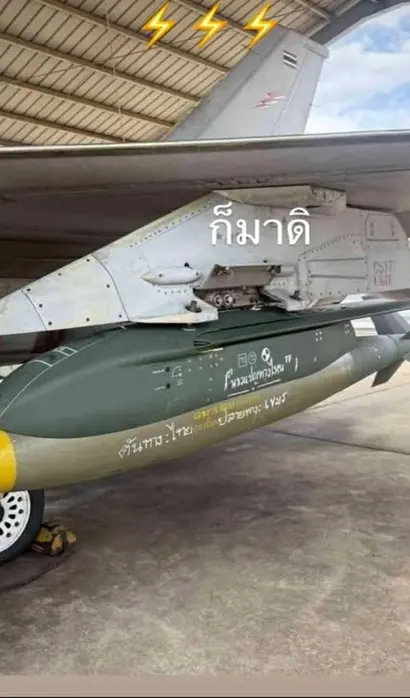
Against this backdrop, images of a Thai Air Force F-16 fighter carrying LIG Nex1's KGGB guided bomb have been circulating on Thai social media, increasing the likelihood that the weapon has been deployed in combat. Previous information had indicated that the Thai Air Force was targeting Cambodian military facilities and troop positions, with reports suggesting only the use of Lizard III guided bombs manufactured by Israel's Elbit Systems.
These guided bombs, similar to those used by the Israeli Air Force when bombing Iran and Syria, were seen in photos mounted on F-16s after having been inscribed with Thai graffiti mocking Cambodia; a photo of the same style was released yesterday morning.
The photos of the KGGB released on Thai social media also showed the weapon mounted on an F-16 after being marked with similar Thai graffiti, suggesting that the Thai Air Force may be using both the Israeli-made bombs and LIG Nex1's guided bombs in tandem.
Notably, while the Cambodian Air Force lacks its own fighter jets, it operates Chinese-made KS-1C anti-aircraft missiles with a range of 50 km. This makes it highly probable that Thailand used a weapon with a longer range than the Lizard III, which has a range of only about 10 km, to conduct its airstrikes.
The KGGB is a GPS-based glide-guided bomb developed starting in 2007 with an investment of 40 billion won. It is a kit that attaches wings and guidance equipment to a non-guided Mk.82 500-pound bomb, turning it into a precision-guided weapon. With a range of up to 70 km, it can be launched from outside the range of most enemy anti-aircraft missiles, allowing for airstrikes that avoid enemy fire.
The cost per KGGB kit is estimated to be around 100 million won. The South Korean Air Force operates at least 1,200 units, and it is known that Saudi Arabia purchased the system in 2018, followed by Thailand in 2021. Thailand's purchase is estimated at approximately 20 units, and countries such as Poland and Colombia are currently considered likely candidates for additional exports.
As the Thai Air Force has not disclosed specific details regarding the weaponry used in the F-16 airstrikes, it may take time to confirm the actual combat deployment of the KGGB. However, with photos of live KGGB ammunition mounted on F-16s now public, the possibility of their use in combat has increased significantly, and it is highly likely that Thailand, having purchased only a small quantity, may opt to acquire more following this incident.