

[비즈한국] It has been belatedly confirmed that an apartment complex in the Gongheung district of Yangpyeong-gun, Gyeonggi Province, developed by ESI&D, a family company of First Lady Kim Keon-hee, was the subject of a court ruling regarding liability for construction defects. The court ruled that ESI&D, the apartment developer, and the Korea Housing & Urban Guarantee Corporation (HUG) were responsible for the defects found in the apartment.
The apartment site is the same location where suspicions of preferential treatment were raised after the Yangpyeong County office retroactively extended the implementation approval deadline in June 2016. Yangpyeong County officials involved in the project are currently on trial for charges including the fabrication of official documents, while Kim's brother, surnamed Kim, who serves as the representative of ESI&D, is being tried for forgery of private documents.
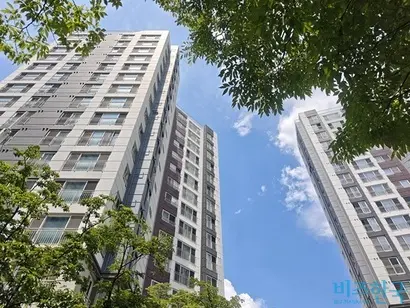
In November 2012, ESI&D obtained implementation approval from Yangpyeong-gun to proceed with the Gongheung district development project. Hanshin Engineering & Construction004960 handled the construction, building an apartment complex of approximately 350 units, which received a usage inspection certificate from the head of Yangpyeong-gun on July 1, 2016.
The lawsuit began in June 2019, about three years after the initial move-in. Residents claimed that despite continuous requests for repairs due to various defects such as cracks and water leaks, no action was taken, prompting them to file a lawsuit.
In July 2021, the 16th Civil Division of the Suwon District Court (Presiding Judge Kim Ju-ok) ordered ESI&D to pay approximately 630 million won in damages, of which approximately 480 million won was to be paid jointly with the Korea Housing & Urban Guarantee Corporation (HUG). Additionally, HUG was ordered to pay approximately 19 million won independently.
According to the verdict, the apartment's management office and the residents' representative council requested repairs from Hanshin Engineering & Construction in May 2018, and sent a formal notice of a damage claim to both ESI&D and Hanshin Engineering & Construction in June of the same year, but no compensation was made. Consequently, in June 2019, the residents' representative council filed a lawsuit for defect repair deposits against the developer (seller) ESI&D, the constructor Hanshin Engineering & Construction, and HUG, which guaranteed the fulfillment of defect repair obligations.
The court stated in the ruling, “In the process of building this apartment complex, Hanshin Engineering & Construction failed to execute parts according to the design blueprints (approval blueprints), performed substandard construction, or altered the design without authorization. This led to defects including cracks, leaks, contamination, and structural detachment in both common and private areas, resulting in functional, safety, and aesthetic issues.”
The court determined that because the seller of the apartment bears the defect liability, ESI&D, not Hanshin Engineering & Construction, was responsible for paying the repair costs to the residents. Furthermore, HUG was deemed liable for the payment of repair deposits as the guarantor of the defect repair contract.
Initially, the residents argued that Hanshin Engineering & Construction should be liable for damages because ESI&D was in a state of insolvency (lacking property or funds), but the court ruled that Hanshin Engineering & Construction held no liability. This was because ESI&D had no record of national tax delinquency from 2017 to 2020, and its assets exceeded its liabilities from 2017 to 2019.
The court concluded, “There is insufficient evidence to prove that ESI&D is in a state of ‘insolvency or an equivalent state’ as defined in Article 9, Paragraph 3 of the Act on the Ownership and Management of Condominium Buildings.” The court only recognized defect liability for ESI&D and HUG. However, considering natural aging and maintenance issues, the liability amount was capped at 85% of the total repair costs.
The residents' representative council appealed the first-instance ruling in August 2021 but withdrew the appeal in September of the same year, concluding the case.
It appears that Hanshin Engineering & Construction paid the entirety of the damages imposed on ESI&D and HUG. Hanshin stated, “The matter was concluded on August 27, 2021, when we paid the full principal and interest of the July 7 first-instance ruling. As the constructor, we paid the entire amount recognized for defect repairs.”
HUG also explained, “In accordance with laws such as the Multi-Family Housing Management Act, we issue defect repair guarantee certificates at the request of developers or constructors. In this case, the certificate was issued at the request of the constructor, Hanshin Engineering & Construction. The constructor, which has the obligation to perform repairs, covered all litigation costs.”