

[비즈한국] As the development of the indigenous KF-21 fighter jet nears completion, discussions on localizing its armament have shifted into high gear. In particular, 'Air-to-Air Missiles,' essential for shooting down enemy aircraft, are the core weapon of aerial combat and a key element in securing air supremacy. However, now that the localization of these missiles has just begun, several worrying signs have emerged. In the name of an 'evolutionary development strategy,' essential functions are being omitted, and critical components are being left out.
First, let's look at the 'Short-Range Air-to-Air Missile-II (Short-Range-II).' This missile is scheduled to be developed by 2032 with a budget of approximately 660 billion won to replace the German-made AIM-2000 currently intended for the KF-21. Its size, appearance, maneuverability, and range are similar to the AIM-2000, with the main differentiation being improved resolution for its infrared imaging seeker. However, the biggest problem is that the Weapon Data Link (WDL) function, essential for modern short-range missiles, has been omitted from the Short-Range-II.
Data link technology is already incorporated into the U.S. AIM-9X Block 2+, a missile that South Korea has already purchased for its F-15K fleet. In contrast, the missile we will begin producing in 2032 lacks this feature. It is not a matter of technical deficiency or budgetary constraints. In fact, while a weapon data link for aircraft is currently being pursued as a basic research project, it is not being applied to the missiles actually destined for operational deployment.
There are two problems with omitting this function. First, it becomes difficult to fully utilize the missile's maximum range. Modern infrared short-range missiles can engage targets from over 20km away, and by using target information obtained via WDL, they can perform surprise attacks without being detected by the enemy. Second, compatibility issues with stealth aircraft arise. Stealth fighters carry their weapons in internal bays and open them only just before firing. Without a data link, the aircraft must keep the weapon bay open while waiting for the missile's seeker to lock onto the target, which undermines the aircraft's stealth performance. This is a challenge faced even by world-class stealth aircraft like the F-22 or J-20.
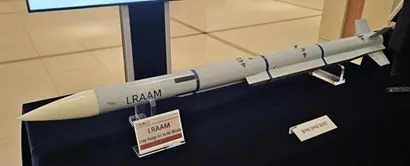
Another issue appears in the Long-Range Air-to-Air Missile (LRAAM), the so-called 'Korean Meteor.' Scheduled for development from 2026 to 2033, the LRAAM is the domestic missile intended to replace the European MBDA 'Meteor,' which is currently the KF-21's primary long-range weapon. While it is based on technology accumulated during the development of supersonic anti-ship and air-to-ground missiles, the problem lies in the fact that the LRAAM's shape, weight, and configuration are planned to be excessively similar to the existing Meteor.
The LRAAM does have an advantage over the Meteor: it is equipped with an Active Electronically Scanned Array (AESA) radar, providing better detection capabilities. However, apart from this, necessary weight reduction and shape optimization have been omitted, and the current development plan essentially follows the specifications of a weapon that conducted its first test firing in 2006. This is an overly conservative design; specifically, to fit into the internal weapon bays of the KF-21EX or future unmanned combat aircraft, design improvements such as foldable tail fins are necessary.
The core cause of this recurring issue lies in the operational requirements (ROC) set by the Air Force, the end-user. By setting ROCs that are essentially at the level of copying foreign weapons, they are failing to reflect technological progress. Even technologies resulting from related research projects are being omitted. An ROC that merely copies the performance of the Meteor or AIM-2000 cannot make our weapon systems competitive. We need a forward-looking ROC to create weapons that are superior to the enemy's based on the technical capabilities we already possess.
If we continue to build 10-year-old weapons in the future under the guise of "minimizing development risk," we are effectively creating a "20-year gap" for ourselves. This will inevitably lead to inefficient situations where we must perform subsequent upgrades for the KF-21EX or future aircraft.
While technology development by defense companies and the Agency for Defense Development is important, the end-user's clear sense of purpose regarding 'what should be built' must come first. To maintain the competitiveness of 'K-Defense,' the military's attitude toward commissioning technology development must change. That will be the first step toward completing a true 'Korean-style air-to-air missile.'