

[비즈한국] It was confirmed late through BizHankook’s reporting that the Korea Land and Housing Corporation (LH) won a lawsuit at the end of last year, receiving a judgment for 11.9 billion won in damages against the government for the costs of cleaning up the former United Nations Command (UNC) site. LH acquired former US military sites in Yongsan-gu, Seoul, including the old UNC site, which had been returned to South Korea by the U.S., in exchange for building and donating a US military base in Pyeongtaek, Gyeonggi Province, to the government. Later, the old UNC site, a portion of the returned land, was sold to the private sector, but LH ended up bearing the cleanup responsibility after soil contamination was discovered during the development process.
The Seoul Central District Court’s 14th Civil Division (Presiding Judge Jeong Ha-jeong) ruled last December in a damages suit filed by LH against the government that the government must pay LH 11.87375 billion won in soil contamination cleanup costs plus default interest. The court stated, "The defendant is liable to compensate the plaintiff for damages caused by failing to fulfill its obligations under the project agreement for this case." Previously, LH had sold the UNC site, which it had acquired from the government, to the private sector, but after discovering contamination during private development, it took on the cleanup responsibility and filed a damages suit against the government in November 2021.
The land in question is the former UNC site returned to South Korea by the US military. In February 1952, the government provided the site in Itaewon-dong, Yongsan-gu, Seoul, for US military use. The US military used the land as the UNC site from around 1957 until returning it to South Korea around February 2007. In November of the same year, LH signed the "US Military Facilities Project Implementation Agreement" with the government, under which LH would build a US military base in Pyeongtaek, Gyeonggi Province, to donate to the government in exchange for receiving US military sites in Yongsan-gu, Seoul, such as the old UNC site.
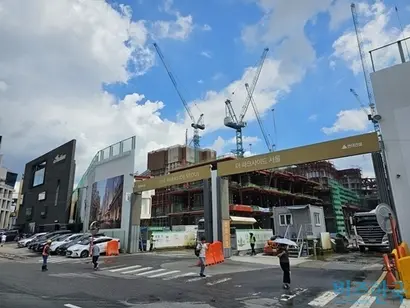
Part of the former UNC site acquired by LH from the government was sold to the private sector. Following the aforementioned agreement, the government transferred ownership of the old UNC site to LH in December 2016. The following July, LH sold 44,935 square meters of the site to Eleven Construction through competitive bidding. The sale price reached 1.0552 trillion won. Eleven Construction planned to build a complex facility on the site, named "The Parkside Seoul," including residential units, a hotel, retail spaces, and cultural facilities.
However, soil contamination was discovered during the development process. In June 2018, Eleven Construction conducted a soil contamination survey required by the Seoul Metropolitan Government to establish plans for the new complex. The survey detected fluorine, a soil pollutant under the Soil Environment Conservation Act, at levels exceeding the standard. In December of the same year, Eleven Construction consulted with LH, the seller of the land, to conduct a detailed soil survey. This survey found that fluorine and Total Petroleum Hydrocarbons (TPH), both soil pollutants, exceeded permissible levels.
LH took on the responsibility for cleaning up the former UNC site. The total cost, including cleanup services, detailed soil surveys, installation of temporary facilities, and verification of service fees, amounted to 11.87375 billion won. All of this was borne by LH. According to the agreement signed between the government and LH, the government was responsible for cleaning up environmental contamination on the transferred land and disposing of underground and surface waste. Before beginning the cleanup, LH notified the government of its intent to claim damages in January 2019. In November 2020, LH sent an official document demanding 10.83044 billion won for cleanup services and verification fees, and by April of the following year, demanded the full 11.87375 billion won in cleanup costs. However, settlement was not reached.
The government countered that it was not responsible for the cleanup. In this lawsuit, the government argued that "environmental contamination" in the facility agreement should be interpreted in the same sense as soil contamination under the Soil Environment Conservation Act. Under this law, soil contamination is limited to pollution caused by business or human activities. The government claimed that it was only responsible for cleanup if the pollution was caused by the government or the US military. Furthermore, they argued that because they had completed the cleanup of pollutants like TPH between May 2008 and June 2013, the current contamination must have occurred after the land transfer.
The court rejected these arguments. The tribunal ruled, "The clause in the project agreement should be interpreted as imposing a responsibility on the defendant to clean up the land if it is contaminated to a level that causes harm to human health, property, or the environment, hindering its development, regardless of whether the cause was natural, and it is unreasonable to require proof of fault by the defendant or the US military." Additionally, considering that no construction work was underway or was only in the initial stages between the time LH acquired the land and the time Eleven Construction discovered the fluorine, the court concluded that the contamination existed prior to the transfer.
The verdict was finalized in January as the government did not appeal. An LH official stated, "We received a ruling that the government must bear the costs of land cleanup in accordance with the agreement. Accordingly, the cleanup costs borne by the corporation were fully settled this past January when the ruling was finalized."