

[비즈한국] The Lee Jae-myung administration's plan to invest 100 trillion won in a joint public-private AI initiative has begun in earnest with the launch of the 'Next Unicorn Project' to foster AI enterprises. The Ministry of SMEs and Startups is set to launch venture investments into promising AI and deep-tech (advanced core technology) startups using funds from the second supplementary budget. A venture fund of approximately 570 billion won is expected to be formed by combining 310 billion won in government seed funding with private capital.
Following the emergence of OpenAI's ChatGPT, interest and investment in AI have surged, leading to a reorganization of priorities for governments and corporations worldwide. Countries are defining AI as a next-generation strategic industry and focusing on securing technological dominance. How much are major nations spending on AI? We examine the current state of AI policy funding and gauge how each country's investment strategy is impacting the global AI competitive landscape.

Major countries have embarked on strategic investments, viewing AI as an opportunity for domestic economic growth and a core sector in the competition for technological hegemony. The fear that missing the investment window could lead to falling behind in long-term competitiveness is a factor accelerating policy responses. Global accounting and consulting firm PwC projects that AI could contribute up to $15.7 trillion (approx. 2.179 quadrillion won) to the global economy by 2030, a scale larger than the combined economic output of China and India.
The US Leads AI with Overwhelming Investment and Innovation Structures
In terms of investment scale alone, the United States is truly an 'insurmountable wall.' Leading R&D and infrastructure investment, the US is deploying the world’s largest volume of policy funds. According to the 'AI Index 2025' report by Stanford University, private AI investment in the US reached $109.1 billion (151.42 trillion won) last year. This figure is 12 times that of China ($9.3 billion, 12.9 trillion won) and 24 times that of the UK ($4.5 billion, 6.246 trillion won). This gap widens further in the field of generative AI. While the US invested $29 billion (40.252 trillion won) in the private generative AI sector in one year, China and Europe spent $2.1 billion (2.91 trillion won) and $1.5 billion (2.082 trillion won), respectively.
Having poured in massive amounts of capital, the US has produced an overwhelming number of AI models. Last year, research institutions and companies in the US developed a total of 40 major AI models, far outpacing China (15 models) and all of Europe combined (3 models).
US AI investment is expected to expand further with the full-scale implementation of the $500 billion (692 trillion won) AI project 'Stargate,' announced by US President Donald Trump the day after his inauguration. This project involves establishing a joint AI venture, Stargate, led by OpenAI, Japanese investment firm SoftBank Group, and US software company Oracle, to build AI infrastructure, including data centers within the US.
China in Pursuit: Proving Its Potential Through Government-Led Strategy
With its superior policy execution, China is cementing its position as one of the two major powers alongside the US in terms of investment and technological innovation, while simultaneously narrowing the performance gap. Following the emergence of DeepSeek early this year, China is currently evaluated as having begun to prove its potential. In the Stanford report, China recorded a cumulative investment of $119.3 billion (165.5884 trillion won) over the 10 years since 2013, placing it second after the US ($470.9 billion, 653.6 trillion won). This is more than four times the amount of the third-place UK ($28.2 billion, 39.1416 trillion won). Recently, China has distinguished itself in R&D competition by holding 70% of registered AI patents.
China is accelerating the strengthening of its national AI capabilities by pushing AI initiatives under government leadership. Since early 2017, the country has been promoting AI adoption and development through state-backed investments and plans; experts assess that total policy resources, including those not captured in quantitative data, are being mobilized. While lagging behind the US in quantity, its policy support and large-scale incentives reportedly exceed simple venture capital or budget figures.
Trend Research, the largest private think tank in the Middle East, analyzed, "China's next-generation AI plan closely coordinates inter-ministerial cooperation and allocates funds for AI research in key areas such as computer vision, natural language processing, and intelligent manufacturing. In response to US export restrictions on advanced AI chips, China has accelerated funding for its domestic semiconductor industry and high-performance computing facilities."

The Rise of the 'AI Big 3' Competition: How Will the Global Landscape Change?
The Lee Jae-myung administration has set a goal to elevate South Korea into the global 'AI Big 3.' The strategy is to catch up through technology and secure global leadership in policy funding, talent, and industrial ecosystems. The countries identified as 'AI leaders' competing for the Big 3 spots include the UK, Canada, and Singapore. According to a Boston Consulting Group report, South Korea is categorized as a 'stable AI competitor' alongside Australia, France, Germany, Japan, Malaysia, and Taiwan.
Based on 10-year AI investment figures, the UK ($28.2 billion, 39.14 trillion won) and Canada ($15.3 billion, 21.24 trillion won) are maintaining their spots in the top five. Next are Israel ($15 billion, 20.82 trillion won), Germany ($11.3 billion, 15.6866 trillion won), India ($11.1 billion, 15.41 trillion won), France ($9 billion, 12.492 trillion won), South Korea ($7.3 billion, 10.134 trillion won), and Singapore ($7.3 billion).
As of 2023, public and private investment figures were recorded as $7.2 billion (9.995 trillion won) for the UK, $3.4 billion (4.72 trillion won) for Canada, and $1.3 billion (1.8 trillion won) for South Korea. The UK is considered Europe’s representative AI innovation nation, possessing more than double the number of AI-based companies compared to other European countries. Since 2014, it has allocated over £2.3 billion (4.302 trillion won) to various AI projects, and in the budget two years ago, it invested £1 billion (1.8704 trillion won) in government funding for AI research. Canada boasts a robust ecosystem of academic institutions and startups centered in cities like Toronto and Montreal.
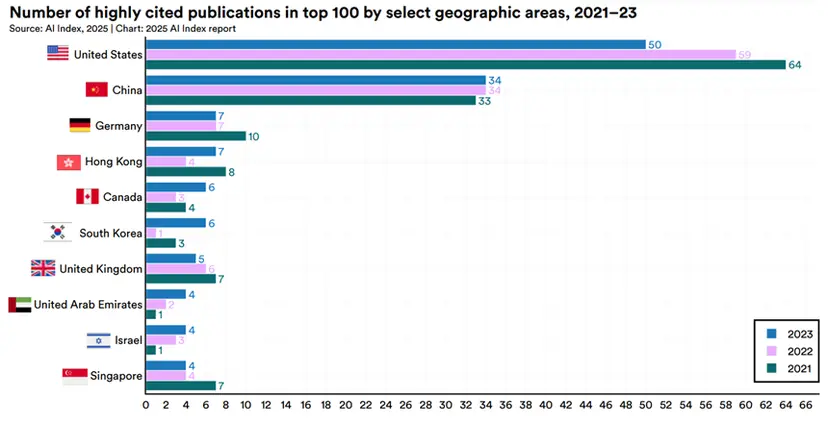
Singapore, with an investment scale similar to South Korea's, consistently ranks around the top 10 in numerous global statistics. However, Singapore holds an edge over South Korea in terms of performance relative to population and policy consistency. Singapore is the country that spends the most on AI relative to GDP. It spends $15.01 per $1,000 of GDP, which is 16% higher than the US. Its competitiveness is also evident in qualitative indicators. Over the past three years, Singapore has published an average of 3 to 4 AI-related papers in the top 100 annually, and with 0.98 AI patents per 10,000 people, it is proving its R&D prowess by entering the global top 5.
While South Korea has shown a notable upward trend in recent paper and patent performance, it still has weaknesses compared to international leaders. Therefore, assessments suggest that for South Korea to strengthen its AI competitiveness, a balance between increased investment, efficiency of support, and qualitative growth is crucial.
The government plans to engage in ecosystem building through projects like the Next Unicorn Project, alongside the injection of 300 billion won in 'AI self-reliance priming' policy funds in the second half of the year. Related ministries, including the Ministry of SMEs and Startups and the Ministry of Economy and Finance, are expanding practical support for AI talent, specialized startups, and advanced semiconductors through policy tools such as strengthening pan-government collaboration and establishing an 'AI Bureau.' Plans include side-by-side implementation of on-site-oriented strategies, such as fostering vertical AI by industry and supporting the global expansion of startups. The industry believes that the rapid execution and efficient distribution of policy funds, along with the establishment of close partnerships with companies, will be the keys to strengthening AI competitiveness.
Meanwhile, according to Grand View Research, the global AI market, which grew to $279.22 billion (387.61 trillion won) in 2024, is projected to grow at a compound annual growth rate of 35.9% from this year through 2030. Global AI spending is expected to continue to increase significantly.