

[비즈한국] I am currently providing astronomical consultation for an SF webtoon serialized on Naver035420. It is Baek Won-dal's 'Eyes of the Stars'. In this work, a world called a so-called "Mirror Earth," which is a perfect replica of Earth, appears. Moreover, a mysterious story unfolds as a situation arises where it seems as if the souls of the dead are all heading toward this Mirror Earth.
Of course, the probability of an identical celestial body existing in this vast universe is extremely low. However, a pair of mirror galaxies that look exactly like they were reflected in a mirror was recently discovered. These two mirror galaxies are even colliding with each other. Don't they say that if you bump into your doppelgänger, both disappear? True to that urban legend, something very dramatic is happening between these two identical mirror galaxies! Does a mirror world or mirror dimension really exist in the universe?
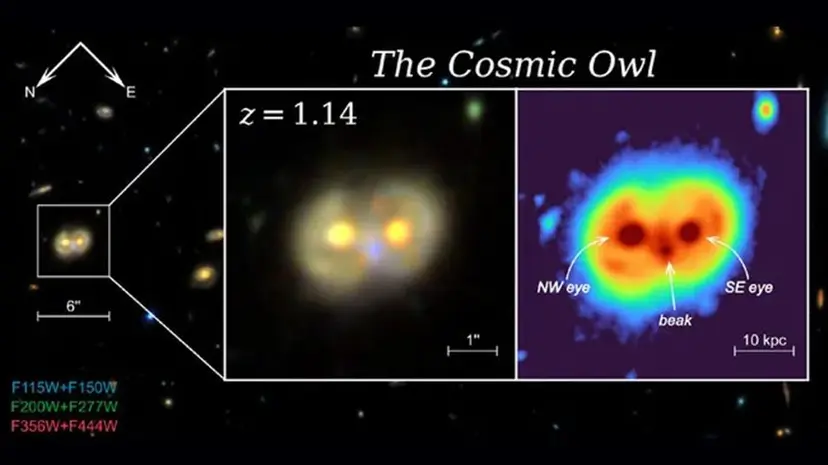
The reason this newly discovered pair of mirror galaxies is even more fascinating is that even if you look at just one of the galaxies alone, it has a unique appearance that is rarely seen. The two galaxies each form a massive circular ring, and when they meet, they look like the eyes of an owl. That is why it was nicknamed the ‘Cosmic Owl.’ The Cosmic Owl galaxy was discovered in a quite distant place, about 12 billion light-years from Earth. Each circular ring shape is about 26,000 light-years in size. In other words, the pupils of the Cosmic Owl are about one-fourth the size of our Milky Way, which has a diameter of 100,000 light-years.
Ring galaxies that maintain such perfect circular forms are rare. A representative example is the Hoag's Object, which was first discovered in the 1950s and whose formation process is still not precisely understood. A relatively old, orange star shines at the center, and young, blue stars form a perfectly round ring around it. It is generally presumed that such ring galaxies are created when a relatively small galaxy almost pierces through the center of a giant galaxy. Just as a meteorite hitting the moon leaves a round crater, it is presumed to be a trace left by a galaxy-scale shockwave as two galaxies passed through each other.
A representative example is the Cartwheel Galaxy. However, the difference is that in the case of this galaxy, not only the outer round ring but also spoke-like spiral arm strands connecting the center to the outer ring are discovered. Such near-perfect round rings are created when a collision occurs at a very specific angle and speed. It is a very rare phenomenon.
The Cosmic Owl captured this time consists of two of these rare ring galaxies. And they are right next to each other! Since it is difficult to see even one, one might think that there is actually only one ring galaxy and that two identical mirror images were created simultaneously due to gravitational lensing. However, through various observations including the James Webb, ALMA, and VLA, spectroscopic analysis of each galaxy image confirmed that both are independent and separate galaxies. Slight differences are observed in the gas composition and the characteristics of the central black holes. The rare phenomenon of leaving a circular ring is happening in both galaxies almost simultaneously!
The two massive ring galaxies are colliding with each other. Traces of more active star formation are visible along the central area where the rings meet. Along the collision surface where the two rings meet, gas clouds are being compressed, and a "starburst"—an explosive birth of new stars—is underway. If you look closely at the photo of the Cosmic Owl, there is another structure between the two round pupils that looks like an owl's beak. This is the trace of an energy jet spewed out by a black hole hiding in the center of the colliding ring galaxies.
Looking at ALMA's radio observations, two bright spots emanating from the left galaxy are visible, which appear to be jets spewed by the supermassive black hole at the center of the galaxy. In particular, one direction of the jet happens to point toward the area where the two giant rings meet. As a result, the jet pushes out and compresses gas material more efficiently at the collision surface of the two ring galaxies, further accelerating the birth of new stars. Intense emission lines showing explosive star birth are confirmed in the gas cloud corresponding to the owl's beak.
According to this observation, the total mass of the Cosmic Owl galaxy pair reaches 320 billion times the mass of the Sun. Because it is a galaxy from the early universe, 12 billion light-years away, its mass may be much lighter than our current Milky Way. However, the supermassive black holes they contain are heavier than the black hole in our galaxy! The masses of the black holes contained in each of the owl's pupils reach 67 million and 26 million times the mass of the Sun. Considering that the mass of the Sagittarius A* black hole at the center of our galaxy is only 4 million times the mass of the Sun, we can see that while the overall scale of the galaxy is small, the black hole residing at its center is much heavier. The fact that the ratio of the black hole's mass to the entire galaxy's mass is overwhelmingly heavy adds weight to the hypothesis that in the early universe, black holes grew in size first, followed by the growth of galaxies.
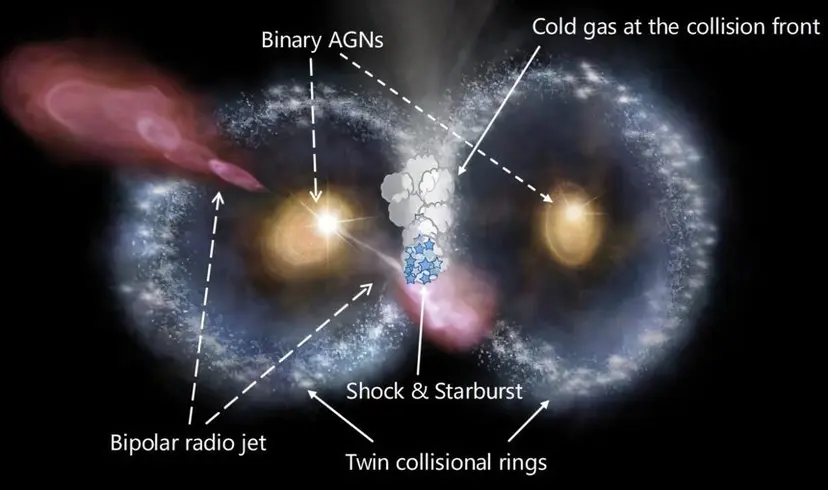
It is difficult to explain why two almost perfectly identical ring galaxies are attached to each other. If both ring galaxies were created by a small galaxy passing through, we can consider this hypothesis: Originally, two ordinary primordial spiral galaxies were paired together here. Then, a long time ago, a single small galaxy passed through both galaxies in succession in a short period of time. Therefore, two ring galaxies resembling Hoag's Object were created at a similar time. There is a possibility that the two galaxies continued to approach each other and began to collide in that state.
According to this hypothesis, the third galaxy should have passed through both about 3.8 billion years ago. Interestingly, this period is similar to the ages and eras of the stars currently observed in the two galaxies. Since the scales of the rings shown by the two galaxies are also almost similar, it seems highly likely that the third galaxy passed through both almost simultaneously.
In fact, the Cosmic Owl is not the first instance where a site of two giant ring galaxies colliding has been discovered. A representative example is ARP 147, well known as the so-called "10-point shot" galaxy. However, the big difference is that the two galaxies in ARP 147 are tilted at different angles. The galaxy that was perfectly penetrated shows a clear round ring, while the other is tilted sideways, making its ring look heavily distorted. On the other hand, the Cosmic Owl shows two perfect rings like twins because both are exquisitely facing head-on.
If the third small galaxy that passed by long ago to create the Cosmic Owl's large pupils is still alive and not completely destroyed, there is a possibility that its traces remain somewhere in the vicinity. The speed at which the round shockwave of the Cosmic Owl galaxy confirmed by this observation is spreading is approximately 200 km/s, which corresponds to the level of a shockwave typically spreading rapidly through interstellar matter. Through such estimated shockwave speeds and collision timing, it might be possible to search for the location where the third galaxy might be.
Dramatic sites like the Cosmic Owl galaxy make us realize once again how vast and infinite the universe is. The universe seems to be a world where everything you can imagine happens. After all, two of those rare ring galaxies coexist, and two mirror-image doppelgänger galaxies are even colliding with each other. You never know. Perhaps somewhere in the universe, there might really be a Mirror Earth, a Mirror Solar System, and a Mirror Me who looks exactly like us.
Reference
https://ui.adsabs.harvard.edu/abs/2025arXiv250610058L/abstract
Who is the author, Woong-bae Ji? He loves cats and the universe. After watching 'Galaxy Express 999' as a child, he dreamed of making the beauty of the universe known. He is currently studying galaxy evolution through galaxy interactions at the Center for Galaxy Evolution and the Near-Universe Research Lab at Yonsei University, and is engaged in various science communication activities such as lectures and writing. He has written books such as 'The Observatory of Having a Thing', 'Thinking About the Universe All Day', and 'Stars, the Science of Light'.