

[비즈한국] Companies sometimes make decisions that are difficult to explain solely by the numbers. Understanding the underlying laws and systems can help provide a deeper look at the inner workings. "Useful Business Tips (Al-Ssul-Bi-Beop)" introduces insights to help understand the flow of business.

One store closes, and a new one opens. It is not rare for both the closed store and the new store to be franchises. Even if the brand marks are different, they both chose a model where they receive trademarks and know-how from a franchisor. This is because, unless one has a special history, tradition, concept, or expertise, opening a franchise is considered a relatively safer choice.
The reality is tough. The fate of a franchise can depend on consumer preferences or market changes, and franchisees often face difficulties due to the franchisor’s lack of operational power or conflicts between the two. Coldly speaking, if opening a store guaranteed profit, the franchisor would open company-owned stores instead of recruiting franchisees. The act of recruiting franchisees inherently involves distributing or shifting risk. Therefore, no one can guarantee the success or failure of a franchise.
That is why franchisors try to recruit as many franchisees as possible to diversify risk, earn profits from logistics, and enjoy network effects. In the industry, there is a compelling rumor that "to collect as many franchisees as possible, the total cost required to open a store (excluding rent, etc.), such as franchise fees, interior costs, and training fees, is set at an amount similar to the severance pay of typical public servants at that time."
Franchisors also face many difficulties. Under the current Korean legal system, there are few ways for a franchisor to fight back if a franchisee takes all the know-how and trade secrets and unilaterally stops the franchise transaction. From the franchisor's perspective, there aren't many ways to generate profit other than logistics or interior costs, and even those are subject to strict regulations through recent laws and decrees.
In particular, with the recent legal requirements granting franchisees the right to form groups like a "franchisee association" and mandating that franchisors cannot avoid negotiating with such groups, legal disputes can easily arise if the franchisor implements operational policies without the agreement of the franchisee association.
In conclusion, the franchise business is not easy for either the franchisor or the franchisee. Because franchisor employees and franchisees interact in person, many disputes arise from human emotions or misunderstandings. They scour each other for reasons to attack, creating disputes for the sake of disputes.
In such a difficult situation, how can unnecessary disputes be prevented? As a lawyer, I believe the first step is to share a checklist and fix things one by one, starting with the small stuff. The complaint forms distributed by the Fair Trade Commission (FTC) contain a lot of helpful content.
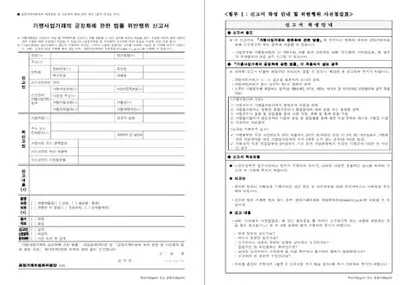
The FTC's complaint form lists items that violate the Franchise Business Act. If franchisors or franchisees familiarize themselves with these contents and rectify potential problem areas, it will help prevent unnecessary misunderstandings or conflicts. The main contents are cited below.
1. The franchisor must not receive franchise fees directly from the franchisee but must deposit them into a separate institution for a certain period (Article 6-5, Deposit of Franchise Fees).
2. Before signing a contract, the franchisor must provide a disclosure document and data on the status of nearby franchise stores; they cannot sign a contract or receive money until 14 days have passed since providing these (Article 7, Obligation to Provide Disclosure Document).
3. The franchisor must not inflate expected profits or provide false information to the franchisee (Article 9, Prohibition of Providing False or Exaggerated Information).
4. If the franchisor fails to provide proper information, provides false/exaggerated information, or discontinues the business without cause, the franchisee may demand a refund of the franchise fee (Article 10, Return of Franchise Fees).
5. The franchisor cannot sign a contract or receive money until 14 days have passed since the day the franchisee was given the contract (Article 11, Matters to be Recorded in the Franchise Contract).
6. The franchisor cannot unjustly interfere with the franchisee's business, refuse contract renewal, or terminate the contract (Article 12, Prohibition of Unfair Trade Practices).
7. The franchisor cannot force store environment improvements on the franchisee without an objective reason, and must bear a portion of the costs when improvements are made (Article 12-2, Prohibition of Forcing Unjust Store Environment Improvements).
8. The franchisor cannot unjustly force specific business hours on the franchisee in light of standard business practices (Article 12-3, Prohibition of Unfair Restriction of Business Hours).
9. The franchisor must define the franchisee's business area at the time of the contract and must not open another store of the same brand in that area without special reason (Article 12-4, Prohibition of Unfair Infringement on Business Area).
10. The franchisor must not take retaliatory actions against a franchisee for requesting dispute mediation or cooperating with an FTC investigation (Article 12-5, Prohibition of Retaliatory Measures).
11. To conduct advertising or promotional events for which the franchisee bears all or part of the costs, the franchisor must reach an agreement or obtain consent from the franchisee in advance and subsequently disclose the details of the cost usage (Article 12-6, Notification of Advertising and Promotion Expense Details).
12. The franchisor must not penalize franchisees for forming groups like an association (Article 14-2, Consultation on Changes in Transaction Terms for Franchisee Groups).
Although the laws may seem complicated, the essence is simple. These violations listed in the FTC's complaint form represent the core of the Franchise Business Act. I hope that by at least familiarizing themselves with these points, franchisors and franchisees can resolve their distrust and misunderstandings.