

[비즈한국] Samsung Electronics005930 Chairman Lee Jae-yong has finally shed his judicial risks after being cleared of all charges in a final verdict, roughly nine years after the onset of the Choi Soon-sil scandal. On the 17th, the Supreme Court upheld the lower court's ruling, which acquitted the Chairman of charges including unfair merger practices and accounting fraud. Reactions from the business community and civic groups to the ruling remain divided. Furthermore, there is speculation within the business sector that Chairman Lee may now join the Samsung Electronics board of directors. With the company’s recent performance struggling, all eyes are on the potential for Chairman Lee to take on a more formal leadership role.
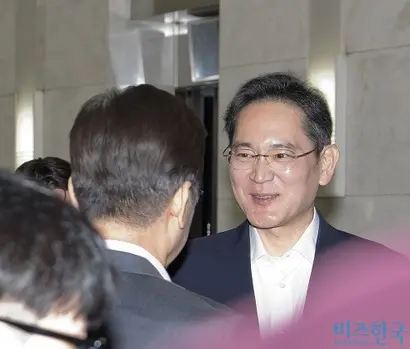
Acquittal After 9 Years
Chairman Lee Jae-yong faced charges that during the 2015 Samsung Group restructuring, he solicited support from former President Park Geun-hye for his succession of management rights, providing equestrian support funds in return. At the time, Samsung Group was pushing for a merger between Samsung C&T028260 and Cheil Industries, a process that faced significant opposition from minority shareholders of Samsung C&T. The core allegation was that Chairman Lee requested the former President to intervene and have the National Pension Service vote in favor of the merger. As the largest shareholder of Cheil Industries at the time, Chairman Lee became the largest shareholder of the merged Samsung C&T entity. Since Samsung C&T effectively acts as the holding company for the group, this effectively completed the succession process.
Chairman Lee was also accused of involvement in 4.5 trillion won worth of accounting fraud at Samsung Biologics207940, a subsidiary of Cheil Industries. The allegation was that the company's valuation was inflated through accounting irregularities, which naturally boosted the value of Cheil Industries, thereby benefiting Chairman Lee, the company's largest shareholder.
While the prosecution had requested a five-year prison sentence and a 500 million won fine for Chairman Lee in the first and second trials, the courts acquitted him. The court did not find that the succession of management was the sole purpose of the merger. Furthermore, it found no evidence suggesting that the merger ratio was unfair or that it caused damage to shareholders. Regarding evidence submitted by the prosecution, such as servers from Samsung Biologics, the court deemed them inadmissible as they were obtained illegally.
The Supreme Court affirmed that there were no legal issues with the appellate court's verdict. The Supreme Court stated, "There were no errors in the lower court's judgment regarding the misinterpretation of legal principles related to the Capital Markets Act or the External Audit Act, nor did it exceed the limits of the principle of free evaluation of evidence by violating rules of logic and experience without conducting necessary deliberations."
Reactions from Various Sectors
Reactions to Chairman Lee’s acquittal are polarized. The business community welcomed the decision. Lee Sang-ho, head of the Economic Industry Division at the Korea Economic Association (FKI), stated, "We welcome the Supreme Court's final acquittal of Chairman Lee Jae-yong," adding that "it will serve as an important opportunity for Samsung Group to focus on cutting-edge technological innovation and secure global corporate competitiveness."
Kang Seok-gu, head of the Research Division at the Korea Chamber of Commerce and Industry (KCCI), remarked, "We respect and welcome the Supreme Court's final ruling regarding the merger of Samsung C&T and Cheil Industries. In a situation where global competition in high-tech industries is fierce, we expect this not only to resolve corporate management risks but also to have a positive ripple effect on the overall Korean economy."
On the other hand, civic groups and labor unions expressed strong opposition. People's Solidarity for Participatory Democracy (PSPD) criticized the ruling, stating, "The judiciary has essentially given a full pardon to economic powers that trample on market order," and "we strongly condemn the judiciary for making such a shameful decision that undermines social justice." The People's Solidarity for Participatory Democracy (PSPD) pointed out, "We view this as a day when judicial and economic justice collapsed, as it condones the illegal management succession and hereditary transfer of power by a chaebol leader."
The Korean Confederation of Trade Unions (KCTU) stated, "This is not just a court result, but a tragic declaration showing how much judicial justice in this country has crumbled," adding, "It is merely further proof that South Korea's judicial system is powerless in the face of chaebol power."
Will He Return to the Board?
This Supreme Court ruling is expected to be a major turning point for the future management direction of Samsung Electronics. Although Chairman Lee serves as the Chairman of Samsung Electronics, he does not participate in the board of directors. He was appointed as an executive director in October 2016 but has been a non-registered executive since his term expired in October 2019. Some speculate that with his judicial risks resolved, a return to the board is likely. There is even talk of him potentially taking office as the CEO of Samsung Electronics.
Experts evaluate that Chairman Lee taking the role of CEO would be significant for negotiations with global partners and strategic decision-making. The presence of a key decision-maker is considered a strategic asset in the face of global semiconductor supply chain restructuring and artificial intelligence (AI) competition. In recent years, Chairman Lee has traveled to the United States, Europe, and Southeast Asia to meet with top-tier world leaders and personally lead efforts in semiconductor plant construction and investment attraction.
International attention is also focused on this verdict. Reuters noted, "Chairman Lee can now focus on the global competition for developing cutting-edge AI chips." The Wall Street Journal (WSJ) reported, "Chairman Lee has been unable to focus entirely on Samsung Electronics' management while the company faced instability amid rapid changes in its core businesses of semiconductors and smartphones over the past few years."
Samsung Electronics has set a goal to surpass Taiwan's TSMC and become the world leader in non-memory semiconductors by 2030. To this end, it is reported that the company is considering additional overseas facilities following the Texas Taylor semiconductor plant in the U.S. There is also talk of potential cooperation with Nvidia or Qualcomm regarding AI semiconductors.
At the same time, tasks such as strengthening ESG (Environmental, Social, and Governance) management, ensuring the independence of the board, and improving the compliance monitoring system remain. This is because the acquittal has raised external expectations for Samsung Electronics' responsible management even higher.
Immediately after the verdict, Chairman Lee's legal counsel stated, "Through today’s final judgment by the Supreme Court, it has been clearly confirmed that the Samsung C&T merger and Samsung Biologics' accounting practices were lawful," adding, "We sincerely thank the court for their wise judgment following a thorough five-year deliberation." Samsung Electronics has not issued an official statement regarding the possibility of Chairman Lee's return to the board.