

[비즈한국] Real estate trust companies involved in “completion-guaranteed land trusts” are now at risk of fully absorbing the risks associated with projects where construction deadlines have not been met. Previously, completion-guaranteed trusts were considered low-risk as they reinforced credit for project financing (PF) sites rather than requiring trust companies to inject their own capital. However, with an increasing number of sites failing to finish construction on time due to contractors, instances are emerging where trust companies are forced to shoulder not only the PF loans but also penalties for homebuyers and risks from unsold units.
A completion guarantee is a promise by a construction contractor to complete a project within a set timeframe, barring force majeure events such as natural disasters, and to assume the developer’s debt if they fail to do so. It is typically used to reinforce credit when a developer for a PF project lacks sufficient credit or collateral. A completion-guaranteed trust is a product where the trust company steps in to fulfill the obligation if the contractor fails to honor their initial guarantee. It is a structure where the trust company re-reinforces credit at PF sites where the contractor's own credit is already weak.
Homebuyers cancel contracts and demand penalties
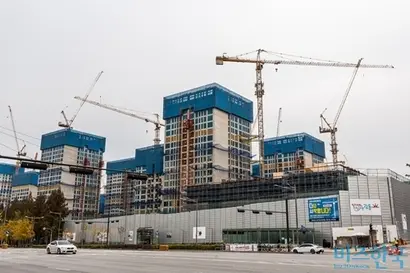
According to the trust industry, Kyobo Asset Trust lost a lawsuit on the 3rd filed by 18 homebuyers of the “Gijang Station Yulim Norwegian Forest Central” apartment complex in Gijang-gun, Busan, seeking penalty payments. The buyers notified the company of contract terminations last June and filed a suit, claiming that Kyobo Asset Trust, which participated in the project as the trustee, failed to meet the completion deadline. The 16 households involved had total purchase payments of 6.74 billion won, with penalties amounting to 670 million won (40 million won per household). It is estimated that a total of about 50 households have canceled their contracts at this apartment complex due to the failure to meet the completion guarantee, resulting in approximately 3 billion won in penalties.
Gijang Station Yulim Norwegian Forest Central is an apartment complex built near Gijang Station in Gijang-gun, Busan, consisting of two buildings (219 households) with a maximum height of 26 floors. Woogyeong Development, the project developer, entered into a completion-guaranteed trust agreement with trustee Kyobo Asset Trust, contractor Daewoo Shipbuilding & Marine Engineering (DSME) Construction, and lending financial institutions to secure PF loans for the project. In this contract, the contractor promised to complete the apartments within 31 months from the loan execution date, but failed to do so. Kyobo Asset Trust, which assumed the completion obligation, also failed to meet the deadline, even with a six-month extension. The apartment was finally completed recently, approximately one year and four months past the original deadline.
An official from Kyobo Asset Trust stated, “The original contractor continuously demanded additional construction costs, and when the company did not accept this, construction stopped. Although we ultimately failed to meet the completion deadline, we finished the construction by changing the contractor. We plan to return the delay interest stipulated in the purchase agreement to the homebuyers who canceled their contracts due to the failure to fulfill the guarantee.” The remaining PF loan is reportedly around 17 billion won and is due this November. Essentially, the trust company is at risk of bearing the homebuyers’ penalties, the lenders’ PF loans, and future unsold inventory.
Lenders demand repayment of principal, interest, and delay interest
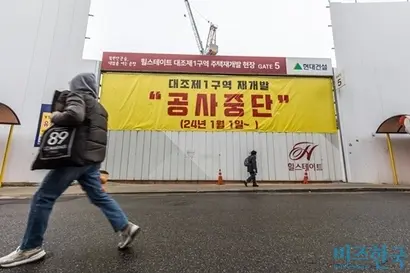
Cases where real estate trust companies bear debts from completion-guaranteed trust sites due to contractors failing their duties are also emerging. The Seoul Central District Court ruled in favor of the plaintiffs in May in a damage suit filed by a PF lender group against Shinhan Asset Trust regarding a logistics center construction project in Pyeongtaek, Gyeonggi-do, conducted under a completion-guaranteed trust. The court ruled that Shinhan Asset Trust, which failed to meet the completion deadline, must pay the entire 25.6 billion won in PF loan principal and interest, plus overdue interest, to the Saemaul Undong Credit Cooperative. This is the first ruling recognizing a trust company’s liability for damages for failing to fulfill a completion obligation.
The project involved building a three-story warehouse facility (total floor area of 18,589㎡) in Eoyeon-ri, Cheongbuk-eup, Pyeongtaek. The developer signed a completion-guaranteed trust contract with trustee Shinhan Asset Trust, the contractor, and the lender group to execute a 30 billion won PF loan. The contractor contracted to finish the building within 16 months from the loan date. Shinhan Asset Trust committed to completing the construction within six months of the original deadline if the contractor failed to do so on time, and promised to compensate the lender group for damages if even that deadline was missed. However, both companies failed to meet the deadline.
A Shinhan Asset Trust official said, “Construction was delayed due to disputes with the previous contractor over construction cost increases, leading us to miss the completion deadline. We have currently completed the construction by bringing in a replacement contractor. As the PF loan is accumulating interest, we repaid it through a provisional payment first. We believe we may be able to recover part or all of the paid amount depending on the outcome of the ongoing litigation with the lender group. We have appealed the current related lawsuit with the same arguments made in the first trial.”
Recently, an increasing number of completion-guaranteed trust sites are seeing trust companies failing to fulfill their completion obligations. As in the cases above, most of these delays stem from contractors having conflicts with developers over construction cost hikes. According to Korea Investors Service, as of the end of last year, 43 completion-guaranteed trust sites managed by five companies—KB Real Estate Trust, Kyobo Asset Trust, Korea Investment Real Estate Trust, Daishin Asset Trust, and Korea Land Trust—failed to meet their completion deadlines. The balance of PF loans for these sites is estimated at 1.6128 trillion won.
A trust industry official stated, “Completion-guaranteed trusts grew in scale, led primarily by financial-affiliated trust companies, starting in the early 2020s during the real estate boom. Trust companies that were reluctant to inject their own capital for risk management reasons jumped into these completion-guaranteed models, where they only provided credit to PF projects. Now that the era of ‘guaranteed sellouts’ regardless of whether it’s an apartment or not has ended, and with rising interest rates and raw material costs, we are seeing a surge in sites where construction is delayed due to cost conflicts. The number of sites where trust companies end up bearing the risk because they cannot fulfill the completion guarantee is exploding.”