

[비즈한국] It has been confirmed that the budget for the Seoul-Yangpyeong Expressway project was not included in this year's supplementary budget proposals. Although 6.1 billion won was allocated for the Yangpyeong Expressway last year, the entire amount was left unused and treated as surplus due to the project's suspension. Subsequently, the former Yoon Suk-yeol administration reflected design costs in this year's main budget, but the entire amount was cut by the National Assembly.
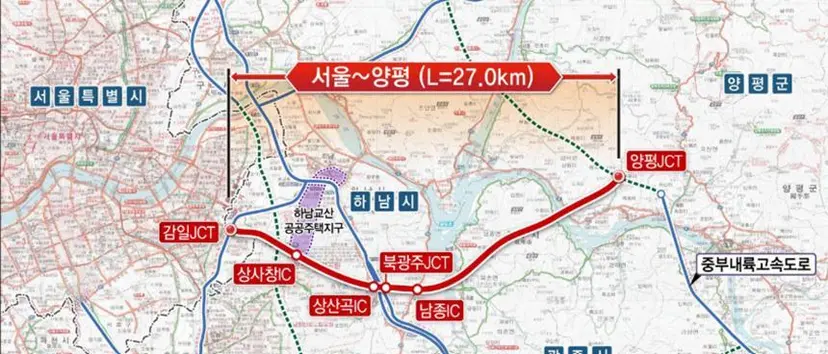
After allegations emerged that the terminus of the Seoul-Yangpyeong Expressway had been changed to a location near land owned by the family of former President Yoon Suk-yeol’s in-laws, former Minister Won Hee-ryong fully suspended the project in July 2023. In August of the same year, the Yoon Suk-yeol administration allocated 12.3 billion won in design costs for the 2024 budget, but half was cut during the National Assembly's review process, leaving a final amount of 6.1 billion won.
As the controversy remained unresolved in 2024, the project did not proceed. Eventually, the 6.1 billion won was processed as unused budget. The former Yoon Suk-yeol administration again allocated 6.2 billion won for design costs this year, but it was entirely cut by the National Assembly.
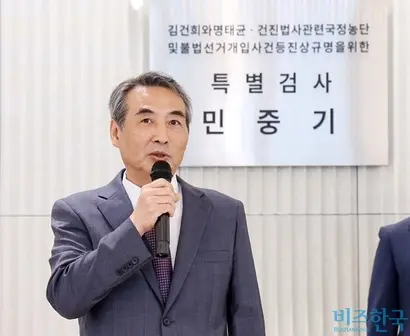
However, the atmosphere has changed since the launch of the Lee Jae-myung administration. In particular, as the Kim Keon-hee Special Prosecutor (Special Prosecutor Team led by Min Joong-ki) has begun full-scale investigations into the Yangpyeong Expressway, expectations are rising that the truth behind the terminus change controversy may be uncovered.
The problem is when the Yangpyeong Expressway project will resume. According to BizHankook's coverage, no budget related to the Yangpyeong Expressway was allocated in either the first supplementary budget drafted in April or the second supplementary budget drafted in June of this year. It is also uncertain whether a budget for the project will be included in the next year's budget proposal that the Ministry of Economy and Finance (MOEF) is set to submit to the National Assembly in September.
An official from the MOEF stated, "There is no budget included in the supplementary budget." An official from the Ministry of Land, Infrastructure and Transport (MOLIT) also said, "Excluding about 200 million won carried over from the 2023 budget, the currently allocated budget is 0 won." The official added regarding the resumption of the project and next year's budget, "That is a matter that needs to be discussed with the National Assembly."
It appears that no matters related to the Seoul-Yangpyeong Expressway project are currently being pushed by the MOLIT. In March, the MOLIT released the results of its own audit, recommending disciplinary action against 7 public officials, stating that poor management was confirmed in its 'Request for Disciplinary Action Following Special Audit on Seoul-Yangpyeong Feasibility Study Services.' Since then, it is confirmed that there have been no further discussions on resuming the project or additional internal investigations.
Some argue that the project should be quickly resumed according to the original plan (the preliminary feasibility study plan). On July 8, Gyeonggi Province Governor Kim Dong-yeon stated that the Yangpyeong Expressway project should be carried out according to the original plan. During his visit to Yangpyeong, Governor Kim said, "The answer now is to quickly push ahead with the original plan. Gyeonggi Province will actively join forces with the central government to ensure a proper project is resumed as soon as possible."
The problem is that costs increase the longer the project is delayed. Based on the 2024 original plan, the total project cost for the Yangpyeong Expressway is 1.7696 trillion won. If everything had gone according to the initial plan, the design should have been completed last year and construction should have started this year. An industry insider pointed out, "Even if the project resumes this year, the design could only be completed in 2026, and construction could start only in 2027. If construction is delayed, costs such as construction fees and land compensation will inevitably rise. However, since this route is a loss-making route where the B/C (Benefit-Cost Ratio) value did not exceed 1 from the start, the input costs are bound to exceed the benefits."