

[비즈한국] The screen golf course F&B shop-in-shop franchise 'Bob Restaurant' is facing widespread operational damage among its franchisees due to prolonged disruptions in food ingredient supplies. With the food and beverage business effectively halted due to supply chain paralysis, store owners are burdened with continued monthly kiosk rental fees. Unlike the "free rental" benefit touted by the headquarters, store owners are locked into long-term rental contracts and forced to rely solely on the company's supply chain, fueling concerns that this operational vacuum may continue.
Providing convenient food and beverages in screen golf courses… Frequent business suspensions recently
Bob Restaurant is a franchise that borrows the concept of the "shade house" (a small, halfway house restaurant on a golf course) to provide convenient food and beverages within screen golf facilities. It gained attention for its model of providing automated kiosks and semi-prepared food packages, which reduced the burden of labor costs and cooking space. Since its launch in 2020, it grew rapidly, surpassing 500 franchise locations within three years.
However, for the past several months, food ingredients have not been delivered properly, leading to a series of business suspensions among franchisees. On the 30th of last month, Basto Technologies, the company operating Bob Restaurant, sent an official letter to franchisees announcing plans for product restocking and normalization of the ordering system. The company explained, "As administrative procedures related to attracting investment have taken longer than expected, we have not yet secured the necessary funds for smooth business operations," adding, "We plan to proceed with product restocking and ordering system normalization sequentially as soon as capital injection is completed."
The normalization date announced by the company was July 15th. One day prior, on the 14th, Bob Restaurant announced through its official SNS channel that "the ordering system will resume normal operations." While 12 restocking items available for order from the 16th to the 18th were unveiled, the quantities are vastly insufficient compared to the total number of franchises, leading store owners to express frustration, stating, "This measure cannot be considered normalization."
According to the supply schedule, as of the 16th, popular items like chicken and tteokbokki sauce were restocked at 800 and 1,050 units respectively; based on the latest number of franchises released by the company (533), this means a single store can order only about 1 to 2 units. Other items ranged from 900 to a maximum of 3,000 units.
On the channel where this announcement was posted, franchisees criticized the situation, saying, "The promises made at the time of the initial contract are not being kept, and we cannot operate other businesses. Who compensates for the losses and how?" and "We can't do business, so how are we supposed to pay for the kiosk fees?" Bob Restaurant stated, "We will ensure that other products are restocked as quickly as possible within July."
Hundreds of thousands of won paid monthly for 'useless' kiosks
The problem is that even with the supply chain cut off, store owners must continue to pay hundreds of thousands of won in monthly kiosk rental fees. Bob Restaurant promotes the rental fees as "effectively free." The structure allows for the redemption of points equivalent to the rental fee when purchasing food ingredients from the headquarters. In promotional posts, they explained, "Although you pay a rental fee every month, the headquarters provides an equivalent amount in store credit that can be used to purchase food products, so you can consider it free." However, if food ingredient purchases are blocked, this system becomes neutralized.
A franchisee named Mr. A, who operates a Bob Restaurant in a screen golf course in the metropolitan area, signed a three-year contract to pay approximately 410,000 won per month in exchange for receiving an order kiosk and a tablet. The total rental fee amounts to about 14.9 million won, with a separate 2 million won franchise fee. While this is a significant expense, Bob Restaurant was able to increase its franchises rapidly because of the system that refunds the full amount of the rental fee (excluding VAT) as a "sales incentive." Franchisees sign an additional sales incentive contract and receive monthly points usable on the company's dedicated site for ingredient purchases. In Mr. A's case, the points provided are worth about 370,000 won per month.
However, if the logistics supply is not carried out properly, the kiosk becomes useless, and only the cost of the machine remains. Points expire automatically if not used within one year of issuance; if supply instability persists, store owners end up paying monthly rental fees for credits they cannot even use.
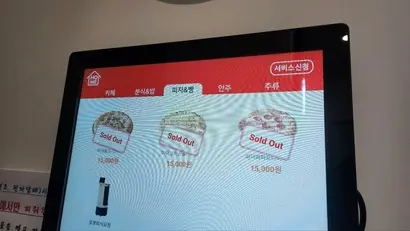
Store owners explain that since the food supply was blocked, the kiosks have become difficult to use for their original purposes, such as ordering and payment. In principle, product supply through other distribution channels is prohibited. The company had emphasized that due to the nature of special quick-frozen semi-prepared foods, cooking methods and equipment were simple; however, in a situation where it is unclear when ingredient supply will normalize, it is not easy to change cooking equipment or hire additional staff.
Bob Restaurant guides franchisees by stating, "It is the rule to sell only our menu, but for items not yet launched, such as instant rice or fried rice, other menu items can be sold. In such cases, you must consult with the headquarters."
Lee Eun-hee, a professor of Consumer Science at Inha University, pointed out, "Although the kiosk is merely an auxiliary tool and the core is the stable supply of ingredients, the contract emphasized the introduction of equipment. In effect, it acted as a tool to induce a dependent contract for food ingredients."
This system resumption is a measure taken after several previous delayed notices and updates to the restocking plan for certain items. The company had originally set May 22nd as the date for normalization, but announced a rescheduling to June 2nd, stating, "An unexpected error was discovered in the internal process, making additional inspections unavoidable."
It has been noted that some franchisees, expressing distrust in the supply chain and the headquarters' overall crisis response system, have begun discussing collective response measures, such as forming a victims' group. Bizhankook contacted Basto Technologies to ask for an official position regarding this situation, franchisee damage, and future countermeasures, but did not receive a separate response.
Professor Lee Eun-hee noted, "Highlighting the marketing expression 'free' despite the existence of a real cost burden has deceptive elements in that the store owners, who are consumers, might misunderstand the core conditions of the contract," adding, "The company has a duty to faithfully fulfill its supply obligations."