

[비즈한국] Not long ago, news that the James Webb Space Telescope had detected traces suspected to be signs of life on an exoplanet named K2-18b drew significant attention. A research team led by astronomer Nikku Madhusudhan at the University of Cambridge analyzed the atmosphere of K2-18b in 2023. This planet had already gained fame for being a "Hycean" world, an ocean planet thought to be covered entirely by liquid water. Last year, his team used the James Webb Space Telescope to capture the moment the planet transited in front of its host star, analyzing the spectrum created as starlight was partially absorbed while passing through the planet's atmosphere. While not definitive, they presented results suggesting the presence of dimethyl sulfide (DMS) (Related article: [Science] Did We Discover a Planet Similar to Earth Billions of Years Ago?).
A year later, they observed the same spot again with the James Webb Telescope and presented new findings suggesting the presence of DMS with even higher probability. DMS attracted further attention because, on Earth, it is known to be produced solely through biological activity, such as by bacteria. It appeared that the James Webb Telescope had captured the clearest evidence of biological activity in history from an exoplanet 120 light-years away. However, since this announcement, numerous doubts and rebuttal papers have poured out, leading to a major confrontation.
Some have even gone so far as to make the pessimistic claim that attempting to find evidence of extraterrestrial life using the James Webb Telescope might be entirely meaningless from the start. There is a very interesting backstory here. The astronomer who recently put forth these pessimistic arguments regarding the James Webb analysis is Sara Seager, a renowned scholar in the fields of astrobiology and exoplanets. As it turns out, she was the advisor who granted a PhD to Nikku Madhusudhan—the very person who heated up the academic world by suggesting the possibility of life signals on K2-18b. How has the controversy over the potential existence of extraterrestrial life on K2-18b unfolded so far? And how did a mentor and their student end up on completely opposite sides? Here is the latest story regarding the controversy surrounding this exoplanet.
Shortly after Nikku Madhusudhan’s paper regarding the potential for extraterrestrial life on K2-18b was released, a paper strongly refuting his claims was published. This paper conducted a very interesting and simple test: it assumed that there was no information at all regarding the atmosphere of the planet K2-18b. They created a "flat" model across all wavelengths and compared how much the actual spectrum observed by James Webb deviated from that flat model. The interesting part is that because the originally observed spectrum signal is so faint, it shows no statistically significant difference even when compared to the flat model that assumes no chemical components exist.
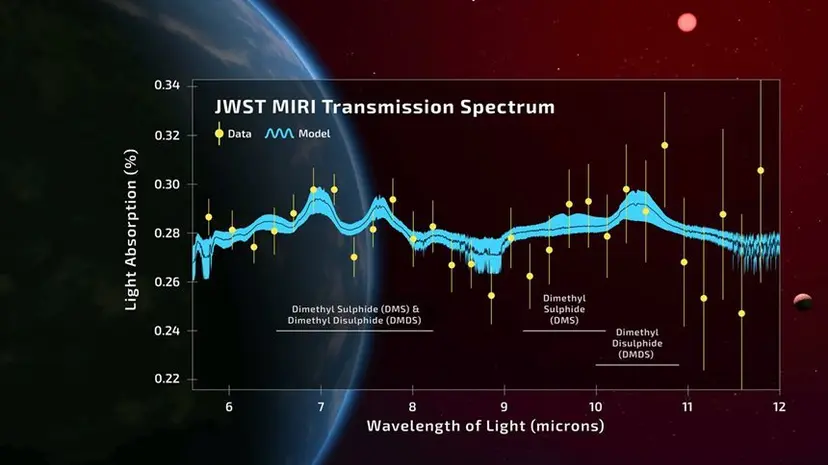
When they mathematically added (Gaussian) normal distribution-shaped changes to the spectrum only at the 7µm and 8.8µm wavelengths where DMS is presumed to leave signals, it did look as if it described the observed spectrum slightly better. However, when comparing the actual statistical figures, there is no significant difference. Based on this, they concluded that absolutely no clear statistical evidence to prove the existence of DMS could be found in the spectrum observed by James Webb in the first place. They also criticized that if one models and analyzes a spectrum within a limited set of components while harboring a desire for a specific chemical to exist, it can inflate and distort the results.
Facing such criticism, Madhusudhan’s team recently conducted a more comprehensive follow-up analysis. Instead of modeling by assuming only a few dozen candidates for chemicals that might be in the atmosphere of the exoplanet K2-18b, they performed additional work considering as many molecules as possible—a total of 650 different types of molecules. They modeled the atmosphere under various conditions where these chemical components exist in different concentrations to statistically find which scenario best reproduces the actual observed atmospheric spectrum of K2-18b. The results showed that a model with a very high content of DMS still provided the best fit.
In this additional analysis, it appeared highly likely that not only DMS but also more diverse chemical components such as diethyl sulfide and dimethyl disulfide were present. Interestingly, all of these are molecules that are very closely linked to biological activities, including bacteria, on Earth. Based on this, Madhusudhan’s team claims that their argument that biological activity is occurring on the exoplanet K2-18b has been further strengthened.
However, even if DMS truly exists in the atmosphere of this exoplanet, more definitive verification is needed to determine whether biological activity is the only way to create this chemical. Astronomers have already confirmed that DMS exists in outer space beyond Earth within the solar system. Notably, the Mars rover Curiosity detected DMS on Mars, and the Rosetta probe detected it on comet 67P. Most recently, DMS was also detected in the molecular cloud G+0.693-0.027 in the center of our galaxy. This suggests that DMS can be sufficiently synthesized even on much more extreme comets or interstellar clouds, not necessarily just on exoplanets. DMS may not necessarily be an indicator of biological activity. It could simply be a molecule that is very common everywhere in our galaxy, even in the galactic center.
In particular, the very high concentration of DMS detected on K2-18b also raises questions about that claim. At the time, Madhusudhan’s team claimed that DMS existed at a level of 10 ppm on K2-18b. This means there is one to 10 DMS molecules for every million molecules in the atmosphere. This vastly overwhelms the DMS content of Earth. Even on Earth, which is full of life, DMS levels are only about one in a billion. Therefore, according to the claims of the Madhusudhan team, K2-18b holds DMS nearly a thousand times more concentrated than Earth. To maintain such a high content, one would have to hold the somewhat dramatic expectation that, like Earth billions of years ago, life forms performing photosynthesis and biological activities are exploding in number on K2-18b. Otherwise, one could suspect that DMS is being created by geological and chemical mechanisms across the planet, independent of life.
As the situation becomes more complex, a very fundamental and fatal problem is being raised among astronomers. It is the issue raised by Sara Seager, who, as mentioned earlier, was Madhusudhan’s PhD advisor. In a recent paper titled "Prospects for Searching for Biosignatures on Exoplanets in the James Webb Era," she offered a critique that perhaps even using James Webb, searching for signs of biological activity on exoplanets could be an almost meaningless attempt.
Over the past 10 years, the exoplanets discovered by astronomers have mainly been found around red dwarfs, which are more than 10 times lighter and smaller than the Sun. Because the stars themselves are small and lukewarm, a planet must orbit at a closer distance to maintain a sufficiently warm temperature. Thanks to this, the planet periodically transits in front of the star at shorter intervals, making the existence of the exoplanet easier to detect. In particular, the James Webb telescope is advantageous for exploring exoplanets around red dwarfs because it observes the universe in infrared, which is the light primarily emitted by lukewarm stars.
For a long time, astronomers have expected that searching for exoplanets around such small, dwarf red stars is much more advantageous. If a star is as bright as or brighter than the Sun, it is difficult to notice the change in brightness when a planet passes in front of it because the star itself is bright. Also, because the starlight is so bright, even if some of it is absorbed while passing through the planet’s atmosphere, the trace would appear relatively very minimal. On the other hand, small, dwarf stars have the advantage that even if a small planet transits in front of them, the change in the star's brightness is more distinct, and the traces left in the spectrum are easier to identify.
However, there is an important fact that astronomers have overlooked: dwarf stars can have more violent surface activity. Since the star itself is small, a convection layer is formed from the surface to the interior of the entire star. Material inside and outside the star is mixed more efficiently. Also, since the star itself is small, its rotation speed becomes faster, which causes the magnetic field around the star to become more complexly twisted. Ultimately, red dwarfs cause flare explosions more frequently than the Sun, and massive starspots that can cover the entire surface of the star can form.
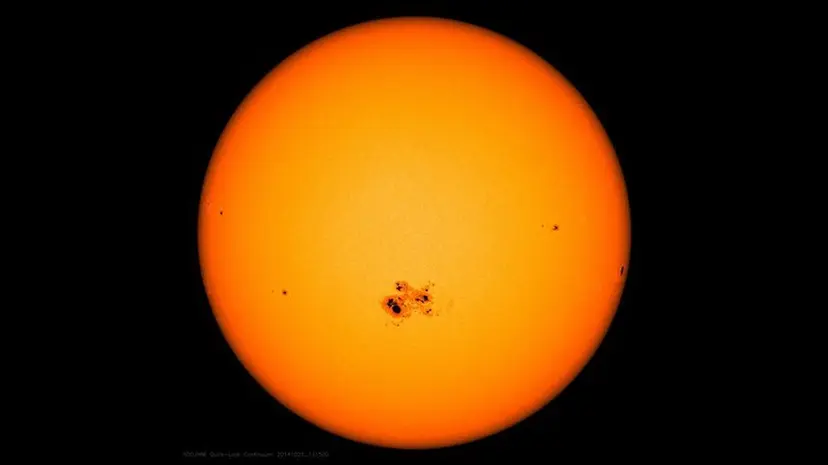
These violent activities on the star's surface have a fatal impact on the appearance of the spectrum observed from Earth. If a large starspot appears on the surface of the star, it is difficult to determine from Earth whether the dimming of the starlight is simply due to the starspot or due to the exoplanet transiting in front of the star. Also, because a massive starspot has a lower temperature and is darker, if a planet happens to transit in front of the starspot area, the traces left by the exoplanet’s atmospheric components on the spectrum could become even fainter. The starlight reduced by the starspot itself mimics an absorption line where the amount of light is reduced on the spectrum, contaminating it. Ultimately, it becomes difficult to distinguish it from traces actually absorbed by the planetary atmosphere components.
Seager points out that even the current James Webb telescope cannot overcome this problem. She pointed out that even if we obtain a spectrum suspected to be traces of an exoplanet's atmosphere using James Webb, it is difficult to fully trust the data. Seager says that the following three things must be considered when identifying components in an exoplanet’s atmosphere.
Unfortunately, according to Seager’s analysis, the signals related to DMS do not satisfy all three conditions. K2-18b is a very surprising case showing the possibility that molecules like DMS, which are deeply involved in biological activity, can be detected on exoplanets beyond Earth. However, regrettably, humanity does not yet have a definitive tool to judge whether it truly signifies the existence of extraterrestrial life.
What is even more regrettable is that this limitation is not a trivial problem caused simply by a low number of observations or simply because the performance of the telescope is not yet satisfactory. It is an inherent limitation embedded in the very method we most commonly use today to judge the possibility of life on exoplanets: the method of analyzing the spectrum of starlight at the moment a planet passes in front of the star.
Ultimately, to find an answer to the long-standing question, "Are we really alone in the universe?", we must devise a new hunting method that goes beyond the methods we have attempted so far. The biggest problem is that humanity has not yet secured a clear alternative. What chemical components can we assert without a shadow of a doubt are the most certain indicators of biological activity, and in what way should we observe to detect those components with high reliability...? We are being demanded to engage in more fundamental, new deliberation.
References
https://iopscience.iop.org/article/10.3847/2041-8213/acf577
https://ui.adsabs.harvard.edu/abs/2025arXiv250118477S/abstract
https://iopscience.iop.org/article/10.3847/2515-5172/add881
https://iopscience.iop.org/article/10.3847/2041-8213/adc1c8
https://iopscience.iop.org/article/10.3847/2041-8213/ad74da
https://ui.adsabs.harvard.edu/abs/2025arXiv250412946S/abstract
https://ui.adsabs.harvard.edu/abs/2025arXiv250416236D/abstract
https://ui.adsabs.harvard.edu/abs/2025arXiv250510539P/abstract
Who is the author, Ji Ung-bae? He loves cats and the universe. After watching "Galaxy Express 999" as a child, he dreamed of sharing the beauty of the universe. Currently, he researches evolution through galaxy interactions at the Center for Galaxy Evolution Research and the Near-Field Cosmology Laboratory at Yonsei University, and engages in various science communication activities such as lectures and writing. He has authored books such as "The Astronomy of Flirting," "Thinking About the Universe All Day," and "Star, The Science of Light."