

[비즈한국] Concerns are being raised regarding the AI advertising operations of Gmarket. Despite a structure where advertising costs surge after a free trial period transitions into a paid service, critics point out that the explanations provided are insufficient. Recently, controversy has erupted after it was revealed that when a seller who suffered from excessive advertising charges raised the issue, Gmarket demanded a "non-disclosure agreement" in exchange for a refund.

Used a free trial, ended up with a "bill bomb" and missing settlement funds
A seller named A, who sells health and wellness products, signed up for a free trial of Gmarket’s "AI Sales Up" advertisement last October. AI Sales Up is one of the representative advertising products Gmarket operates for sellers. It is a CPC (cost-per-click) advertising service where artificial intelligence analyzes consumer behavioral patterns to automatically display the seller's products at optimal times and locations.
A stated, "The service automatically switched to a paid subscription after a 7-day free trial. Initially, monthly ad costs were in the 100,000 KRW range, and sales were occurring. I assumed the ads were running stably and didn't pay much attention. Then, at some point, the sales settlement funds from Gmarket stopped coming in. Upon checking, I found that unlike the period immediately following the transition to paid status, the advertising costs had skyrocketed. The entire amount that was supposed to be settled (sales deposit) had been drained by advertising costs," they said.
According to the report provided by A, for the two months after switching to the paid service, ad costs were maintained at around 100,000 KRW per month, and sales were consistent. However, starting in January, the third month of ad execution, the cost rose to 800,000 KRW; in March it hit 1.98 million KRW; and in April it surged to 4.67 million KRW. Conversely, during this period, there were zero sales generated through the advertisements.
The reason for the massive increase in ad costs was that A's advertising budget had been set to "unlimited." Gmarket automatically set the seller's ad budget to unlimited when they participated in the AI Sales Up free event. Usually, on online platforms, sellers set monthly or daily ad budgets and run ads within those limits. However, Gmarket allowed unlimited automatic ad execution without any separate budget setting, and A’s sales deposits were entirely exhausted by advertising fees.
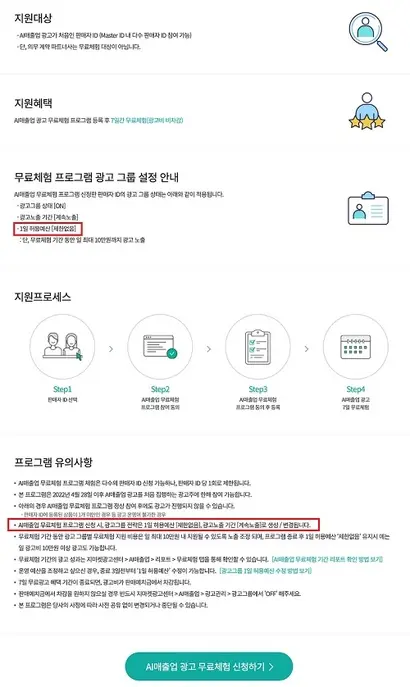
Looking at the Gmarket AI Sales Up free event page, under the explanation that "the advertising group status of the seller ID that applied for the AI Sales Up free trial program will be applied as follows," the line "1-day allowable budget [No limit]" is posted. However, this phrase is merely mentioned briefly as part of the terms of service, without any separate highlights or warning pop-ups.
A argued that the explanation was not intuitive and that the core information—that advertising fees could be charged without limit—was placed in a location that was not easily visible. In particular, they claimed it was impossible to foresee that the entire deposit could be automatically drained by ad costs based solely on the phrase "1-day allowable budget [No limit]."
"They wrote a long explanation for the free event and required clicking an agreement button to participate. If there is a risk of excessive advertising charges, shouldn't they have obtained separate consent for that? I didn't even receive a notice about this before the transition to the paid service," they claimed.
Gmarket, which demanded a "non-disclosure" pledge, explains it was "an exceptional measure"
A expressed frustration over the fact that no sales were generated despite millions of won in advertising costs being incurred. They argued, "Immediately after the free trial ended, there was efficiency with a small amount of ad spend, which is why I didn't realize the budget was set to unlimited. The advertising costs gradually increased, but no sales were generated at all. I asked for a detailed explanation regarding the ad effectiveness but did not receive a proper answer."
Regarding this, Gmarket stated, "Sales performance has various variables such as pricing, discounts, and timing. We provide detailed reports on the efficiency of the previous day's advertisements every morning."
Controversy is also growing over the fact that Gmarket demanded a "non-disclosure agreement" as a condition for a refund when A continued to raise the issue. A said, "I requested a refund for the excessive advertising charges. Then Gmarket said they would only provide a refund if I signed a pledge not to speak about this issue externally."
In response, Gmarket explained, "Even though it was a normal charge, we decided to provide compensation as an exceptional measure on a moral level, considering the seller's situation. Since it was an exceptional measure, we made a request not to make it a public issue."
Consumer protection groups believe that such advertising operation methods by Gmarket could be considered deceptive. An official from the Citizens’ Coalition for Consumer Sovereignty pointed out, "It is difficult for those using e-commerce platforms to check every detail. The fact that costs could increase significantly more than expected is a highly important issue from the user's perspective. Even if they provided notice, the current way of informing users can be seen as having the potential for deception."
The official added, "The problem is that sanctions for such situations are not easy. With current laws being inadequate, it is not easy for administrative agencies to actively interpret this as a deceptive practice. Sellers are also in the position of consuming the platform's products (advertising), but the reality is that there is a lack of devices to protect them. It is time for institutional reform."
Gmarket stated, "As there is always a possibility of similar cases occurring, we plan to actively review institutional improvements."