

[비즈한국] In the summer of 2025, the "end of Jeonse" sits at the center of discourse surrounding the real estate market. A succession of negative factors—such as Jeonse fraud, "깡통전세" (underwater Jeonse where the deposit exceeds the home's value), loan regulations, and the shift toward monthly rent—seems to shake the very foundations of the Jeonse system.
Amidst this upheaval, we cannot help but re-examine the role the Jeonse system has played in Korean society over the past several decades, and consider the direction in which future housing policy should head.
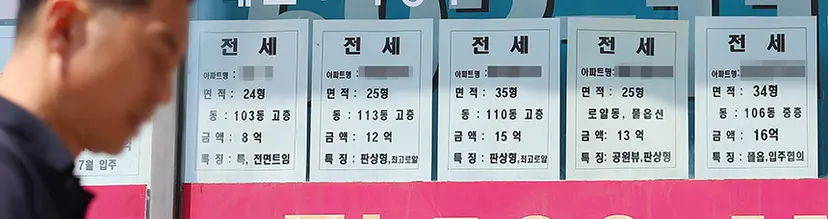
Recently, the rise of Jeonse fraud and "깡통전세" issues has led to strong calls for the abolition of the system. However, these are problems stemming from operational flaws and institutional loopholes rather than the essence of the Jeonse system itself. Jeonse is a system that has grown and been maintained within the unique historical and social context of Korea; it is a valuable social asset that requires improvement and supplementation, not abolition.
Historically, Jeonse is a system that has persisted for over 500 years, dating back to the Joseon Dynasty. As urbanization began in the late Joseon period, Jeonse played an important role in solving urban housing problems. Especially after the Korean War, as rapid urbanization and industrialization took place, Jeonse was an effective means for the private sector to solve housing problems that the state could not resolve. The expansion of housing supply using Jeonse deposits served as a driving force for economic revitalization. Thus, Jeonse has not been a mere rental method, but has faithfully performed its role as an important "housing ladder"—an intermediate process for non-homeowners to eventually purchase their own homes.
The landlord receives a lump sum and lends the home to a tenant, who then resides stably for a certain period without monthly rent. Upon contract expiration, the full deposit is returned. In the rapid urbanization and industrialization following the Korean War, Jeonse was the key to resolving housing shortages. In an era when financial infrastructure was inadequate, Jeonse deposits served as an interest-free funding source for landlords, while acting as "forced savings" and a "housing ladder" for tenants on their path to homeownership.
Jeonse was more than just a lease agreement. It had lower housing cost burdens than monthly rent, and receiving the deposit back upon contract expiration was advantageous for asset formation. For young people, newlyweds, and those dreaming of entering the middle class, Jeonse was a "ladder of hope." In times when bank loans were difficult to obtain, Jeonse acted as a form of private finance, contributing to housing supply and economic growth; it was a system of "stability" and "hope" that guaranteed long-term residency.
From an economic perspective, Jeonse offers clear advantages to both landlords and tenants. Landlords can secure additional funds interest-free by utilizing the Jeonse deposit. This can be used for various economic activities, such as purchasing additional housing or funding business operations. From the tenant’s perspective, the cost is much lower than monthly rent; as seen in the case of 'Raemian Solvenue' in Gangdong-gu, Seoul, it is possible to live there at a cost more than 1.1 million won per month cheaper than monthly rent. Furthermore, the Jeonse deposit is returned in full after the contract expires, providing an opportunity for tangible asset formation. Especially for those lacking an economic foundation, such as young people and newlyweds, it is an essential option for both a stable residence and a stepping stone to owning a home.
However, in 2025, Jeonse is facing a severe crisis. Jeonse fraud and "깡통전세" damages have emerged one after another, primarily centered on new multi-unit villas. As home prices have fallen and multi-homeowners or corporate landlords have gone bankrupt, cases where deposits cannot be returned have spread nationwide.
While the government has taken measures such as making subscription to Jeonse deposit return guarantees mandatory and enacting the Special Act on Jeonse Fraud, the anxiety of victims has not easily subsided. As Jeonse loan guarantee limits have been drastically reduced to reflect tenants' income and existing loans, and bank loan screenings have become stricter, securing Jeonse funds has become even more difficult. Compounded by interest rate hikes, tenants have had no choice but to turn to monthly rent or "Ban-jeonse" (a mix of deposit and monthly rent).
Looking at actual field statistics, as of May 2025, the proportion of monthly rent among residential lease contracts nationwide reached 61%. The monthly rent ratio for non-apartment properties (villas, multi-household houses) exceeded 76%, and the average monthly rent in the Seoul metropolitan area exceeds 800,000 won. While the Jeonse renewal rate is recovering to over 75%, the shift to monthly rent is becoming entrenched in low-priced housing and rural areas. The era of monthly rent has dawned.
As this shift toward monthly rent accelerates, the burden of housing costs is increasing. With monthly rent, over 20 million won can disappear in two years. The more young people, newlyweds, and low-income groups are pushed toward monthly rent, the fewer opportunities they have for asset formation. The housing ladder that led from "monthly rent → Jeonse → homeownership" is collapsing, and the dream of owning a home is drifting further away.
With monthly rent, money leaves your pocket every month, but with Jeonse, you get your deposit back when the contract ends. The Jeonse deposit becomes the seed money for homeownership and a ladder for social mobility.
Of course, the problems with Jeonse are clear. Jeonse fraud and "깡통전세" were caused by complex factors—including information asymmetry, poor loan screening, moral hazard of landlords, and distortion of the real estate market—rather than flaws in the system itself.
It is difficult for tenants to know key information such as the landlord's financial status and mortgage settings, and a structure has repeated where landlords with excessive leverage own multiple homes, only to go bankrupt during market downturns. Inadequate policies, such as the tightening of Jeonse loan regulations, limitations of guarantee insurance, and a shortage of public rental housing, have also exacerbated the problem.
Looking at overseas cases, the U.S., Germany, and Japan are centered on monthly rent. Deposits are merely equivalent to 1–2 months of rent, and tenant protections such as the right to demand contract renewal are strong. Conversely, while Korea's Jeonse requires a "large lump sum," it is advantageous for long-term residency and asset formation.
Similar to the 'Anticretico' in Bolivia, systems similar to Jeonse only exist in a few developing countries. However, even the monthly rent-centered systems of developed nations suffer from problems like soaring rents, housing instability, and the gap between classes. A monthly rent-centered system is not necessarily ideal.
The crisis of Jeonse is largely due to failures in operation, management, and market/policy, rather than the system itself. There is sufficient room for institutional improvement, such as introducing escrow systems, disclosing landlord credit information, providing appropriate levels of loan support, expanding public rental housing, and strengthening tenant protections. Jeonse is not an object for abolition, but a precious social asset that should be developed to be safer and more transparent through improvement and supplementation.
A Korean housing market without Jeonse would be as desolate as a society where the ladder of social mobility has disappeared. If we give up on Jeonse, the dream of homeownership may also vanish. The future of Korean housing policy depends on protecting the essential value of Jeonse while preparing innovations and safety devices that fit the changes of the times. Jeonse remains an absolutely necessary system for Korean society.
Kim Hak-ryeol, also known by his pen name "Pasion," is the head of the Smart Tube Real Estate Research Institute and a former team leader at the Korea Gallup Real Estate Research Division. He operates the Naver blog 'Pasion's World Exploration' and the YouTube channel 'StuTV.' He is the author of several books, including 'The Power of Gyeonggi Real Estate (2024),' 'The Absolute Principles of Seoul Real Estate (2023),' 'The Future of Incheon Real Estate (2022),' 'Kim Hak-ryeol's Absolute Principles of Real Estate Investment (2022),' 'Korea's Real Estate Future Map (2021),' 'From Now On, Only Places That Will Rise, Rise (2020),' and 'Korea's Real Estate User Manual (2020).'