

[비즈한국] With natural disasters such as flooding becoming frequent due to sudden localized heavy rains, local governments have rolled out various flood countermeasures. A representative example is the management of rainwater drains, which allow rainwater to escape during flooding. Yongsan-gu also installed QR codes and information signs on roadside drains and began management and operation in 2025. However, issues have been raised regarding the inappropriate installation and maintenance of these signboards.
Furthermore, it has been pointed out that even when reporting via QR code, it is inconvenient to check the history of reports and management status, contrary to initial guidance. It was also revealed that because the app is only provided for Android, iPhone users using iOS cannot access certain features such as map searches. Yongsan-gu stated, "As this is the early stage of operation, we will identify and review areas for improvement."
Reporting is possible via QR code, but the signs are hard to find
In April 2025, Yongsan-gu introduced "Smart Rainwater Drains," attaching QR codes to approximately 17,000 drains to assign management numbers. On-site checks confirmed that information signs were installed in various locations, ranging from major roads within Yongsan-gu to alleys in hillside neighborhoods.
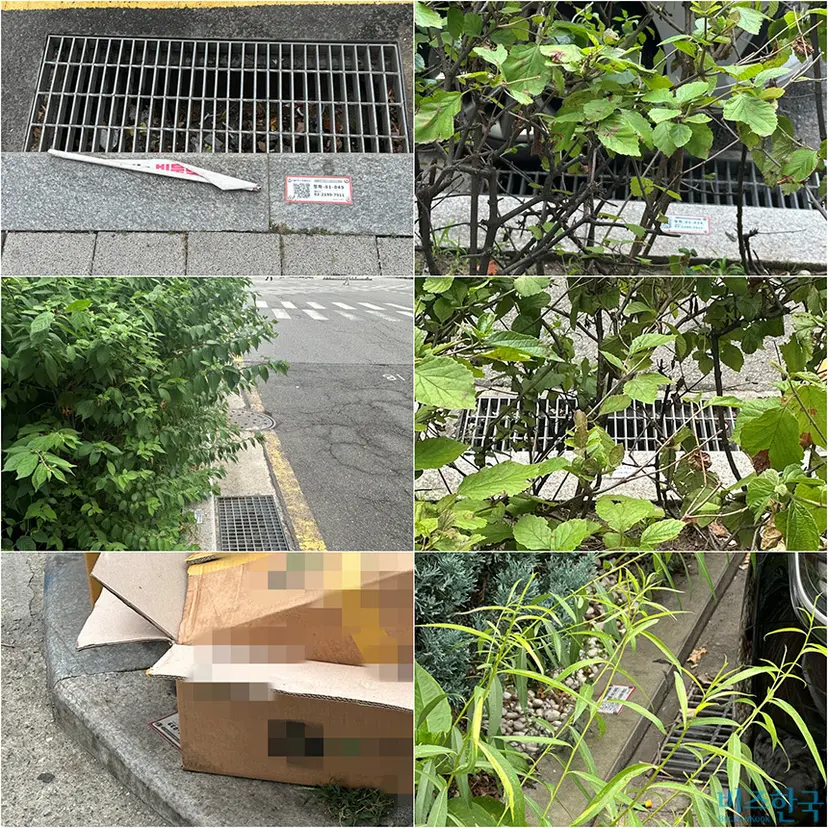
However, some signs were placed in locations difficult for pedestrians to access. Some were located between dense landscaping hedges along the roadside, requiring people to step into the road to scan them. Due to their location, accessibility was poor, meaning citizens had to navigate through bushes or risk walking into traffic to verify and report them.
Additionally, issues with illegal dumping and parking around the signs appeared urgent. Some signs were buried under piles of trash left by nearby restaurants, while others were blocked by parked cars. Consequently, citizens trying to report issues had to either clear the trash themselves or squeeze between parked vehicles.
Moreover, some signs were damaged by the footsteps of passing pedestrians, or obscured by foliage and debris. While installation locations were restricted for practical reasons, improvements are needed for signs obscured by external factors like trash or vehicles.
In fact, when checking the "Smart Rainwater Drains" near Cheongpa-dong, Yongsan-gu, some were found to be clogged with fallen leaves or trash. Although a management system was established to receive reports from residents, effectiveness issues are emerging.
Even if you want to report, the app system linked to the QR code is inconvenient
Yongsan-gu introduced the Smart Rainwater Drain system by highlighting that it allows for mobile-linked inspections, history management, and resident reporting. Even if mobile inspections and history management are handled by staff, it was difficult for residents to check the status of their reports or management records.
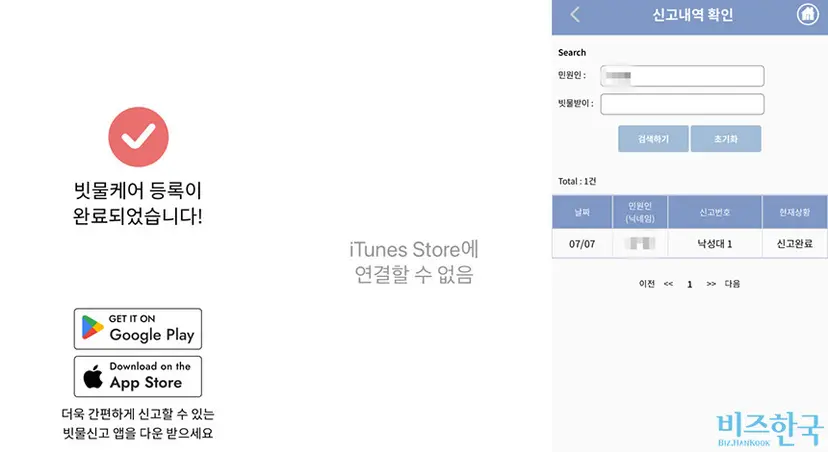
In reality, in other autonomous districts, residents are able to view their report history and the district office's processing status. By entering their name, they can check how their report is being handled.
There was also the problem that the resident reporting system relies on an Android app. There is no iOS app available to date. Consequently, for iPhone users, the reporting system links to a website.
Although there is a link for the Apple App Store after reporting, it does not connect to the store because the app does not exist. In contrast, in other districts, once a report is completed, it links to a resident reporting status screen.
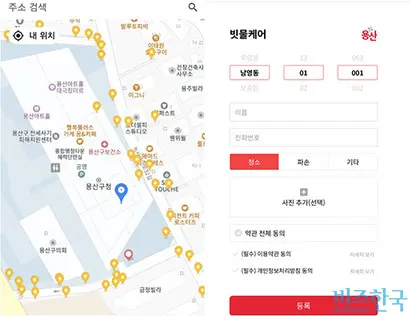
Since there is no separate app for iOS, the iOS web screen cannot perform map-based searches or confirm the location status of smart drains, which are provided in the Android app. While the Android app allows for location confirmation via GPS and reporting through map selection, this is impossible on an iPhone.
Yongsan-gu: "We are in the early stages of operation and are working on improvements"
A Yongsan-gu Office official stated that since they are currently in the early stages of operation, they will review areas for improvement.
Regarding the installation location of the signs, the official said, "If signs are installed in high-traffic areas for vehicles or pedestrians, they can be damaged, so there were cases where we had to adjust the location." They also added, "We will look into and take action on areas obscured by landscaping plants."
The official added, "We are also aware that signs are obscured by trash or parked vehicles, and this is a matter that needs to be discussed with related departments such as the Sanitation Department or the Parking Management Department." They mentioned, "While the Water Management Department clears surroundings while managing drains, it is something that must be improved in cooperation with other departments."
As for the inability to use the app on an iPhone, the official explained, "It is true there is no iOS app, but that is because we shifted the reporting system from an app-based one to a QR code-based one." They noted, "While it is true that we initially developed it for Android because app development was relatively simple and user-friendly, issues with accessibility were raised."
The official explained, "There was feedback that accessibility drops if people are required to install an app just to report something, so we changed the operation direction to allow reporting directly by scanning the QR code with a smartphone, regardless of the operating system."
Regarding checking report status and receipt procedures, the official said, "Some people report without entering their phone number, and if they do provide it, we currently send status updates manually if requested. However, there is no automated way to do this via text message yet." They added, "This is something we will discuss to advance the system."
The official concluded, "We have been in full operation since May, so we are in the initial phase—Version 1.0, so to speak. Since it is still the early stage, we plan to continuously review whether to update it after further usage."
They added, "We have received about 150 reports from May until now. That's more than 50 reports per month. As there are citizens who continue to report, we are aware of the issues and plan to fix them."