

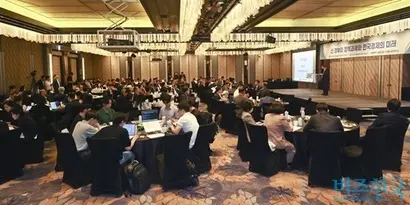
[비즈한국] What is the prerequisite for the sustainable growth of the Korean economy? Key figures from the domestic economy and management sectors gathered to diagnose the Korean economy and present a vision for economic policy. The ‘2025 Shared Growth Conference,’ co-hosted by Ilyo Shinmun and the Institute for Shared Growth (Chairman Chung Un-chan), was held on July 9 at the Four Seasons Hotel Seoul Nuri Ballroom in Jongno-gu, Seoul. This conference focused on exploring ways to grow together based on cooperative competition and finding practical solutions.
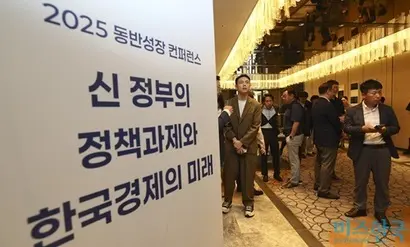
Held under the theme of ‘The New Administration’s Policy Tasks and the Future of the Korean Economy,’ the 2025 Shared Growth Conference diagnosed the problems of low growth and polarization in the Korean economy and presented concrete mutual growth plans, including shared growth and entrepreneurship. Shared growth is a social philosophy that advocates growing together and sharing the fruits of that growth fairly. Leaders from academia and industry agreed that amidst a changing global economic order—characterized by the US-China hegemonic competition and the artificial intelligence (AI) revolution—Korea must foster innovation and pursue sustainable development through shared growth.
The conference consisted of a morning session featuring presentations on diagnosing and forecasting the Korean economy, followed by an afternoon session of discussions and networking with entrepreneurs and young business leaders. For the first topic, ‘Prospects and Tasks for the Korean Economy,’ Nam Chang-woo, Vice President of Research at the Korea Development Institute (KDI), took the stage on behalf of KDI President Cho Dong-chul, who was attending a government meeting. Next, Park Jong-kyu, former president of the Korea Institute of Finance, took the podium on the topic of ‘Where is the Korean Economy Headed?’ Subsequently, Kim Young-sik, a professor of economics at Seoul National University, and Woo Seok-jin, a professor of economics and statistics at Myongji University, spoke during the plenary discussion.
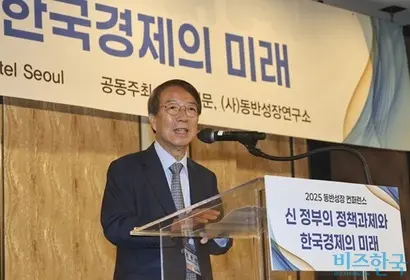
Chairman Chung Un-chan, who delivered the keynote speech, emphasized that shared growth is a matter of ‘growth’ rather than ‘distribution.’ As an economist and former Prime Minister, Chairman Chung has consistently argued that shared growth is essential to solving the chronic problems of the Korean economy. "A healthy community can only be created when opportunities are provided equally, competition is fair, and there is hope that the gap can be narrowed," Chung stated. "There must be something to share for an economy to grow, and corporate innovation is essential for growth. Innovation is the process of developing and adopting technologies, products, and services that are distinctly different from the past."
Korea is evaluated as a country that has achieved innovation by expanding its market through trade and actively imitating and adopting new technologies despite having a small domestic market. On the other hand, it is currently experiencing low growth and polarization due to limitations in innovation foundations—such as restricted technology, human capital, and institutional flexibility—as well as limited capital scale and a high concentration of large corporations.
"Although Korea ranks at the top globally in terms of R&D investment scale, it lacks the acquisition of cutting-edge core technologies," Chung pointed out. "We must boldly pivot from our current direction of focusing on 'Development,' which allows for short-term results, to 'Research,' which is fundamental. It is important to work on developing long-cycle technologies like bio, in addition to short-cycle technologies like IT, and to create a virtuous industrial ecosystem where large corporations and SMEs can grow together."
Based on KDI’s research findings, Vice President Nam Chang-woo pointed out the structural problems of the Korean economy and discussed future directions. Pessimistic projections suggest that Korea could see a potential growth rate of effectively 0% in the 2040s, considering the slowing pace of technological advancement and policy financing that hinders efficient resource allocation. "Economic growth is not a sufficient condition for social stability, but I believe it can increase its possibilities," Nam explained. "If growth is pushed upward, distribution indicators—such as a decrease in the proportion of the poor and an increase in the proportion of the high-income class—will improve. This means the government can reduce fiscal spending and have greater capacity to withstand pressures like taxes."
SMEs are responsible for a relatively large share of employment, but their productivity is low because the value-added they generate is limited. Some point to a ‘Peter Pan Syndrome,’ referring to the phenomenon where SMEs maintain their current status rather than growing. "It is necessary to reduce the polarization in labor productivity between large corporations and SMEs, and to increase efficiency in hourly labor productivity by properly allocating the total annual working hours, which are high compared to the OECD average," Nam stated.
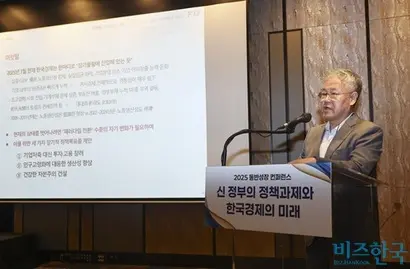
Macroeconomics and fiscal policy expert Park Jong-kyu remarked, "We are currently in a period of 'stagnation without wage growth,' making it extremely difficult to choose policies." He continued, "Within 20 years, it is likely that interest income earned by domestic companies will surpass the interest income earned by households. Meanwhile, households use their savings for apartments rather than investing in companies. SMEs keep carrying over retained earnings that exceed seven times their net annual profit because they feel it is difficult to borrow money from financial institutions when they actually need it. In such a structure, it is difficult for our economy to demonstrate 100% of its capability. We need to change the financing for SMEs, including having banks take responsibility for supporting promising companies."
In the afternoon session, Chairman Chung, Hwayo Chairman Cho Tae-kwon, and Institute for Shared Growth Director Lee Da-yeon held a discussion and Q&A session on shared growth and entrepreneurship. Chairman Cho, who founded Hwayo, took over his father’s family business in 1988 after working in defense industry exports at Daewoo Group, beginning with the ceramics company Kwangjuyo. Later, he ventured into the dining industry with the Korean restaurant Gaon and expanded into the alcoholic beverage manufacturing business in 2003.
Shared growth also aligns with the fair economy stance emphasized by President Lee Jae-myung during his candidacy. Recently, the Ministry of SMEs and Startups launched a large-scale investigation into the status of mutual growth and cooperation between large corporations and SMEs. The Shared Growth Commission is recruiting research agencies, entrusted by the Ministry of SMEs and Startups, to conduct surveys on the status of mutual cooperation between large and small companies. The Commission plans to start the survey in early July and report the findings to the Ministry as early as November this year.
Kim Won-yang, CEO of Ilyo Shinmun, noted, "The way to alleviate conflicts in our society is growth, not distribution. It is not just about increasing the size, but only the even growth of all classes and strata can be the driving force to heal all the conflicts of this era."