

[비즈한국] Hanjin Group Chairman Cho Won-tae is drawing attention for openly expressing concerns regarding tariffs in recent foreign media interviews. The domestic industrial sector, including Korean Air003490, is on edge due to US tariff policies. If trade volumes shrink due to tariffs, Korean Air's cargo business is bound to take a hit. Furthermore, this could also have a negative impact on Korean Air's exports of aircraft components.
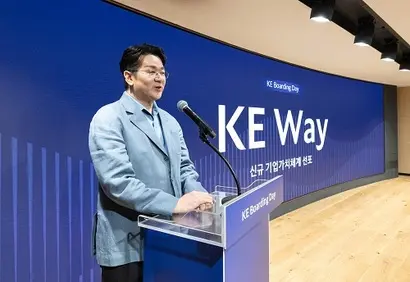
In a CNN interview on May 1 (local time), Chairman Cho stated, "We have already seen a decline in customers on routes to the US and Europe," adding, "While it is around the 5% level year-on-year, it is having a significant impact on our business." Chairman Cho continued, "The Korean economy sits between the US and China and is heavily dependent on both countries," and added, "We are preparing for the impact that lies ahead."
In a Bloomberg interview on June 2 (local time), Chairman Cho said, "I hope the next Korean government will make protecting the aviation industry from tariffs a top priority in trade negotiations with the US." He spoke more directly about his concerns regarding tariffs and his requests to the government. It is rare for the head of a major domestic conglomerate to voice opinions to the government publicly rather than through an economic association. This is interpreted as an indication of how urgent the tariff issue is from Chairman Cho's perspective.
While Korean Air’s primary business is air transport services, it also operates an aircraft component manufacturing business. Korean Air supplies parts such as fuselages and wing structures to Boeing in the US. It is also expanding its business scope by participating in the production of airframe structures for military aircraft. However, US President Donald Trump is pushing for the imposition of tariffs on aircraft parts. If tariffs are imposed on these parts, Korean Air's component business will inevitably be affected.
Even beyond aircraft parts, if President Trump's tariff policy is fully implemented, there is a high possibility that trade volumes will decrease. This is a factor that could directly impact Korean Air's cargo transport business. It is reported that trade volumes bound for the US have already been shrinking for several months due to uncertainty over tariffs. On the 7th (local time), President Trump notified that a 25% reciprocal tariff would be imposed on all Korean products starting August 1.
Lee Seo-yeon, an analyst at Sangsangin Securities, analyzed, "Korean Air's cargo revenue for the second quarter of this year is expected to reach 1.0532 trillion KRW, a 4% decrease compared to the same period last year, and we anticipate that transport volume will decrease by 6% amidst tariff uncertainty."
Bae Se-ho, an analyst at iM Securities, stated, "Volatility in the performance of the cargo sector may increase depending on future changes in US tariff policy," and added, "We project that Korean Air's cargo volume for the third and fourth quarters of this year will decrease by 8.1% and 6.2% respectively year-on-year, but these estimates could change significantly depending on the outcomes of US tariff policies."
Last December, Korean Air finalized the acquisition of Asiana Airlines for 1.5 trillion KRW. If performance continues to deteriorate while having spent such a large sum, it will negatively impact Korean Air's financial health. Korean Air's operating profit had already dropped by 19.81%, from 537.5 billion KRW in the first quarter of last year to 431 billion KRW in the first quarter of this year. Securities firms are not very optimistic about Korean Air's second-quarter results either. A fortunate point is that Air Incheon has agreed to acquire Asiana Airlines' cargo business division on August 1. Once the acquisition is complete, the risk of tariff uncertainty for Asiana Airlines' cargo business can be somewhat avoided.
Chairman Cho is not in a position to influence President Trump's tariff policies. Nor can he represent Korea in tariff negotiations. For Chairman Cho, the only path is to pin his hopes on trade negotiations between President Lee Jae-myung and President Trump. It is assessed that this context is why Chairman Cho mentioned tariffs directly in his foreign media interviews.
Some suggest the possibility that Korean Air could be exempted from tariffs under certain conditions. For instance, scenarios have been suggested where Korean Air could be exempted by offering to purchase a large number of Boeing aircraft. However, in this case, it would be difficult to avoid backlash from the European aircraft manufacturer Airbus, as Korean Air has conducted significant business with both Boeing and Airbus to date. Korean Air, however, has not released any specific stance regarding countermeasures for the tariffs.