

[비즈한국] Criticism is emerging that the government's policy for affordable housing for ordinary citizens has taken a step backward as it significantly scales back policy-backed loan programs. During an "Emergency Household Debt Inspection Meeting" with related agencies on June 27, the Financial Services Commission (FSC) announced high-intensity household debt management measures, which included regulatory caps on the "Didimdol" and "Beotimmok" loans, which are meant to support housing for ordinary citizens.

According to the household debt management plan released by the FSC, the total volume targets for both self-managed bank loans and policy-backed loans will be reduced. From July 2025, the total volume target for household loans across all financial sectors, excluding policy loans, will be cut to half the level of the original plan, while policy-backed loans will be reduced by 25% compared to the annual supply plan.
For individuals who own two or more homes in the metropolitan area or regulated regions who seek to purchase an additional home, or for single-home owners purchasing an additional home, the LTV (Loan-to-Value) ratio will be set at 0%. This measure is intended to block the demand for additional home purchases that are not for actual residency purposes.
The FSC also announced that it would limit the limit for mortgage loans used for living stability funds against homes held in the metropolitan area or regulated regions to a maximum of 100 million won. Furthermore, to curb "gap investment" purchases, it announced a ban on jeonse (lump-sum deposit rental) loans that are conditional on a change of ownership. It also decided to limit the ceiling for credit loans to within 1 to 2 times the borrower's annual income.
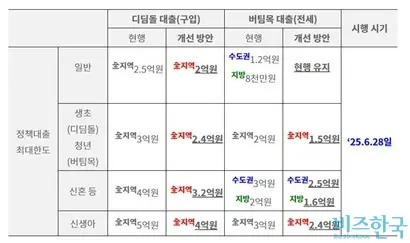
The problem is that the "Didimdol" and "Beotimmok" loans, which are policies designed for ordinary citizens, were included in this regulatory scope. Didimdol loans are for home purchases, while Beotimmok loans are for jeonse deposits. These two policy funds, operated by the Housing and Urban Fund, are provided to homeless ordinary citizens at low interest rates. Consequently, the loan requirements are strict: all members of the household must be non-homeowners, and applicants must have an annual income of 50 million won or less for Beotimmok, and 60 million won or less for Didimdol.
According to the operational plan announced by the FSC, the standard Didimdol loan limit was reduced from 250 million won to 200 million won. The youth Beotimmok loan was also reduced from 200 million won to 150 million won.
First-time homebuyers are also not exempt from the regulations. The "First-time Buyer Didimdol Loan," originally capped at 300 million won, has been reduced to 240 million won. Both Didimdol and Beotimmok loans have seen reductions in the scale of support applied to newlyweds and households with newborns.
Confusion has erupted on the ground because the government applied the cuts to policy funds the day after the announcement. Person A, who fears losing their deposit due to the Beotimmok loan limit reduction, stated, "I received a preliminary screening from the bank and have already signed a jeonse contract. All that was left was the final loan application, but the limit was suddenly cut, and explanations regarding the application criteria vary. The bank says I won't know for sure until the review, and it's unclear whether the new policy applies based on the contract date or the loan application date. If the loan isn't approved, I'll lose my deposit."
Rate hikes under the Yoon administration, limit cuts under this administration
Except for its first year in office, the former Yoon Suk-yeol administration raised policy loan interest rates every year. Under the pretense of controlling household debt, it raised Didimdol and Beotimmok loan rates by 0.3 percentage points in August 2023, and by up to 0.4 percentage points in August of last year. In March of this year, despite a cut in the base interest rate, loan rates were hiked by 0.2 percentage points. This is the exact opposite of the policy stance in August 2022, when the government announced that it would freeze Didimdol and Beotimmok loan rates without reflecting base rate hikes to alleviate the housing burden on homeless citizens.
The newly inaugurated Lee Jae-myung administration has now reduced the loan limits just three months after the Didimdol and Beotimmok rates were raised. While the FSC plans to focus on housing supply and housing fund support for low-income citizens instead of lowering policy loan limits, these policy-backed loans are, in fact, a core part of the housing support policy for low-income individuals.
Experts express disappointment that policy-backed loans were included in these regulations. Park Won-gap, a senior real estate analyst at KB Kookmin Bank, commented, "While the stability of the macroeconomy should not be ignored, the housing market is diverging, so it is regrettable that the loan policies were not differentiated between apartments and non-apartments. I also wish they had provided a grace period of about ten days before implementation."
Some analysts suggest that the regulation of policy funds is aimed more at resolving the financial distress of the Housing and Urban Fund rather than stabilizing the real estate market. As of 2023, the net assets of the Housing and Urban Fund stood at 35.7284 trillion won. However, it was pointed out that the fund's available capital has shrunk significantly since the Ministry of Economy and Finance diverted 3.2 trillion won from the Housing and Urban Fund to cover tax shortfalls last year.
Kim In-man, director of the Kim In-man Real Estate Economics Institute, analyzed, "It is unfortunate that policy-backed loans for ordinary citizens are included in the regulatory scope. This relates to the Housing and Urban Fund, which appears to be drying up. The surplus capital, which was around 40 trillion won, is now down to about 7 trillion won. It seems they took this opportunity to cut it back together. It is hard to see first-time homebuyer loans and ordinary jeonse loans as having a significant impact on real estate price increases. On the positive side, they say they will increase public rental housing instead of cutting policy loans, but the problem is that this does not yield immediate results and takes time."
Meanwhile, the FSC has not disclosed concrete plans regarding the housing supply or housing fund support programs for low-income citizens that they intend to focus on in lieu of the policy loan limits.