

[비즈한국] There are names that frequently appear in recent news: U.S. President Donald Trump, Tesla CEO Elon Musk, and U.S. Federal Reserve Chair Jerome Powell. While these three are symbols of politics, technology, and monetary policy respectively, they have recently been showing signs of clashing with one another.
The most dramatic confrontation is taking place between Trump and Musk. Initially, Musk maintained a very close relationship with Trump while heading the Department of Government Efficiency (DOGE) under the Trump administration, but he openly rebelled against the Trump administration’s large-scale tax cut bill (the "One Big Beautiful Bill," or OBBBA), leading to a conflict.
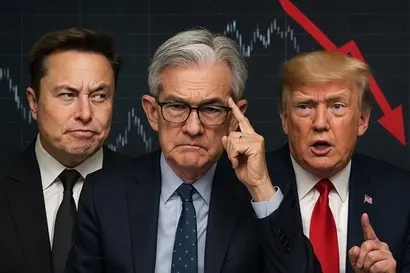
When Musk pointed out that “if the insane spending bill is passed, the ‘America Party’ will be founded the very next day,” Trump retorted that federal budget savings should be achieved by cutting government subsidies provided to companies run by Musk. Musk eventually went on to found the “America Party” himself, and Trump dismissed it as “ridiculous.”
As the conflict between the two resurfaced, Tesla's stock price fluctuated significantly. Theme stocks related to Musk, such as artificial intelligence (AI), autonomous driving, and virtual assets, also showed a weak trend.
The conflict between Trump and Powell is also ongoing. Since being re-elected, Trump has been pressuring Powell to resign, demanding rapid interest rate cuts, while Powell is holding his ground, stating that “it is not yet the time.” This conflict over rate cuts is increasing uncertainty not only for U.S. monetary policy but also for the global asset market.
The problem is that the statements made by these three men are directly reflected in the market, and the aftermath affects our assets as well. On July 8, Trump sent official letters to 14–15 countries, including South Korea, stating, “We will impose reciprocal tariffs of 25–40% starting August 1.” However, he did leave room for adjustments to the tariff rates and timing if trade barriers are removed. Consequently, risk management aligned with the timing of these tariff implementations has emerged as a top priority for domestic investors.
Kim Dae-jun, a researcher at Korea Investment & Securities, said, "In terms of investment, tariff anxiety and sluggish exports are a burden on stock prices," adding, "If demand from the U.S. decreases due to the shock of tariffs, exports could worsen further." Indeed, while earnings prospects are deteriorating for sectors exposed to trade uncertainty, such as semiconductors, automobiles, and home appliances, domestic-demand industries such as holding companies, finance, cosmetics, and retail are seeing growing expectations for earnings improvements, independent of trade risks.
Musk remains a key figure who dictates the direction of core stock market themes, including AI, robotics, virtual assets, and satellite communications. While there were expectations that Musk would focus on Tesla and autonomous driving after stepping down from the Trump administration, his political clash with Trump has re-intensified, introducing volatility to Tesla's stock price. For this reason, if your portfolio is concentrated solely on Musk-related themes, it is time to consider rebalancing.
Powell is maintaining a cautious stance on interest rates. Although Trump and the market are demanding early rate cuts, the Federal Reserve is delaying a shift in policy direction, citing reasons such as the potential for renewed inflation due to tariffs.
Jeong Yong-taek, a researcher at IBK Securities, said, "The Fed's dilemma is to strike a balance between President Trump, who is pressuring for interest rate cuts in a direct and blatant manner every day, and the market’s demand for more aggressive rate cuts. However, there are still many factors to verify, such as the impact of tariffs on prices."
Hints regarding the future direction of interest rates are expected to be found in the minutes of the June Federal Open Market Committee (FOMC) meeting, which will be released on the 9th (local time).
Lee Kyung-min, a researcher at Daishin Securities, said, "If no requirements that would restrict rate cuts are identified in the FOMC minutes besides tariff uncertainty, and if the outlines of tariff negotiations are captured during July, expectations for rate cuts could accelerate."
Ultimately, in a market where political, technological, and policy variables are moving separately, sector diversification and risk management are more important than simple market direction. The fight between these three men will not end easily, but we must read the flow and stay centered rather than succumbing to anxiety.