

[비즈한국] KAI has begun development of a carrier-based drone aircraft. The approach involves modifying an Unmanned Combat Aerial Vehicle (UCAV) for the Air Force, which was previously in the conceptual research stage, to enable its operation from aircraft carriers. This UCAV not only features a modular nose section but is also capable of carrying long-range air-to-air missiles and air-launched drones in its internal and external weapon bays.
This information was disclosed on July 8th at the "8th Seminar Commemorating the Victory of the Battle of the Korea Strait," hosted by the office of National Assembly member Yoo Yong-won. At the event, Kang Byung-gil, head of the Future Systems Research Lab at Korea Aerospace Industries047810 (KAI), stated that it is possible to develop a carrier-based unmanned combat aircraft based on the UCAV currently in the conceptual design stage at KAI.
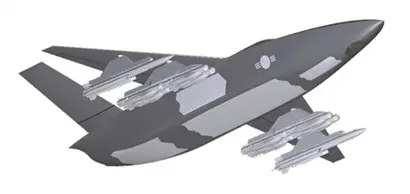
The UCAV previously developed by KAI is a Collaborative Combat Aircraft (CCA) designed to perform formation flights with the manned KF-21 fighter. While CCAs are being actively developed in countries like the U.S., China, and Turkey, and projects like Korean Air003490's LOWUS are underway in Korea, KAI’s UCAV is significantly larger and possesses a competitive edge in terms of payload capacity and performance.
KAI is currently modifying this UCAV for aircraft carrier deployment. This involves reinforcing the landing gear and adding a tail hook for carrier landings, allowing the KAI drone to take off and land from conventional aircraft carriers.
The key specifications of the carrier-based drone are as follows: a Maximum Take-Off Weight (MTOW) of 6 tons or less, a range of approximately 482 km (300 nautical miles), a weapons payload of 800 kg, and a maximum speed of Mach 0.6 or less. This is similar in size to the Czech L-39 Albatros trainer, which is relatively slower compared to the KF-21 Boramae, which reaches speeds of Mach 1.8.
The reason KAI opted for lower speed is the inclusion of a high-efficiency high-bypass turbofan engine. Since the carrier-based drone is intended for reconnaissance (ISR) missions as well as air combat and ground attack, priority was placed on efficiency over high speed.
While it may not match manned fighters in speed, the KAI carrier-based drone possesses several new capabilities not found in manned aircraft. First, it has stealth functionality. To evade enemy radar detection, it is equipped with an internal weapons bay, a feature also applied to the KF-21 EX.
The second feature is flexible mission equipment replacement through a modular design. By swapping the nose section, various sensors such as AESA radar, infrared search and track (IRST) systems for air combat, and electro-optical targeting systems (EOTS) for ground attacks can be mounted depending on the mission. Future variants are expected to be capable of carrying maritime search radar as well.
The third feature is its powerful armament and integrated drone operation capability. The KAI carrier-based drone can conduct long-range air combat by carrying MBDA’s Meteor long-range air-to-air missiles, and it can function as a "drone mothership" by carrying medium and small air-launched drones currently being developed by KAI. This follows a concept where one drone operates others, with a single carrier-based drone commanding multiple UAVs simultaneously.
If full-scale development proceeds, South Korea will become the third nation in the world to develop a jet-powered unmanned attack aircraft for aircraft carriers, following the U.S. MQ-25 and Turkey’s Bayraktar Kızılelma. In particular, it could establish itself as a formidable competitor to Turkish drones, which are already strong in the global export market.
Compared to the Kızılelma, the KAI carrier-based drone has a larger payload capacity, and its ability to conduct air combat using an AESA radar—a feature the MQ-25 lacks—provides a distinct competitive advantage.
However, a noted limitation is that the command-and-control ship for manned/unmanned teaming must be of sufficient size and capability to accommodate these large unmanned aircraft. For takeoff, an Electromagnetic Aircraft Launch System (EMALS) capable of supporting over 6 tons is required, and Korea currently plans to research and develop a 20-ton class EMALS indigenously. As this is a first-time endeavor for the country, some level of technical risk is inevitable.
As an alternative, I suggest first developing an 8-ton class EMALS tailored to the MTOW of the KAI unmanned carrier aircraft, then gradually expanding to a 20-ton class that could eventually operate MQ-25 class aircraft, or pursuing parallel development of a version equipped with canards and thrust-vectoring nozzles (TVC) that can take off using a ski-jump ramp without the need for a catapult.
For the past 20 years, the South Korean Navy has made efforts to secure an aircraft carrier, but these attempts have repeatedly fallen through due to budget and manpower constraints. However, if KAI’s unmanned carrier aircraft, the manned/unmanned integrated command system, and the drone aircraft carrier become a reality, they will not only help safeguard national interests at sea but also gain attention as a new key defense export item.