

[비즈한국] The launch of NH NongHyup Bank's foreign exchange (FX) platform is imminent. Considering that major commercial banks have been building and operating non-face-to-face FX trading platforms for years, this is a relatively late move. As the government pushes policies to improve the domestic FX market environment and FX trading volumes continuously hit record highs, banks have been quick to build platforms and respond. As a latecomer, NongHyup Bank appears to be focusing on FX trading while also putting effort into overseas expansion.

NH NongHyup Bank recently named its FX trading platform ‘FX allone’ and is accelerating development. In line with the platform's launch, the bank filed for a trademark of the same name with the Korean Intellectual Property Office on June 23. The product classifications are classes 09, 16, 35, 36, and 38, and the designated goods include △FX margin trading brokerage programs △security programs for FX margin trading △FX margin trading and brokerage businesses △and FX margin trading information transmission businesses.
An official from NongHyup Bank stated, "We are developing the FX trading platform with the goal of opening it within the second half of the year," adding, "It will be similar in form to services operated by other commercial banks."
The banking industry has been actively building non-face-to-face FX trading platforms. Among major commercial banks, Hana Bank took the lead. In May 2020, Hana Bank launched the ‘Hana FX Trading System,’ which enables non-face-to-face, real-time trading. In December 2022, it partnered with Toss Securities to launch the financial industry's first 24-hour trading service.
Among other major commercial banks, KB Kookmin Bank introduced ‘KB Star FX’ in January 2023, a comprehensive platform that allows for currency exchange, spot trading (short-term FX trading), forward trading (FX trading at an agreed rate for a specific future date), and FX swap trading based on real-time exchange rates, and released an app version with improved convenience in September 2024. Shinhan Bank operates ‘eFX,’ an FX trading platform based on an electronic trading interface (API) for corporate banking.
Woori Bank launched ‘Woori WON FX’ in January 2024, an electronic trading platform that allows corporations and individual business owners to conduct real-time FX trading. Woori Bank differentiated itself from other platforms with a ‘time-limit order’ function that allows users to perform currency split trades at set times. Following this, in June 2024, IBK Industrial Bank of Korea completely revamped ‘IBK Internet FX/Forward Exchange,’ the non-face-to-face FX trading system it first introduced in the banking sector in 2011, and re-launched it as ‘IBK FXON.’
Considering that major commercial banks have already built and are operating FX trading platforms, NongHyup Bank is somewhat late to the game. NongHyup Bank established its FX trading platform business plan in early 2024, selected vendors, and began developing a platform for corporate clients. It appears that NongHyup Bank did not rush to build a platform because its foreign exchange asset scale is not as large as other banks.
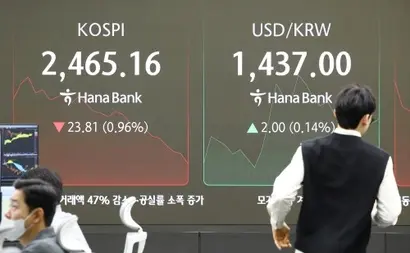
The banking industry’s move to build FX trading platforms is due to high exchange rate volatility caused by international conditions and rising FX trading volumes. According to data from the Bank of Korea on foreign exchange bank trading trends, the daily average FX trading volume (spot and FX derivatives) of foreign exchange banks in the first quarter was $72.76 billion, reaching its highest level since the statistics were reorganized in 2008. The previous record high was $70.91 billion (third quarter of 2024), meaning the record was broken in just two quarters.
Regarding the increase in FX trading, the Bank of Korea explained, "In addition to seasonal factors where trading decreases in the fourth quarter and increases in the first quarter, demand for hedging against foreign exchange risks due to foreigners' domestic securities investments and rising exchange rates (average won-dollar exchange rate of 1,452.9 won as of the first quarter) contributed to the increase." According to the Bank of Korea, domestic banks recorded a trading volume of $32.54 billion, while foreign bank branches recorded $40.22 billion. These figures represent an increase of 4.8% and 9.6% respectively compared to the previous quarter.
The government's policy to improve the structure of the FX market also influenced the industry's moves. Authorities announced structural improvement plans in February 2023 and are implementing them sequentially. Starting July 1, 2024, the FX market closing time was extended from 3:30 PM to 2:00 AM the next day, aligning with the London market closing time. Accordingly, the won-dollar exchange rate now moves until market close. In the year since the reorganization, the average daily spot trading volume has increased by 16.3% year-on-year. The government plans to eventually expand operating hours to 24 hours.
Meanwhile, in addition to its FX trading business, NongHyup Bank is also striving for overseas expansion. On July 1, NongHyup Bank obtained final approval from British financial authorities to establish a London branch. The London branch is NongHyup Bank's first overseas branch in the European region, an achievement reached four years after NongHyup Bank opened its London office in 2021. The London branch will officially begin operations on July 15.
With this opening, NongHyup Bank now operates 7 overseas branches (London, New York, Sydney, Hong Kong, Beijing, Hanoi, Noida), 2 subsidiaries (Cambodia, Myanmar), and 2 offices (Yangon, Ho Chi Minh City). NongHyup Bank aims to use the London branch as a bridgehead for expanding its global IB business in the EMEA (Europe, Middle East, Africa) region. CEO Kang Tae-young said, "We will grow the London branch into a strategic hub for vitalizing the IB business and discovering synergies across the NongHyup group."