

[비즈한국] A few months ago, an asteroid made headlines: 2024 YR4. When it was first discovered, the probability of this asteroid colliding with Earth seemed very high. At one point, the collision probability reached 3%. A 1 in 30 chance of hitting Earth! It meant that with just a slight nudge, the Earth could face an unexpectedly early end. Amidst the fear that a scenario seen only in disaster sci-fi movies might play out in reality, many astronomers kept a constant, watchful eye on this asteroid. Naturally, the James Webb Space Telescope also observed the asteroid, providing hints about the nature of this threat looming over us.
Fortunately, more precise orbital analysis over the past few months has reduced the probability of an Earth collision to nearly 0%. However, it is too early to let our guard down. Recent analysis suggests this asteroid seems to be aiming for the Moon, not Earth. A collision with the Moon is now being discussed with a slightly higher probability than the initially projected Earth collision. Even if Earth isn't hit directly, a massive impact on the Moon, our neighbor, could cause indirect damage to us. In that sense, 2024 YR4 still poses a threat.
Can Earth and the Moon overcome this unexpected crisis? What clues will precise observations via the James Webb Space Telescope provide us?
Observational networks designed to monitor potentially hazardous asteroids (PHA) have been built all over the world. The name itself is quite dramatic: ATLAS (Asteroid Terrestrial-impact Last Alert System). On December 22, 2024, 2024 YR4 was accidentally captured by a telescope in Chile. According to analysis so far, this asteroid follows a highly elongated elliptical orbit. In 2024, it was passing its perihelion, the point closest to the Sun. It approached within 800,000 km of Earth, which is how it was captured by the telescope in December 2024.
Upon its initial discovery, the probability of the asteroid colliding with Earth in 2032 appeared very high. It once hit a 3% collision probability and attracted significant attention by reaching Level 3 on the Torino Scale, which indicates the hazard level of asteroid impacts. Before 2024 YR4, there was the famous asteroid Apophis, which was deemed highly likely to hit Earth in 2029. Apophis once reached Level 4 on the Torino Scale, and 2024 YR4 recorded the highest risk level seen in a long time since then.
According to current orbital analysis, this asteroid will approach Earth about eight times over the next 100 years. Among them, 2032 was identified as the most dangerous period. Fortunately, however, based on additional observations over the past three months, we can breathe a sigh of relief. Further analysis shows that the probability of this asteroid colliding with Earth has dropped to nearly 0%. Both NASA and the ESA have officially removed this asteroid from their lists of potentially hazardous asteroids.
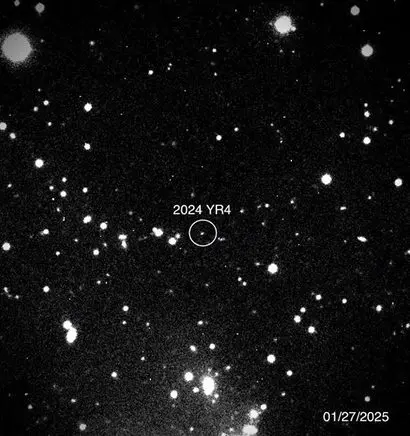
Some might feel even more anxious because the collision probability has fluctuated so much in just a few months. In fact, predicting the collision probability between Earth and an asteroid is not a simple problem. It is particularly tricky because it is difficult to determine an asteroid's exact size and mass after only a few days of observation. Just because an asteroid appears as a dark dot in a telescope image does not mean it is necessarily small. It could appear dark because its surface is very dim or made of materials that do not reflect sunlight well, even if its actual size is enormous. Since an asteroid's size and mass are the most important factors in determining the scale of damage from an impact, we must know its precise size and albedo to protect Earth from the threat.
The James Webb Space Telescope closely observed the asteroid’s thermal radiation through infrared observations. The results were quite surprising. The asteroid’s surface reflectivity (albedo) is estimated to be between 0.08 and 0.18, or roughly 0.13. This value is commonly seen in typical rocky asteroids. Based on this, modeling the asteroid’s thermal radiation suggests that 2024 YR4 is about 60 meters in diameter. This is similar to the estimated size of the asteroid involved in the 1908 Tunguska event, which flattened forests in Siberia. The diameter of the Tunguska asteroid is estimated to be about 40 to 100 meters.
In this analysis, astronomers also calculated the potential damage if, by extreme misfortune, 2024 YR4 were to eventually collide with Earth. The energy released at the moment of impact would reach approximately 20 to 30 megatons of TNT. There is a possibility of massive damage within a radius of up to 80 km. While the margin of error is large, if a collision were to happen, the most likely impact zone would follow Earth’s equator, stretching from Mexico to the Atlantic Ocean, Central Africa, the Arabian Peninsula, and the Indian region.
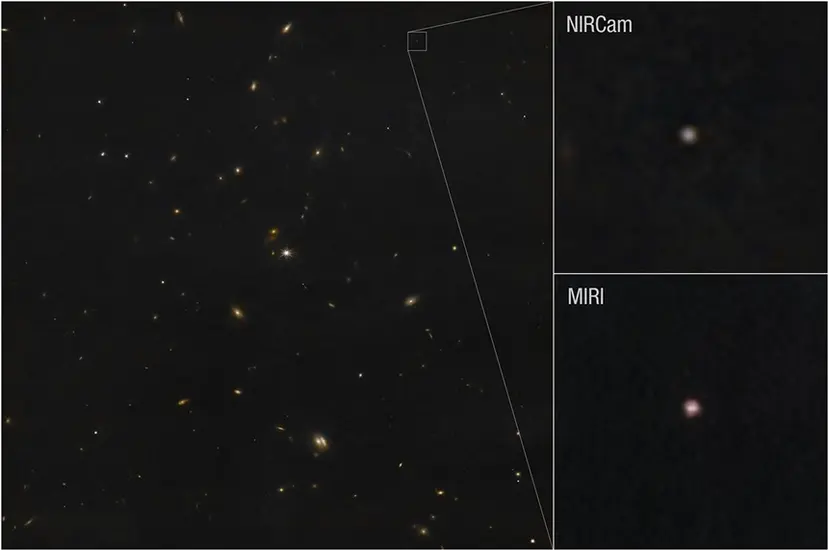
Observations by James Webb show that the infrared light reflected by this asteroid repeatedly brightens and dims in very short cycles. This appears to be because it is rotating very rapidly while having an elongated or distorted shape, much like the oblong 'Oumuamua. Astronomers estimate that 2024 YR4 may be 1.4 times longer than its width, or it could be a flat, disk-like shape three times wider than its vertical diameter. The asteroid appears to be rotating at a very high frequency of 19.5 minutes. Contrary to what astronomers often expect, it is estimated that non-round, flat, or elongated asteroids and small solar system bodies are much more common.
While the probability of collision with Earth is currently near zero, it seems the target 2024 YR4 was actually aiming for was the Moon, not Earth. Recent analysis shows a 3.8% chance that this asteroid will collide with the Moon. If the Moon and the asteroid were to collide in 2032, we could easily see the dazzling moment of impact from Earth. The moment of impact on the Moon would release 5 megatons of TNT-equivalent energy and could leave a giant crater on the lunar surface ranging from 500 meters to 2 km in diameter.
Even if a massive asteroid collides with the Moon, the flash at the moment of impact would surprisingly not be blindingly bright; it would appear as a small, brief flash of light and then vanish. However, after the explosion, the Sun's light could reflect off the gases from evaporated rocks, causing the Moon to appear brighter for an extended period. Astronomers estimate that this light might be visible during the day and could even appear brighter than a full moon for a while. While the asteroid may not actually collide with the Moon, there is a 96% probability that it will pass just 1,000 km above the lunar surface. According to analysis so far, there is nearly a 100% probability that this asteroid will pass very close to the Moon. If we are unlucky, it could leave a massive scar on the Moon in the process.
An interesting hypothesis regarding the origin of this asteroid has also emerged. Astronomers found an unexpected clue in a meteorite that fell to Earth in January 2015, long before 2024 YR4 was discovered. The trajectory of the meteorite that fell in 2015 is very similar to that of 2024 YR4. Furthermore, five other asteroids reported in the last eight years share a very similar trajectory with 2024 YR4.
This suggests that the asteroid and its fragments might not be random rocks flying independently, but rather share a common origin. Astronomers estimate that perhaps a fairly large asteroid wandering in the asteroid belt between Jupiter and Mars experienced a collision with another asteroid, and the resulting large and small fragments have only now reached our vicinity near Earth. A collision occurred somewhere in the asteroid belt, and its butterfly effect happens to be targeting our Earth and Moon.
According to this observation, 2024 YR4 appears to be experiencing the Yarkovsky effect, where its orbit changes slightly due to the radiant heat from the continuous solar radiation it receives. Its orbit has been gradually shrinking from its original path to its current one. As such, it is not just the Sun's gravity that determines an asteroid's orbit. A variety of factors—the other planets in the solar system passing by, radiant heat from sunlight, and potential collisions with other debris—all dictate the fate of an asteroid. Predicting the possibility of a collision between an asteroid and Earth is a very troublesome and cautious task that requires paying attention to almost everything happening in our local space.
2032—only seven years remain. Will 2024 YR4 really collide with Earth or the Moon then? To find the accurate answer, we must keep a constant eye on this asteroid. Unfortunately, however, it has momentarily hidden in the darkness. The last time James Webb targeted the asteroid was in May 2025. Until 2028, the asteroid is moving away from the Sun along its orbit toward its aphelion (the point farthest from the Sun). Therefore, it will be even more difficult to see with Earth's telescopes in the future. We must try to determine the most accurate orbit for this asteroid based on the limited data obtained up to this May. Coincidentally, if the asteroid that temporarily hid in the darkness is caught by a telescope again, it will be at a point when it is already on the verge of colliding with Earth or the Moon.
Some astronomers are dreaming of a "reversal," seeing the threat of asteroids as a new opportunity for space exploration. Asteroids are treasure troves that hold the secrets of the universe, especially the materials that existed when the solar system was first created 5 billion years ago. If an asteroid carrying such precious treasures approaches us of its own accord, we could potentially utilize it as an opportunity to secure samples at a relatively low cost. However, the time for this asteroid to approach Earth again is not far off—2032. Therefore, if we are to send a probe to 2024 YR4, we must hurry.
Astronomers are looking forward to a method that utilizes the next Artemis mission, scheduled to be launched toward the Moon in mid-2028. This would involve launching a small CubeSat-type probe destined for asteroid 2024 YR4 alongside the lunar lander on the rocket. This would allow an attempt to reach 2024 YR4 by 2028 by using the Moon’s gravity to adjust the trajectory once more. Close-range exploration would provide more precise data than the current James Webb observations, offering vital clues to determine 2024 YR4's exact mass, size, and orbit.
With NASA’s space exploration budget currently slashed in half, it seems very difficult to realize such new space exploration plans in the immediate future. It is regrettable, but we can only hope that the terrible fate experienced by dinosaurs 100 million years ago will not be repeated for humanity in the 21st century.
References
https://ui.adsabs.harvard.edu/abs/2025arXiv250219346H/abstract
https://aas.org/2025/04/01/an-update-on-asteroid-2024-yr4-from-jwst/
https://iopscience.iop.org/article/10.3847/2515-5172/adc6f0
https://blogs.nasa.gov/webb/2025/04/02/nasas-webb-finds-asteroid-2024-yr4-is-building-sized/
Who is the author, Woong-bae Ji? He loves cats and the universe. After watching 'Galaxy Express 999' as a child, he dreamed of sharing the beauty of the universe. He is currently researching galaxy evolution through interactions at the Yonsei University Galaxy Evolution Research Center and the Near-Field Cosmology Lab, and is engaged in various science communication activities, including lectures and writing. He is the author of books such as 'The Observatory of Flirting', 'Thinking About the Universe All Day', and 'Stars, the Science of Light'.