

[비즈한국] Three months have passed since the impeachment motion against former President Yoon Suk-yeol was cited. It has also been a month since the launch of the Lee Jae-myung administration. BizHankook investigated the current state of the commercial district near the Constitutional Court, which had suffered from the impeachment trial and the resulting pro- and anti-impeachment protests.
The area around Anguk Station was bustling with people, even on a weekday. Upon getting off at Anguk Station on Subway Line 3, it seemed there were more foreigners than Koreans moving through the station. True to its reputation as one of Seoul’s iconic traditional tourist destinations, foreigners were seen constantly fanning themselves despite the sweltering heat while enjoying hanbok experiences.
Foreign tourists who arrived at Anguk Station were filling up the cafes and restaurants in the alleys. The demographic was diverse, ranging from young people to middle-aged and elderly visitors. As expected of a major traditional tourist spot in Seoul, it was easy to encounter foreigners of various nationalities, including Chinese and Japanese, as well as those from Europe and Southeast Asia.
The road stretching from Anguk Station to the Constitutional Court and Jeongdok Library is a neighborhood well-known as the Bukchon Hanok Village. The commercial district, centered around the Constitutional Court and Jaedong Elementary School, features art galleries, cafes, restaurants, and traditional hanok houses, extending all the way to Samcheong-dong and the Board of Audit and Inspection. This area was designated as a so-called “vacuum zone” during the impeachment ruling last April.
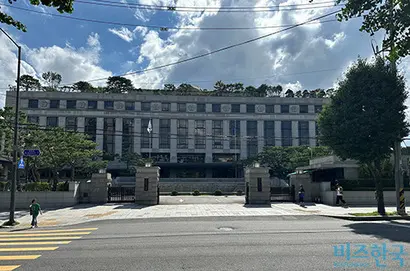
The area in front of the Constitutional Court was quiet. During the impeachment trial period, it was easy to spot one-person protesters or picket signs with aggressive slogans. Now, as if nothing had ever happened, neither protesters nor picket signs could be seen. The police officers who had completely blocked both sides of the road were also not visible. Only one security guard was standing there. The main gate of the Constitutional Court was wide open, allowing anyone to enter or exit easily.
Tourists, Who Had Decreased During the Impeachment Trial, Return to Anguk Station
“Foreign tourists were very scared. They kept asking what on earth was going on…” said a representative from a nearby Bukchon tourist information center, referred to as A. They explained that international tourists were very worried because the area around the Constitutional Court was heavily packed with police.
They added, “Political views aside, now that the impeachment turmoil is over and political stability has been restored, the number of tourists has increased again. That goes for foreign tourists as well. That is a relief.”
Just as they said, the commercial district near Anguk Station seemed to have returned to its pre-impeachment state. It was said that the district, which slowly regained vitality from the weekend after the impeachment trial ended, has found peace. It seemed to be influenced by the improvement in consumer sentiment following the launch of the new government. It was filling up not only on the road in front of the Constitutional Court near Anguk Station but also in the side alleys.
Especially during lunchtime, it was difficult to find a spot as crowds from the Hyundai Gye-dong headquarters located to the east of the district poured out to have lunch. Externally, the area looked significantly more active.
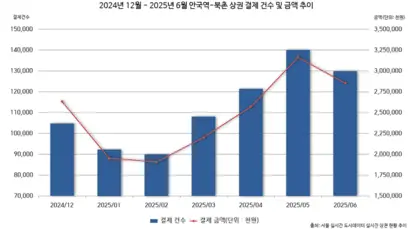
The revitalization of consumption is also reflected in statistics. In the Bukchon area, which includes the Constitutional Court commercial district, the number of transactions and payment amounts plummeted to under 100,000 transactions and in the 2 billion KRW range during the martial law and impeachment period. However, after the conclusion of the impeachment trial, they surged in April and May, with the number of transactions exceeding 120,000 and the amount surpassing 2.5 billion KRW.
Cannot Just Smile: Overtourism and Polarization
Despite being a weekday afternoon, long lines had formed at popular bakeries and cafes near Anguk Station. These were shops that had become famous nationwide through Instagram and other social media. It was said that one has to wait for several tens of minutes just to get into the packed shops. Specific stores that gained fame through SNS or YouTube showed similar phenomena.
However, local residents are not entirely happy about the influx of visitors. This is due to overtourism. While the areas around Anguk Station, Bukchon, and Samcheong-dong have always been famous, they have become noisier and more crowded recently with the return of foreign tourists.
“People only look for the famous bakeries and cafes…” said B, the owner of a small neighborhood shop, trailing off. They noted, “People line up for ages at the famous shops that have gone viral, but that’s not the case for every store, is it?” B pointed out a “polarization phenomenon” where some shops that attract tourists do well, while others continue to struggle.
B shared, “Because there are so many tourists, prices have soared. Doesn’t it cost over 10,000 KRW just to buy a few pieces of bread?” adding, “A Korean meal with a main dish and side dishes costs about the same. Even a cup of coffee costs well over 6,000 KRW. Customers might feel it, but shop owners are also struggling with the rising prices.” They explained that as prices rise, rent rises, which in turn drives prices up further.
They added, “Actually, the tourists disappear after 8 PM, and it gets dark here quickly,” saying that having many tourists does not necessarily help the commercial district. B noted that Anguk Station and Bukchon do not see much business in the evenings and late at night.
'Red Zone' Set in the Hanok Village from Anguk Station to Bukchon… Evening Business is Grim
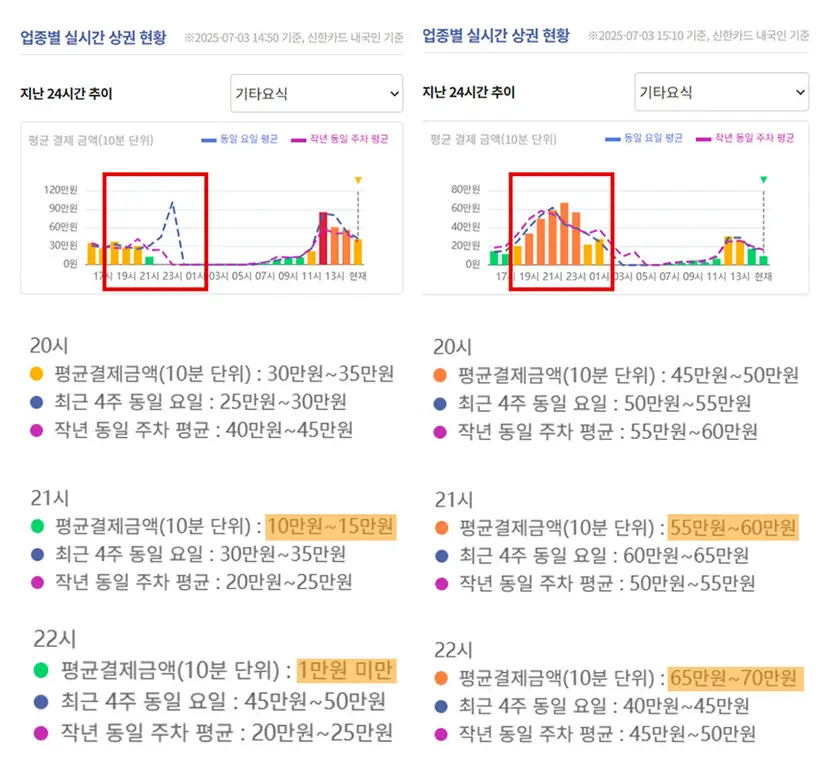
In fact, many restaurants and cafes indicated that they take last orders at 8:30 PM and close around 9 PM. This can be confirmed by looking at Seoul’s commercial district analysis data; while the Ikseon-dong area, which extends south from Anguk Station, sees more people from 8 PM to 9 PM, the opposite is true for Anguk Station, where there are almost no people after 8 PM or 9 PM. The difference in store payment amounts varies from 5 times to as much as 50–60 times.
This is due to the "Red Zone" policy implemented by Jongno-gu in the Bukchon area. Since March 2024, Jongno-gu has enforced "Red Zone" measures that restrict tourist access after 5 PM in the Bukchon area. They only permit tourists to visit between 10 AM and 5 PM.
Despite this, B complained that tourists still frequently leave trash behind or peer into private homes, causing constant privacy intrusions. “Because they block access after 5 PM, people now come from the morning, creating more noise,” they sighed. “They restricted evening access because there were too many tourists, but that, in turn, causes losses for those of us trying to run a business.”