

[비즈한국] As the government pushes for the legalization of digital assets and a stablecoin craze gains momentum, attention is once again turning toward security tokens. While security tokens were once hailed as a new growth engine, interest had waned as their integration into the regulated financial system was delayed. In 2023, the banking sector began preparing for the issuance and distribution of security tokens in partnership with brokerage firms and IT companies, and with the new administration prioritizing security token legalization this year, the status of these preparations is drawing significant interest.
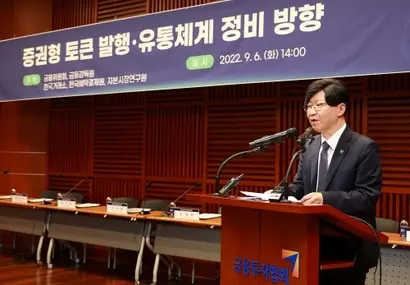
With growing interest in Korean won-based stablecoins, it remains to be seen whether the institutionalization of security tokens will also be reignited. As brokerage firms, fintech companies, and banks have recently rushed into the stablecoin space, security tokens—a similar type of digital asset based on distributed ledger technology (which records transaction information or data without a central administrator, such as blockchain)—are being discussed in tandem.
Security tokens refer to the digitalization of securities under the Capital Markets Act using distributed ledger technology. Existing assets such as stocks, bonds, and real estate can be issued and traded in the form of digital tokens. A Security Token Offering (STO) refers to the issuance and distribution of these tokens in the private sector; however, STOs are not currently permitted under the Electronic Securities Act. In February 2023, financial authorities announced the "Plan to Establish a Regulatory Framework for the Issuance and Distribution of Security Tokens" to allow STOs by amending the Capital Markets Act and the Electronic Securities Act, but the legislation failed to pass during the 21st National Assembly and has now been carried over to the 22nd.
Following the authorities' announcement of the regulatory framework, the financial sector engaged in various consortiums to prepare for STOs. Brokerage firms, which would act as the issuers of security tokens, formed consortiums with banks and IT companies. Major commercial banks also entered into partnerships to prepare for the market.
In June 2023, Hana Bank participated in the "Next Finance Initiative (NFI)" at the group level alongside Mirae Asset Securities006800 and SK Telecom017670. Hana Bank joined NFI with a focus on commercializing blockchain-based services, while Hana Securities focused on cooperation in the security token business. It has been confirmed that NFI has currently established a computer system for the issuance and distribution of security tokens.
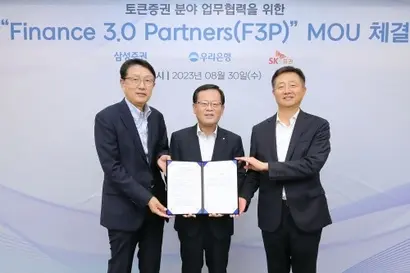
Woori Bank formed a consultative body called "Finance 3.0 Partners (F3P)" in August 2023, joining forces with Samsung Securities017670 and SK Securities001510. Launched with the goal of responding to the institutionalization of security tokens and achieving rapid market entry, F3P aims to jointly build a standard STO platform. Kyobo Securities joined in May 2024 to provide further support. While the STO platform has not yet been completed, the firms are monitoring the situation as they wait for the authorities to issue formal STO guidelines.
NH Nonghyup Bank took the lead in April 2023 by forming the "Banking Sector STO Consortium," which includes various banks such as KB Kookmin, IBK Industrial Bank of Korea, Shinhan, Woori, and Jeonbuk Bank. NH Nonghyup Bank was selected as a target for the 2024 private-sector blockchain concentration and diffusion project, and had already completed infrastructure construction, such as an issuance platform, by the end of last year.
The financial sector's persistent interest in STOs is due to the fact that security tokens are closely linked to the fractional investment industry. Fractional investment, which involves dividing ownership or stakes in high-value assets for investment purposes, is classified as a new type of security, such as investment contract securities or beneficiary certificates. In this process, the divided rights can be issued as security tokens.
Shinhan Bank is focusing on fractional investment services and signed a memorandum of understanding (MOU) in June 2024 with Sejong Telecom036630 and Shinhan Securities to promote a joint security token business. The goal is to collaborate with Shinhan Securities on the issuance and distribution of security tokens, and with Sejong Telecom to provide related services, such as linking deposit and withdrawal accounts for real estate fractional investment services.
However, fractional investments are also currently being operated as "innovative financial services" rather than being fully integrated into the regulated system. Despite this, there is growing concern as the government began imposing taxes on dividend income generated from fractional investment products—such as investment contract securities and trust beneficiary certificates—starting July 1.
The Ministry of Economy and Finance explained, "Considering the nature of fractional investment products, where a third party performs asset investment, operation, and management on behalf of multiple investors, we will tax the gains as dividend income, consistent with the current taxation on funds." Consequently, a 15.4% dividend income tax is being applied to earnings received from the 1st.
Ultimately, while legalization remains the key for both security tokens and fractional investments, it remains to be seen whether the current administration will implement it. In his congratulatory speech at the "Digital Financial Ecosystem and Security Token Convergence" seminar held at the Korea Exchange in February, when he was the party leader, President Lee Jae-myung stated, "The revitalization of digital finance centered on security tokens will be a turning point that drives high-value financial industries and innovative economic growth in the long term." He also included the legalization of security tokens in his presidential campaign pledges.
On June 25, the Korea Securities Depository (KSD) also opened a security token testbed platform in preparation for STO legalization. As an electronic registration institution, the KSD manages the total volume of issuance and distribution, and this testbed platform consists of an integrated management system for this purpose. The KSD plans to prepare for operations in line with the passage and implementation of the bill.
However, some point out that this round of discussions regarding legalization must not end as a mere flash in the pan. A banking industry official noted, "If STOs are permitted, there are many linked businesses that financial companies can pursue, such as using loan receivables as fractional investment products," adding, "Companies want to actively invest in and develop businesses only when a system is in place. Because of the high uncertainty, it is difficult to attempt it. We will have to wait and see if this ends up being just a trend."