

[비즈한국] Fintech company TravelWallet has received a suspended sentence of a 2 million KRW fine after being charged with failing to report the receipt of foreign currency from its US subsidiary to the head of a foreign exchange bank. A suspended sentence is a measure where, despite a guilty verdict, the court deems the offense relatively minor and waives the punishment if the defendant remains free of specific incidents for a two-year probation period. The court took into account that the omission was caused by insufficient guidance from the bank involved in the transaction. TravelWallet stated, “We reviewed the procedures by repeatedly consulting with the bank before the transaction and had no intention to evade the law.”

TravelWallet, specialized in foreign exchange, found in violation of ‘Foreign Exchange Transactions Act’
The Seoul Central District Court (Presiding Judge Lee Jong-woo) ruled on the 25th of last month to suspend the 2 million KRW fines imposed on both TravelWallet and its CEO Kim Hyung-woo, who were charged with violating the Foreign Exchange Transactions Act.
In December 2023, TravelWallet was brought to trial for failing to report a transaction to the designated foreign exchange bank head as required by law when it received 2.11846 million USD (approximately 2.8 billion KRW) from its US-based subsidiary into a TravelWallet-owned account at JPMorgan Chase. According to the Foreign Exchange Transactions Act and related regulations, residents must report foreign currency deposit transactions with non-residents abroad to the head of their designated foreign exchange bank.
This case began when the Financial Supervisory Service identified the violation, imposed a fine, and referred it to the police, leading to criminal proceedings. While the prosecution initially sought a summary order, the company requested a formal trial. The company's position was that it was unfair to be fined for an unintentional matter caused by a lack of guidance from its bank.
The court accepted the company's arguments but still rendered a guilty verdict. Factors such as administrative error and the fact that it was a first offense were considered in sentencing. The court stated, “The sentence is determined as ordered by comprehensively considering all sentencing factors, including the circumstances leading to the crime, the content and scale of the offense, and the situation after the crime.”
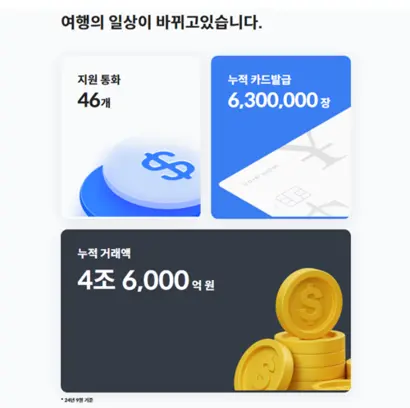
TravelWallet is a fintech company specializing in foreign currency payments, primarily focused on overseas payment and remittance services. Its flagship offerings include 'TravelPay,' a mobile app-based prepaid foreign currency card for travelers, and international remittance services.
TravelPay, which promotes itself as being more advantageous than bank currency exchange or credit cards, features zero transaction fees for all currencies. By connecting directly with international card brands like Visa and operating its own foreign currency management system, it has increased efficiency by reducing unnecessary intermediary costs. The remittance service is provided without fees in 22 countries, including the US, UK, Singapore, Australia, Thailand, and Vietnam. Garnering attention for easy overseas payments and ATM withdrawals, the company has seen steady growth, with revenue recorded at 59.2 billion KRW in 2024, 22.7 billion KRW in 2023, and 2.6 billion KRW in 2022.
TravelWallet: “Taking measures to strengthen internal control capabilities”
The failure to report was confirmed to have occurred during the transition of TravelWallet’s payment system, where the implementation of procedures was omitted. Under the circumstances at the time, it appears the company received the 2.8 billion KRW in foreign currency without filing a deposit transaction report due to insufficient notification from its domestic designated foreign exchange bank.
Under the Foreign Exchange Transactions Act and related regulations, when foreign currency payments and credit/debt relationships exist between a resident and a non-resident, and the transaction involves offsetting (settling debts/credits against each other) rather than a simple remittance, both an offsetting report and a remittance report are required.
Cho Jung-hee, managing attorney at Law Firm Decode, said, “Reporting related to foreign exchange is complex in practice because it must be filed with different agencies, such as the Ministry of Economy and Finance, the Bank of Korea, or the trading bank, depending on the purpose and importance of the transaction. This is why separate legal advice is often utilized.” He added, “In particular, companies like TravelWallet that provide overseas remittance services are inevitably exposed to foreign exchange law issues due to their business structure, posing a higher legal risk compared to other industries.”
TravelWallet stated, “As a startup focusing on foreign currency remittance and payment services, we have strived to comply with foreign exchange laws and regulations, and there is no reason for us to intentionally avoid reporting.” The company added, “We became aware of this last year, voluntarily paid the fine, and have since changed our domestic designated foreign exchange bank.”
TravelWallet has begun efforts to strengthen its internal controls. To preemptively block future risks, the company stated it has meticulously reviewed potential legal violations through measures such as strengthening employee training on overall foreign exchange operations, establishing a compliance (legal monitoring) department, and hiring professional legal monitoring staff.
Kang Hyung-gu, Vice President of the Korea Finance Consumer Federation, pointed out, “While punishment is not a cure-all, given the nature of fintech services involving foreign exchange, both the banks and the service providers need to improve their understanding of procedures and implementation systems. Rational and systematic management measures are necessary to prevent the recurrence of similar cases.”