

[비즈한국] The Canadian coffee brand Tim Hortons appears to be restructuring its expansion strategy. While accelerating the growth of its stores by making Gangnam a strategic base, the company is also picking up speed with its franchising business. Although Tim Hortons garnered high expectations when it announced its entry into Korea two years ago, it has failed to establish a clear presence in the market. As evaluations of growing anxiety continue to emerge, the industry's attention is focused on whether Tim Hortons can reverse the stagnant atmosphere.
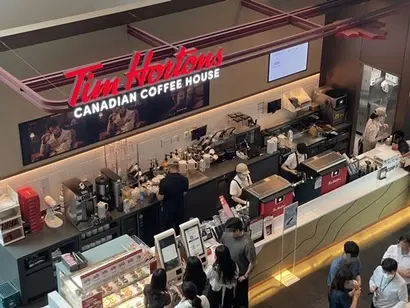
Tim Hortons: “No additional store closures, Gangnam is our strategic base”
Entering its second year in Korea, the Canadian coffee brand Tim Hortons is accelerating its store openings. Last month, the brand opened three new locations: the Gangnam Station Daeryung Tower branch, the Centerfield Intersection branch, and the POSCO Intersection branch. What stands out is that all these new stores are concentrated in Gangnam. It reflects a clear intent to target business districts with high foot traffic and strong demand from office workers. Tim Hortons currently operates 22 stores, 7 of which are concentrated in Gangnam.
At the time of its entry into the Korean market, Tim Hortons focused its initial expansion on the Gangnam area. Its first branch opened near Sinnonhyeon Station, and the second near Seolleung Station. Recently, Tim Hortons has been turning its eyes back to Gangnam. A Tim Hortons representative said, “The Gangnam area is a major commercial district with high foot traffic and where consumer trends are formed quickly,” adding, “It is one of the key strategic hubs where we can expand our brand experience.”
Tim Hortons decided to expand in Gangnam after receiving a positive response at the Sinnonhyeon branch, which was its first store in Korea. The aforementioned representative stated, “Based on the positive consumer response to the Sinnonhyeon branch, we confirmed the growth potential of the Gangnam area,” and added, “As various business conditions aligned quickly, we were able to open a series of new stores in the Gangnam area recently.”
Some in the industry analyze that Tim Hortons is benchmarking the expansion strategy of Starbucks. Lee Jong-woo, a professor of business administration at Ajou University, explained, “Existing franchises used to analyze commercial districts and place one flagship store in each area. However, unlike other franchises, Starbucks employed a strategy of concentrating multiple stores in large commercial districts.” He added, “That plan was successful, and Tim Hortons is expanding in a similar fashion. It appears they are trying to capture the premium market by focusing on the Gangnam area, which has high purchasing power.”
Interpretations have also emerged that Tim Hortons has begun restructuring its domestic stores following the recent closure of the Incheon Cheongna International City branch. While there have been reports that the company is preparing for additional closures of less profitable stores, Tim Hortons maintains, “There are no concrete plans for further store closures.”
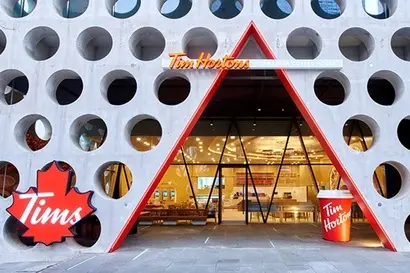
With budget coffee being the trend, is Tim Hortons’ franchise expansion possible?
Tim Hortons is embarking on a full-scale growth phase by launching its franchise business. After entering the Korean market, the company operated only directly managed stores, but it began preparations for franchising last April. Currently, it is recruiting franchisees through its website and other channels.
A Tim Hortons representative stated, “The plan announced at the time of our entry to expand to over 150 stores by 2028 remains valid,” and added, “To expand our domestic business, we are actively increasing directly managed stores in strategic hubs, and we expect the opening pace to accelerate through the franchising business that was formalized in the first half of this year.”
However, there are also predictions that Tim Hortons’ franchise business will not be easy, as the domestic coffee market is nearing saturation. Professor Lee Jong-woo assessed, “Although Tim Hortons is marketing as a premium brand, it is attracting consumers with prices lower than Starbucks. While this operational method might be effective in Gangnam or office-dense areas, it is uncertain whether it will work in regional markets where budget coffee is strong.”
In particular, the fact that Tim Hortons intends to expand franchises centered around large-format stores is also a cause for concern. Industry experts analyze that demand for consuming coffee for the purpose of using the store premises accounts for only about 20%. The remaining 80% are consumers who drink coffee as a beverage via takeout, leading to a trend of increasing small shops such as takeout-specialized stores. On the other hand, since Tim Hortons is pushing to expand franchises primarily with large stores of over 165㎡ (about 50 pyeong), some point out that there could be limitations in terms of profitability.

When it became known in 2023 that Tim Hortons, considered Canada’s national coffee, would land in Korea, consumer interest was quite high. However, Tim Hortons faced public backlash for raising prices upon entering the domestic market. While Tim Hortons is known for “value-for-money coffee” in Canada and gained popularity for it, it set prices in Korea 1.5 to 2 times higher than local prices and promoted a premium marketing strategy. An Americano, which sells for around 2,700 won in Canada, was priced at 4,000 won in the Korean market.
Regarding why domestic prices were set higher than local ones, a Tim Hortons representative explained, “This is because we implemented a localization strategy through space planning tailored to the domestic coffee market and consumer needs.” They added, “Instead of the QSR (Quick Service Restaurant) model generally applied in North America, we introduced a cozy café concept. Consequently, we invested heavily in our stores and infrastructure.”
The domestic coffee market is recently being reshaped around budget coffee. As the economic downturn prolongs, the number of consumers looking for budget coffee brands that prioritize cost-effectiveness is increasing. The growth of budget coffee brands is also steep. As of the end of last year, the number of Mega MGC Coffee stores was 3,420, and Compose Coffee had 2,772. The industry expects that Mega MGC Coffee likely rose to the number one spot in terms of store count in the domestic coffee industry last year.
Facing the onslaught of budget coffee, Tim Hortons appears to be looking for new survival strategies. Since April, it has been putting effort into marketing by appointing Canadian-born NCT member Mark as its first brand model since entering the Korean market. Last month, it also held an event offering a 60% discount on popular summer menu items.
An industry official mentioned, “Just a few years ago, the Korean market was considered a high-growth market for global brands. However, as the consumption slump continues, they are struggling,” adding, “Brands that fail to increase their market share this year are expected to go through a restructuring process soon. It is a time of heightened tension in the industry.”