

[비즈한국] Do you know the Milkomeda Galaxy? It is a portmanteau of the Milky Way, our own galaxy, and its neighbor, Andromeda. For a long time, astronomers believed that our galaxy and the Andromeda galaxy would eventually merge in the distant future. Although the two galaxies are currently separated by 2.5 million light-years, each possessing its own beautiful spiral arms, stars, and gas-filled disks, it was predicted that they would collide, causing their stars' orbits to become chaotic and eventually forming a massive, diffuse, and spherical elliptical galaxy. This collision process was expected to be completed within 5 to 7 billion years. The massive future galaxy formed this way was named the Milkomeda Galaxy.
For a long time, the fate of the Milkomeda Galaxy was considered as inevitable as the destiny of the universe itself—much like the fate of our Sun, which is destined to swell into a red giant and eventually become a planetary nebula in 5 billion years. However, an increasing number of astronomers are recently questioning this fate. A paper recently published in ‘Nature Astronomy’ presented an intriguing possibility that our galaxy and the Andromeda galaxy might face an entirely different future. To be more precise, it suggests that it is impossible to predict whether the two galaxies will collide at all. Was the Milkomeda Galaxy merely a figment of humanity's imagination, misunderstanding the fate of the universe? Can our galaxy ultimately avoid a perilous collision with Andromeda and maintain its current beautiful spiral arms?
Predictions that the Andromeda galaxy would collide with our galaxy began to emerge in earnest after 2012. Astronomers compared how rapidly the positions of stars within the Andromeda galaxy changed in Earth's night sky; interestingly, the Andromeda galaxy showed almost no movement in the sky. It showed no significant positional change even within a millisecond over the course of a year. This meant that from Earth's perspective, the Andromeda galaxy has virtually no velocity perpendicular to our line of sight.
On the other hand, Andromeda displays a very distinct Doppler effect. Specifically, it shows a "blueshift," where light is clearly shifted toward the shorter, blue end of the spectrum. In the Doppler effect, a blueshift indicates that the light source is rapidly approaching us. In other words, the entire Andromeda galaxy is barreling toward us at high speed. According to the observed blueshift, Andromeda appears to be rushing toward us at an incredible speed of approximately 110 km per second.
With almost no tangential velocity and a very high velocity strictly along our line of sight, the Andromeda galaxy is heading straight for us. Given the distance to and velocity of the Andromeda galaxy, astronomers at the time predicted that our galaxy and Andromeda would collide head-on in about 5 billion years. The violent collision and merging process of the two galaxies have been well-represented through existing simulations. For over a decade, this possibility was considered an obvious hypothesis, viewed as a destined cosmic event that would inevitably occur in the distant future.
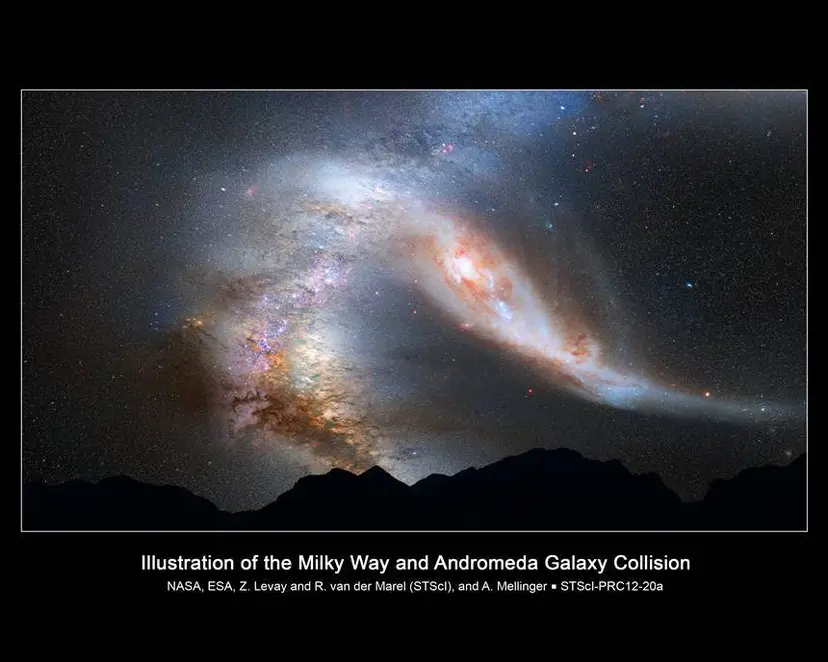
Currently, our galaxy and the Andromeda galaxy occupy the positions of the first and second most massive galaxies in the Local Group. Astronomers previously thought that after the initial collision in about 5 billion years, smaller satellite galaxies and other neighboring galaxies wandering nearby would also be drawn into and merged into the Milkomeda Galaxy. They predicted that after another 150 billion years, all galaxies currently forming the Local Group would have merged into a single, massive, diffuse, giant elliptical galaxy.
However, an increasing number of astronomers are recently proposing entirely different predictions regarding the fate of the Milky Way and Andromeda. There is a core criticism common to these analyses: the existing predictions oversimplified the situation. Our galaxy is orbited by quite sizable dwarf galaxies that cannot be ignored, such as the Small and Large Magellanic Clouds. One can observe long streams of stars and gas left behind by these two galaxies as they have been captured by our galaxy's gravity and orbited it for a long time. Similarly, the Sagittarius Dwarf Galaxy has also left traces along its trajectory.
Various dwarf galaxies are also found near the Andromeda galaxy, including the M33 galaxy, also known as the Triangulum Galaxy. Dwarf galaxies have less than 1/100th the mass of large galaxies. At first glance, one might think their gravitational effects can be easily ignored, but that is never the case. While low in mass, these dwarf galaxies are positioned very close to the central galaxy. Because the distance is small, their resulting gravitational effect on the central galaxy is quite strong. Particularly when predicting a fate spanning billions of years, these effects can significantly impact the final outcome.
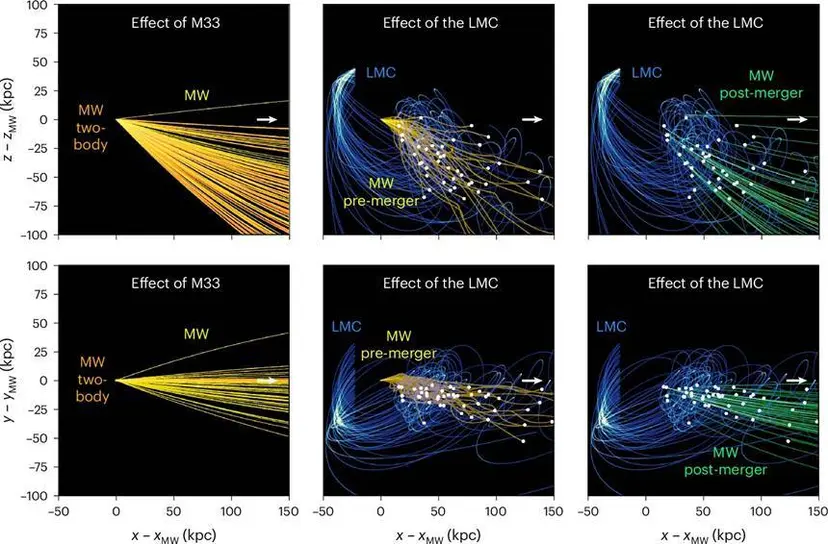
In this analysis, astronomers incorporated precise movement data of surrounding dwarf galaxies obtained most recently by the Hubble and Gaia space telescopes. Based on this, they simulated the fate of the Local Group over the next 10 billion years, accounting for the effects of our galaxy, the Andromeda galaxy, and major dwarf galaxies like the Magellanic Clouds and M33. To make the simulation as realistic as possible, they considered a total of 22 variables that could influence the result, including galactic mass, orbital velocity, and direction. This resulted in the most precise simulation ever conducted for our galaxy and the surrounding Local Group.
So, did the simulation result point to the birth of the Milkomeda Galaxy? Not at all. With so many variables to consider, the uncertainty of the results increased significantly. This paper obtained a total of 100,000 different results through Monte Carlo simulations, which randomly set various variables. A direct collision was defined as occurring when the distance between the two galaxies dropped below 500,000 light-years. The simulation showed that there was only a 2% chance that our galaxy and Andromeda would follow the familiar fate of being mashed into the Milkomeda Galaxy within 5 billion years! In the remaining 98% of cases, the two galaxies avoided a direct collision or passed by each other at a distance without significant interaction. Even if the two galaxies were to merge into one massive galaxy, it would occur in a much more distant future, well beyond the 5 billion-year mark.
Among the unexpected 98% of results where the Milkomeda Galaxy was not expected to form within 5 billion years, 50% showed that the two galaxies would simply pass by each other in the distance, allowing them to maintain their current disk shapes without significant disruption. The other 48% indicated that while there would be no direct, violent collision within 5 billion years, the distance between them would slowly decrease and their orbits would shrink, potentially leading to a merger into a single galaxy within 20 to 30 billion years. However, for this to happen, a form of dynamical friction—where the dark matter halos of the two galaxies overlap, causing their orbital energy to decrease and their orbits to gradually shrink—would need to occur.
Ultimately, this new analysis shows that, contrary to previous predictions, the fate known as the "Milkomeda Galaxy" may not be inevitable. It might even be a prediction that is detached from reality and will never happen in our universe. A universe merged into Milkomeda was perhaps just a fictional future that existed in the imagination of humanity ten years ago, back when we did not yet fully understand the universe; the actual universe may be heading toward a completely different destiny.
As the title of this paper suggests, the fate of the universe is full of uncertainty. To look into the future of the universe, we must not focus only on the bright, massive objects that are easily visible on the surface. To understand the universe's fate, we must pay attention to even the smaller, darker, and less noticeable entities. Just as we must pay attention to the small, faint dwarf galaxies drifting through the void of the Local Group between our galaxy and Andromeda. The universe is constantly showing us just how delicate a subject it is to handle.
References
https://science.nasa.gov/missions/hubble/apocalypse-when-hubble-casts-doubt-on-certainty-of-galactic-collision/
https://www.nature.com/articles/s41550-025-02563-1
Who is the author, Ji Ung-bae? He loves cats and the universe. After watching 'Galaxy Express 999' as a child, he dreamed of spreading the beauty of the universe. He currently researches the evolution of galaxies through interactions at the Yonsei University Galaxy Evolution Center and the Near-Field Cosmology Laboratory, while engaging in various science communication activities such as lectures and writing. He has authored books including 'Astronomy on a Date', 'Thinking About the Universe All Day', and 'Stars, the Science of Light'.