

[비즈한국] The labor market is facing its worst conditions this year, with the number of new hires falling below the 900,000 mark for the first time in five years. This collapse in the labor market is largely due to the downturn in the real estate sector, which has caused a sharp decline in construction hiring, as well as sluggish domestic demand, which has reduced hiring in the hospitality and food service sectors.
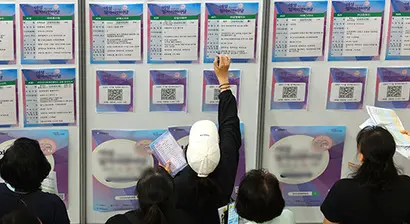
In particular, because most of the job losses in the construction and hospitality/food service industries involved temporary or day laborers, the deterioration of the labor market due to weak domestic demand is having a disproportionately severe impact on vulnerable populations. The recovery of the labor market appears to depend on whether the supplementary budget (extra budget), which President Lee Jae-myung identified as necessary to revitalize the domestic market during his first parliamentary policy speech on the 26th, proves as effective as the government anticipates.
In his parliamentary speech regarding the supplementary budget, President Lee Jae-myung stated, "Our economy, which weathered the COVID-19 pandemic, has fallen into a severe crisis over the past three years," and pointed out, "In particular, the illegal emergency martial law on December 3rd dealt a fatal blow to an already stagnant domestic economy." He continued, "There is an old saying that 'timing is everything in economics.' I ask for the National Assembly's active cooperation so that we do not miss the golden time for economic recovery," emphasizing, "It is crucial to revitalize our economy, especially the domestic market, through swift budget preparation and rapid execution."
President Lee explained that the supplementary budget includes 11.3 trillion won in consumption stimulus measures to address the severe domestic slump, 3.9 trillion won in investment promotion funds to boost the economy, and 5 trillion won for public livelihood stability to support small business owners and vulnerable groups. The President's focus on stimulating consumption and boosting social overhead capital (SOC) and the real estate market is due to the dire situation facing the construction, hospitality, and food service sectors.
According to the Ministry of Employment and Labor's "Labor Force Survey by Establishment," the number of new hires as of April this year was 890,000, down 21,000 from a year earlier. This marks the first time since 2020 that the number of new hires in April has fallen below 900,000. The sharp drop is largely attributed to the downturn in the real estate sector, which led to a decrease in building permits and construction starts, alongside an accumulation of unsold housing units, causing hiring in the construction sector to plummet. According to Ministry of Land, Infrastructure and Transport housing statistics, national housing permits in April this year reached 24,026 units, down 14% from a year ago, while construction starts fell by 43% to 25,044 units over the same period. "Chronic" unsold housing inventory rose to 26,422 units nationwide this year, a 23% increase from the end of last year.
Reflecting this cooling of the construction industry, construction hiring in April this year was 251,000, a drop of 24,000 compared to a year ago. The vast majority of these lost construction jobs were temporary or day-labor positions. While the number of permanent hires in the construction industry fell by only 1,000 to 19,000, the number of temporary and day-labor hires dropped by a staggering 23,000 to 232,000.
This sharp decline in temporary and day-labor hiring highlights the severity of the "job cliff" in the construction sector. As the industry's prospects remain grim throughout the year, this weakness in construction hiring is expected to continue. The Bank of Korea has projected this year's construction investment growth rate at -6.1%, the lowest level since the 1998 Asian financial crisis (-13.2%).
Weak hiring is also appearing in the hospitality and food service sectors, which are feeling the full force of stagnant domestic demand. In April, hiring in these industries totaled 121,000, a decrease of 10,000 from the previous year. The damage to temporary and day-labor jobs was even more pronounced here than in construction. While the number of permanent hires in hospitality and food service increased by 6,000 to 37,000, the number of temporary and day-labor hires fell by 16,000 to 83,000.
As consumers, already tightening their belts due to high interest rates and inflation, closed them even further following last year's emergency martial law declaration, the subsequent impeachment crisis, and the fallout from U.S. tariffs, temporary and day-laborers were the first to face mass layoffs. According to Statistics Korea, the production index (constant price) for the hospitality and food service sector in April was 114.7 (2020=100), a 2.5% decrease from a year ago, trapped in a slump that has prevented growth for two consecutive years.