

[비즈한국] “I’ve been in this business for 40 years, and right now is the worst it’s ever been.”
On the 26th, in Euljiro 4-ga, Jung-gu, Seoul, a representative of an interior design firm surnamed Kim let out a sigh. “We only get about 1 or 2 customers a day,” he said. “Perhaps because there isn’t much building going on these days, our revenue has been cut in half over the past year.”
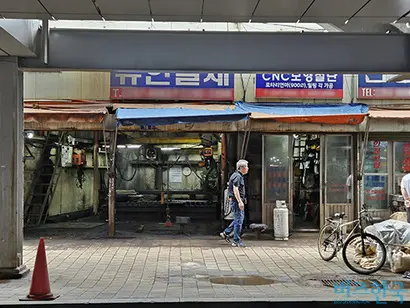
As the construction industry stagnates, the vitality has vanished from the Euljiro building materials street, where construction supply and interior design shops are concentrated. The area spanning from Euljiro 3-ga to 5-ga flourished after the Korean War as tool shops gathered to collect military supplies flowing out of U.S. military bases. It handles a wide range of construction supplies, including hardware, timber, and furniture.
At one time, the Euljiro building materials street was considered Seoul’s premier tool district, with sayings like “If you have a blueprint, you can even build a tank” and “A walk around the alley is all you need to furnish a home.” Even now, Euljiro is crowded with people, but they are mostly office workers and restaurant patrons. The foot traffic that once headed toward construction and interior shops has thinned out.
I visited the Euljiro building materials street on a weekday afternoon. Through the glass, a shop owner was seen napping in an office chair. Another owner was engrossed in a newspaper, wearing magnifying glasses. From a store with its door open, the sound of a radio leaked out. Shops with customers or those receiving order calls were a rare sight.
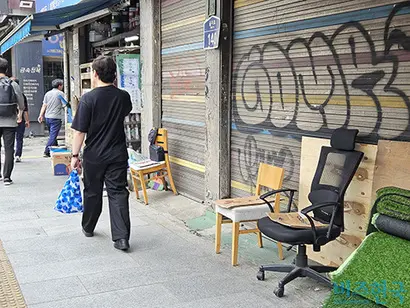
Chairs lined up in front of a lighting store caught my eye. When I asked the owner about their purpose, he replied, “I put them out to get some fresh air. I often sit around chatting with the owners of the neighboring shops.” In about one out of every three shops, the owner was sitting outside on a chair. Instead of customers, the street was only filled with office workers wearing their employee ID cards around their necks.
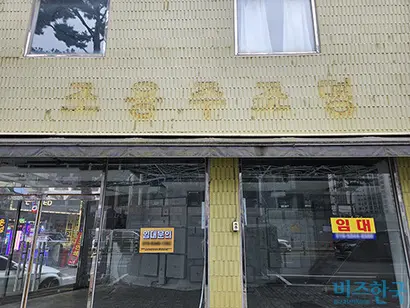
A merchant surnamed Han, who sells tiles and ceramics, said, “Many people have closed their businesses because they were only paying rent without making any real revenue.” Indeed, empty shops could be seen throughout the street. Notices reading “Lease Inquiries” were posted on the storefronts. Some places had their shutters pulled down and were no longer in business. A family visiting the Euljiro street to pick out wallpaper remarked, “We came because we heard there were many interior design firms, but we were surprised by how dreary it looked.”
The construction industry has entered a period of stagnation. According to the construction trend survey for April released by Statistics Korea in June, the value of construction orders decreased by 17.5% compared to the same month last year. The value of large-scale construction contracts also fell by 14.5% compared to the same period last year. According to the Construction Association of Korea, the number of bankruptcies among general construction companies rose sharply from 7 in 2023 to 12 in 2024, in just one year.
The hardware and furniture industries, which are downstream sectors of construction, have been hit just as hard. According to the National Tax Service, as of 2023, the average annual revenue of hardware stores nationwide was 188 million won, a 2.66% decrease from the previous year. Statistics Korea reports that furniture sales dropped from 3 trillion won in the first quarter of 2024 to 2.8 trillion won in the first quarter of 2025.
Merchants on the Euljiro building materials street are waiting for the construction economy to improve. A merchant surnamed Lee, who deals in wallpaper and flooring, said, “During COVID-19, there was an interior design boom, so things were fine. It’s actually harder now. The only way to survive is for the construction industry to recover quickly.” While talking to the reporter in the alley, he suddenly stopped mid-sentence and rushed away when he saw a potential customer hovering at the entrance of his shop.