

[비즈한국] Five months after establishing its Korean subsidiary, China's largest electronics company, Xiaomi, has opened its first official offline store in the country. While the company has previously focused on online sales with a "value-for-money" strategy, the move suggests an attempt to solidify its brand presence through a physical touchpoint.
Xiaomi is actively courting Korean consumers by including the country in the first wave of releases for new products, timed just before Samsung Electronics005930's "Galaxy Unpacked" event. The offline store serves as an integrated space combining product experience, purchasing, and after-sales service (AS), while promoting Xiaomi's signature "inter-device connectivity" strategy to drive linked sales. While the company has pledged to systematize its AS—a long-standing weakness—critics point out that there is still a lack of a concrete roadmap for expanding its service network nationwide. It remains to be seen whether this strategy can overcome past limitations.
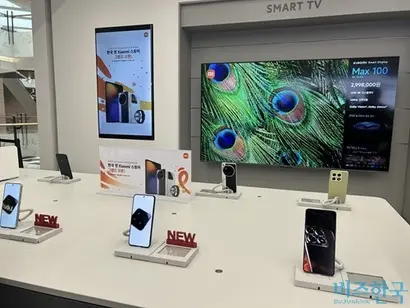
First Domestic Store Focuses on "Practicality" While Offering Integrated AS
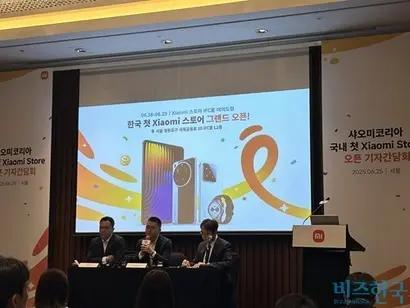
Xiaomi has rolled up its sleeves to penetrate the Korean home appliance market by opening its first offline "Xiaomi Store" at IFC Mall in Yeouido, Seoul. The concept is to provide a space where customers can verify products previously only available online, thereby boosting satisfaction through hands-on experience. At a press conference on the 25th, Jony Wu, President of Xiaomi Korea, stated, "This is an important milestone in strengthening our connection with Korean consumers and establishing ourselves as a brand that feels like a friend," adding, "We will expand our touchpoints nationwide to provide innovative products and services to more consumers."
Following a four-day trial period, the store is set to officially open on the 28th. Despite being the first domestic location, the store design focused more on practical utility than a flashy or sophisticated exterior.
In fact, about 100 products across all categories—ranging from smartphones, smart TVs, and home appliances to daily necessities like jump ropes and sunglasses—were displayed in the space of about 60 pyeong (approx. 197㎡), including the storage area. Two professional repair technicians are stationed at an AS counter next to the checkout. The company plans to increase this to three in the future. Mobile products like smartphones, tablets, and smartwatches are placed on a central table, while larger items, including 100-inch TVs, robot vacuums, hair dryers, and shavers, are arranged on side racks.
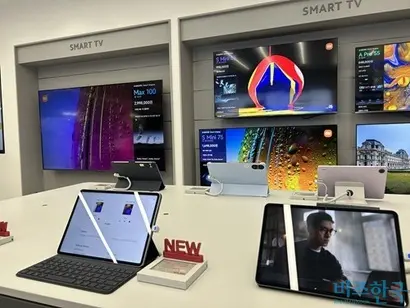
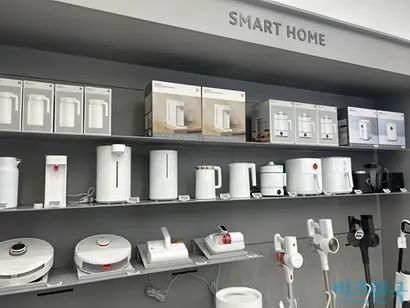
Xiaomi intends to ensure no gap in service quality between online and offline channels. It will also sequentially implement linkages between the two, such as a "buy online, pick up in-store" service. Andrew Li, General Manager of Xiaomi's East Asia International Business Department, explained, "We will provide a convenient purchasing environment online and a better user experience at offline stores," adding, "Products sold via the online store and offline shop will have identical pricing, costs, and model ranges."
Addressing the "Controversial" AS Situation: A Pivot Toward Direct Management?
A notable focus is the shift in the AS system. The greatest weakness of foreign home appliances, and a primary source of buyer dissatisfaction, is an inadequate after-sales system. Xiaomi, too, has frequently faced criticism regarding its AS. Even after establishing its Korean subsidiary, Xiaomi has limited its AS support to devices officially released within the country. In the past, Xiaomi smartphones were imported and sold individually by online retailers; in 2016, Xiaomi headquarters signed contracts with local distributors and briefly operated stores. At that time, Xiaomi faced backlash for not being obligated to provide AS for products sold through distributors even within the warranty period. To date, Xiaomi does not operate a single company-owned AS center in Korea. Currently, AS is outsourced to SK Networks Service, which provides support through 14 branches nationwide.
The lack of standardized repair costs across centers has also been identified as a limitation. According to the Consumer Sovereignty Civil Assembly, the cost to replace the screen of a Xiaomi "Redmi 14C" is 25,000 won higher at the Guro branch (78,000 won) than at the Gwangmyeong branch (53,000 won). Similarly, while the "Redmi Note 13 Pro 5G" is 11,000 won more expensive at the Guro branch (133,000 won), the "Redmi Note 13" is 4,000 won more expensive at the Gwangmyeong branch (101,000 won).
While Xiaomi maintains that it cannot interfere with the pricing set by outsourced providers under current laws, critics argue that improvement is necessary. The Consumer Sovereignty Civil Assembly pointed out, "If there are legal constraints, they should follow Apple's lead by expanding company-operated repair centers to strengthen supervision and clearly notifying customers of repair costs to minimize confusion." The group advocates for the standardization of repair costs for Chinese home appliance brands and mandatory establishment of offline centers.
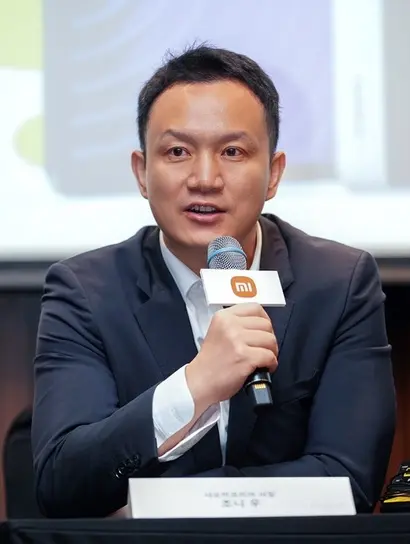
Strengthening the AS system was a key topic at this press conference as well. The improvements proposed by President Jony Wu are threefold: offline integrated stores that handle both sales and service in one location, independent operation of AS centers, and cooperation with local partners to ensure stable service.
While the company expressed plans to expand offline stores to Seoul, the metropolitan area, and key regions nationwide, it did not provide specific details regarding the scale or timeline for building independent AS centers, nor specific plans for strengthening partner cooperation. When asked, President Wu admitted to feeling a heavy sense of responsibility but asked that the offline AS centers be seen as "the first step Xiaomi Korea is taking in Korea." While the general direction was presented, the response lacked details on execution.
President Wu added, "I believe we need to learn from the excellent services of our domestic competitors. There is a certain gap between the company's goals, consumer expectations, and the current level of service. We will strive to narrow that gap as quickly as possible."
Attention is now focused on whether Xiaomi, having reorganized its operations from online/offline presence to after-sales service, can stand out in the Korean appliance market. Notably, while Xiaomi ranks third globally in smartphone market share and first in smartwatches, its presence in the domestic smartphone market is minimal, hovering near 0%.
Hwang Yong-sik, a professor of business administration at Sejong University, noted, "The service sector, including AS, is one of the main reasons many companies have withdrawn from the Korean market in the past. It is essential to fully consider the high standards, unique characteristics, and market environment of Korean consumers, whom major brands use as a 'testbed'." He added, "Only by learning from past failures and focusing on strengthening quality and service can the company secure competitiveness."