

[비즈한국] Some of the traditional markets that once sustained the "livelihood of the common people" have transformed into tourist hotspots teeming with foreigners. While they may appear to be booming, the merchants dealing with foreign visitors have complicated feelings.
June 24, Namdaemun Market, Seoul. A merchant held up five fingers to a foreign tourist examining eco-bags on a rack, saying, "Seven thousand, 7,000 won." English, Chinese, Japanese, and various other languages could be heard on the street. People went back and forth on the stairs of an international currency exchange located on one side of the market. A merchant (A), who has run a clothing store in Namdaemun Market for over 10 years, said, "It’s hard to do business without foreigners now."
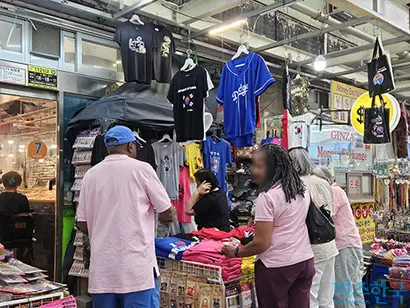
Namdaemun Market and Gwangjang Market in Seoul are representative traditional markets frequently visited by foreign tourists due to their excellent accessibility. Merchant A said, "I think the ratio of foreign to Korean customers is about 7 to 3," adding, "It’s especially hard to find Koreans on weekdays."
Merchants at these traditional markets, whose main customer base has become foreigners, maintain that they have no choice but to adjust their business to suit the preferences of tourists. "The tastes of Koreans and foreigners are completely different," A explained. "I’ve stocked my store with colorful character T-shirts to capture the hearts of tourists from Hong Kong and China."
The streetscape of Seoul's Gwangjang Market has also changed to cater to foreign preferences. I walked through the market myself. Stores selling mung bean pancakes (bindaetteok), sweet pancakes (hotteok), dumplings, nutritional supplements, and red ginseng products were dominant. These are all items that tourists can eat on the spot or pack as souvenirs.
There were only 5 stores selling groceries needed by local residents, such as vegetables, seafood, and meat. Stores selling various souvenirs, such as T-shirts with the "Seoul" logo and magnets shaped like Namsan Tower, were also frequently seen. These are places rarely visited by Koreans.

As a result, merchants are losing Korean customers who visit traditional markets. This is because the fundamental function of traditional markets—supplying groceries and daily necessities to local residents—has weakened. Kim (76), who has been visiting Gwangjang Market for over 50 years, said, "There used to be many stores selling side dishes, vegetables, and meat, but they have almost disappeared now," adding, "I rarely shop here anymore and only come occasionally for a stroll." The demand from local residents, who are highly likely to become repeat customers, is directly linked to revenue.
Ironically, despite the efforts put into attracting foreign customers, there are complaints among tourists that it is difficult to feel the unique character of Korea. Asgush (25), a traveler from Turkey visiting Korea, said, "I walked around Gwangjang Market, but I don't see much difference from the markets I've seen in Turkey," adding, "I think it's better to visit temples or villages to experience Korea's traditions." If the identity of a traditional market disappears due to strategies customized for foreigners, it is difficult to guarantee the continued demand from foreign tourists.
Merchants also face the burden of having to compete with large corporations. In Gwangjang Market, a large store for "HBAF," a brand famous for its flavored almond products, has taken up a significant space. "HBAF Almonds" are viral products that foreign tourists consider a must-buy souvenir when visiting Korea. Stores handling snacks have also displayed "HBAF Almonds" at the very front of their racks. Right next to the "HBAF" store, a large, modern-style cosmetics shop has been doing a brisk business for about 3 weeks. K-Beauty is another area in which foreigners have great interest.
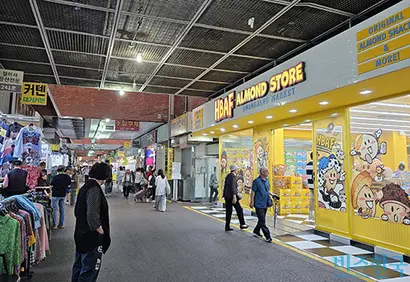
The number of foreign tourists, which fluctuates according to international affairs, is also a variable for merchants. This is because their revenue depends entirely on foreigners. It has become harder to generate stable income than in the past. Merchant B, who has been selling red ginseng products at Gwangjang Market for 36 years, said, "During the COVID-19 pandemic, the footsteps of foreign tourists stopped, and there was a period of great despair in the market."
For traditional market merchants to operate their businesses stably, local residents must visit the markets. However, the number of customers is steadily declining. According to the "2023 Survey on the Management Status of Traditional Markets, Shopping Districts, and Stores" published by the Small Enterprise and Market Service, the annual number of customers at traditional markets decreased from 2.41 billion in 2019 to 1.66 billion in 2023.
Koreans maintain that they have no reason to visit traditional markets. Lee Kyung-moon (50) said, "If online malls like Coupang or Market Kurly hold discount events, I can get goods cheaply and conveniently," adding, "Enduring inconvenience for the sake of low prices is a thing of the past."
Experts emphasize that for traditional markets to regain the interest of locals, they must become spaces where one can experience regional culture and unique characteristics. Kim Yong-han, CEO of MI Strategy Research Institute, who studies local commercial districts, advised, "In a situation where online shopping is increasing, it is difficult to compete through simple product sales," adding, "They must create various experiential elements, such as developing food incorporating local identity and planning festivals targeting the younger generation."