

[비즈한국] Just 3 to 4 years ago, ‘Defense Tech’ was a field that was uncomfortable to discuss openly in the European startup scene. This was due to ESG-focused investment criteria, a preference for peaceful technology, and lingering historical aversion to the military industry. However, the landscape shifted dramatically after Russia’s invasion of Ukraine in 2022. In fact, interest has soared as investments in European defense technology reached an all-time high in 2024, the largest in a decade.
As the conflict on the Ukrainian front lines has dragged on and NATO has entered a reorganization phase—coupled with repeated air raids and reciprocal missile attacks between Israel and Iran just days ago—the global defense market is in a state of constant agitation. Following U.S. airstrikes on Iranian underground missile bases and air defense facilities, interest in terrorism-related drones and intelligence weaponry has also intensified.
Amidst this trend, the EU announced its "Readiness 2030" plan on March 4, confirming a defense reinforcement budget of 800 billion euros (approximately 1,260 trillion won). Consequently, not only government bodies but also investors have begun to turn their attention to "defense technology."
This change is confirmed by the numbers. According to Sifted, a media outlet specializing in startups, private investment in European defense startups more than tripled in 2024 compared to the previous year, and some VC funds have launched dedicated tracks for dual-use or sovereign tech.

In this climate, some VCs argue that defense startups should grow "quietly." The protagonist is Rob Lacher, co-founder of the Berlin-based Visionaries Club. The Visionaries Club is a venture capital fund backed by a community of European digital founders and family business entrepreneurs, which has focused on early-stage startups in B2B and deep tech. Its portfolio includes promising European startups such as Pigment, Personio, Miro, and Vay.
Rob Lacher, a co-founder of the fund, has a long history in the European early-stage investment ecosystem, having served for over nine years as a co-founder and partner at La Famiglia VC. La Famiglia is a VC firm specialized in seed and early-stage investments, where Lacher led the initial vision and managed the first fund. Major investments he has led or participated in span a wide range of areas, from B2B SaaS firms like Deel and Forto to logistics, AI, healthcare, and defense tech.
Lacher recently mentioned on the Sifted podcast, "Because defense startups deal with industries where lives are at stake, they must grow quietly and responsibly in 'stealth mode'," revealing his philosophy as a defense VC. He also emphasized, "In fact, technologies that have the greatest impact on the battlefield are often not well known to the public." However, in reality, the spotlight cast on the defense sector is so bright that both expectations and concerns coexist.
Rapid Growth to a Valuation of 12 Trillion Won
The most prominent player is Helsing. Headquartered in Munich, Germany, the defense AI startup Helsing recently raised 600 million euros (870 billion won) led by Prima Materia, the investment firm of Daniel Ek (founder of Spotify), boosting its valuation to 12 billion euros (17 trillion won).
The speed of its growth, not just the amount of investment, is astonishing. As recently as last year, Helsing was a 5 billion euro company focused on AI-based battlefield software. However, as it fully entered hardware development, its value more than doubled, and it has now ascended to the ranks of Europe's top high-tech startups.

Investors compare Helsing to the U.S.-based Palantir and Anduril, evaluating it as the "vanguard of European defense startups." Palantir, established in the U.S. in 2003, is a big data analytics and intelligence software company that supports the integration and analysis of battlefield data for the U.S. Department of Defense and intelligence agencies through its proprietary platform. As of 2025, it has already secured annual contracts worth over 1.3 billion dollars (1.7 trillion won) with the U.S. Department of Defense and is increasing its influence amid rising tensions in the Middle East.
Anduril Industries is a defense tech startup based on autonomous systems, founded in 2017 by Oculus founder Palmer Luckey and others. Developing the Lattice AI operating system, unmanned surveillance towers, drones, and autonomous maritime, ground, and aerial platforms, it is winning border security and military procurement contracts in the U.S., the U.K., and elsewhere. As of June 2025, its valuation has reached approximately 30.5 billion dollars (41 trillion won), growing rapidly due to the convergence of the Russia-Ukraine war and the U.S.-China strategic competition.
The cases of Palantir and Anduril show that defense tech ultimately requires systems with proven performance and large-scale contracts. As much as expectations are high, Helsing is being compared to U.S. defense firms and is being required to prove itself on a much larger stage.
The ‘Exit Dilemma’: Is an IPO Possible?
Viewed another way, Helsing’s 17 trillion won valuation implies that an IPO is practically the only "exit" route. The market capitalizations of major European defense firms are already not far from Helsing’s valuation. Saab, a Swedish giant and Helsing investor, is valued at about 28 billion dollars, France's Thales at 51 billion euros, and the U.K.'s BAE Systems at 57 billion pounds. This is why industry insiders say, "Defense primes no longer have the capacity to acquire Helsing."
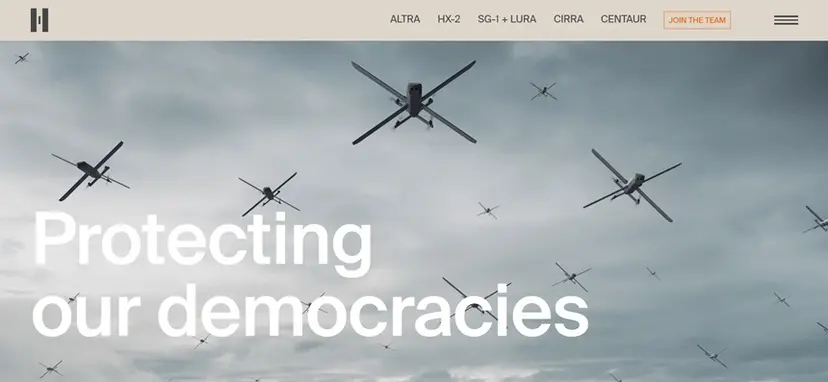
If so, is an IPO possible? While Helsing’s co-CEO Torsten Reil has set a boundary, stating, "We are focused on growth and execution, and are not discussing exits," realistically, more weight is placed on the possibility of a U.S. listing. This is because Europe remains a disadvantageous market for high-growth tech companies in terms of regulations and fundraising. In particular, the regulatory barriers are firm because European countries have different security regulations and varying export controls.
Among VCs, there is also a sober assessment that the U.S. model, like Palantir or Anduril, was only possible because they had the U.S. Department of Defense as a "giant customer." The European defense market is small, and the procurement process is complex. Therefore, it remains to be seen whether Helsing can translate its current valuation into actual revenue and profit.
In South Korea, private investment flows centered on "strategic technologies" such as defense, secondary batteries, nuclear power, and aerospace have also been active recently. However, the Helsing case shows that simply attracting investment is not enough to leap into a global defense tech company. This is why we must now consider a strategic approach regarding "where to grow, who to work with, and what message to convey." What we need now is an ecosystem that can trust and nurture "quiet technology."
The author, Eunseo Lee, majored in law in South Korea and studied theater in Berlin. Based in Berlin, a city of art and a European startup hub, she leads 123factory, which connects the Korean and German startup ecosystems while growing alongside the city.