

[비즈한국] The perennial buzz in the solar system that never goes away is the "Ninth Planet," known as Planet X. Pluto, long called the ninth and final planet of the solar system, was eventually demoted following a vote in 2006, reducing the count to eight. However, even since then, astronomers have persistently contemplated the possibility of another ninth planet. In particular, the theory suggests that a large planet—one truly deserving of the name, rather than an ambiguous celestial body like Pluto—might still be hiding in the darkness at the edge of the solar system. The debate among astronomers over Planet X sometimes feels like a fierce race to see who will plant a flag at the farthest point from the Sun.
The reason the story of Planet X sounds so intriguing is likely due to Mike Brown, a figure who cannot be excluded when discussing the demotion of Pluto. Long before others considered it, and at a time when most astronomers believed there were no more large celestial bodies to be found in the solar system, he set out on a solo hunt for a new planet. Eventually, he discovered numerous celestial bodies in the outer solar system similar to or even slightly larger than Pluto, effectively becoming the "Pluto Killer" who jeopardized its status.
However, starting in 2016, Brown began to capture the academic world's attention with a new claim: that a true ninth planet, "Planet Nine (Planet X)," was indeed hidden beyond Pluto. He specifically based this on the orbits of Trans-Neptunian Objects (TNOs), which travel in highly elongated elliptical orbits that cross in and out of Neptune's orbit.
Interestingly, the elliptical orbits of these TNOs were skewed toward one particular direction relative to the Sun, as if something were hidden on the exact opposite side. It is highly unlikely that these TNOs would form such a unique orbital distribution by pure coincidence. Brown argued that this is because another gas planet, roughly 5 to 10 times as massive as Earth, is hiding on the opposite side. Initially, Brown estimated that Planet X would follow an elliptical orbit tilted significantly, by about 15 to 20 degrees, relative to the Earth's orbital plane. As these new findings accumulated, a hunting boom for Planet X began to emerge once again in the astronomical community.
Recently, two interesting results pointing to extremely different conclusions about the existence of Planet X have been published. One paper claims that after analyzing observational data spanning more than 20 years, it has identified about 13 of the most likely candidates for the long-sought Planet X. Conversely, another paper refutes this, arguing that the skewed TNO orbital distribution—long considered the strongest evidence for Planet X—can no longer serve as a valid basis. Two papers making polar-opposite claims are now in conflict. One says they have finally found Planet X candidates, while the other asserts that there was no such thing as Planet X in the first place. Does a ninth planet really exist in the solar system?
First, let's examine the first paper, which claims that candidate celestial bodies for Planet X can be found. Even if Planet X exists, confirming its existence through actual observation would be extremely difficult. For one, its predicted orbit is too distant. On average, it is estimated to be more than three times further from the Sun than Pluto. At such a vast distance, the sunlight reaching the planet would be very weak, and the light reflected off its surface would be nearly invisible from Earth.
Because the orbit is so large, its speed is also very slow. Its movement across the night sky would be almost imperceptible. Consequently, to confirm that another planet is wandering the outer solar system, one would have to photograph the same patch of night sky daily and look for something moving slowly against the background stars. However, if it takes nearly 1,000 years to complete one orbital revolution, it is hard to notice any movement, no matter how much you observe the night sky. According to the orbital model of Planet X, which was reverse-engineered from the distribution of TNO orbits, if Planet X is truly hiding there, the speed at which it moves across Earth's night sky is only a fine angle of about 0.05 degrees per year. Such a subtle difference is difficult to detect with only a few days or months of observation.
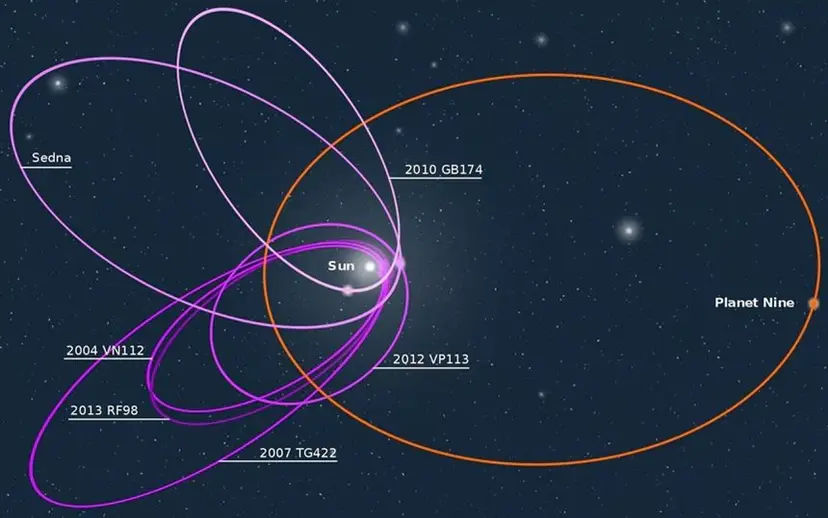
To find Planet X, infrared observations are more advantageous than visible light. Since it would be very far from the Sun, Planet X would receive insufficient sunlight and thus have a very low temperature. While visible light dims very rapidly as distance increases, infrared light has the advantage of being visible from even greater distances. Therefore, in this paper, astronomers scoured observational data from infrared space telescopes to find candidates for Planet X. One set of data was from the IRAS satellite in 1983, and the other was from the AKARI space telescope, conducted between 2006 and 2007, 23 years later.
Astronomers compared photos of the same area of the sky taken 23 years apart to see if any celestial bodies had moved during that time. 23 years is a sufficient interval. Given the estimated orbital speed of Planet X, it could have moved about 1 degree in the night sky over 23 years. This difference is clearly noticeable when comparing two photos. Astronomers identified 13 celestial bodies that had changed positions during that time. On average, all of them had shifted their position across the night sky by about 0.78 degrees over the 23-year period. After re-verifying one by one, they selected the most likely candidate for Planet X. This single candidate displayed nearly the same size, color, and brightness in both photos taken 23 years apart. It is suspected to be the same object simply having changed its position.
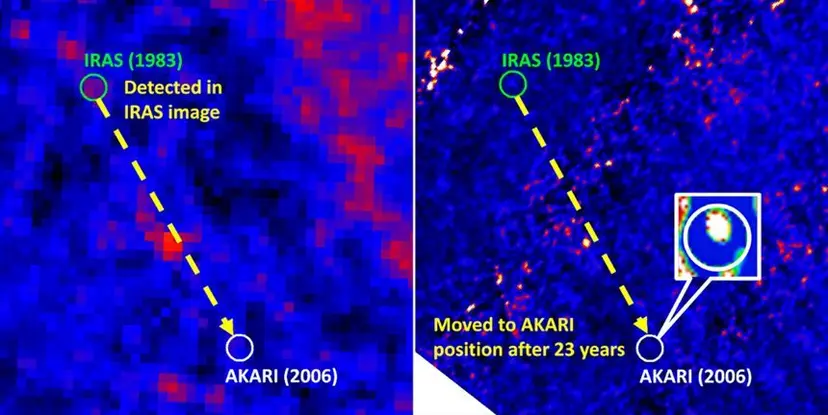
So, has the long-sought Planet X finally been identified? It is hard to be certain. The data used in this analysis, consisting of only two snapshots, is insufficient to determine the entire orbit the body traces. Future consecutive observations are necessary to track the direction and speed of this object to determine its full orbit. Additionally, further analysis is needed on what materials constitute its surface. If the surface is made of components like ice that reflect sunlight better, it could appear brighter even if it is small. Depending on the estimated size of the celestial body, its mass and orbit could all vary.
This analysis was made possible because humanity has been consistently observing the entire universe for quite a long time. Thanks to the fact that we have been capturing every corner of the night sky for over 20 years, we now live in an era where we can dig back through accumulated data to see if there is anything we missed.
However, a new argument has been presented from the opposite side. It was suggested, along with new evidence, that the orbits of TNOs, which were considered the most reliable proof of Planet X, might not actually be skewed in one direction. Recently, astronomers discovered another new TNO object slowly drifting across the night sky using various telescopes, including the Canada-France-Hawaii Telescope. Starting on July 23, 2017, a small new dot began to be captured by telescopes, and through seven years of consistent observation, they succeeded in capturing the same object in a total of 19 photos. A small dot was slowly moving across the background stars. Based on this data, astronomers confirmed that it is another TNO object drifting in and out of Neptune's orbit at the edge of the solar system. This object is currently named 2017 OF201.
Like other known TNOs, this object follows a highly distorted elliptical orbit centered on the Sun. At its farthest point from the Sun, it reaches a distance of 1,600 times the distance between the Earth and the Sun. Conversely, at its closest approach to the Sun, it reaches about 40 AU, which is similar to the average distance between the Sun and Pluto. It takes about 25,000 years to complete one orbit of its elongated elliptical path.
The current estimated size of this object is only about 700 km. It is the size of an asteroid, much smaller than the Moon or Pluto, let alone Earth. Ceres, the largest asteroid in the asteroid belt between Mars and Jupiter, has a diameter of about 900 km. Therefore, at this size, it can be considered a fairly large dwarf planet, slightly smaller than Ceres. An interesting fact is that if one traces the currently revealed orbit backward, this object approached its closest distance to Earth around the 1930s. This coincides with the time Pluto was first discovered, but unfortunately, it seems its appearance was not captured at the time because it was too small compared to Pluto.
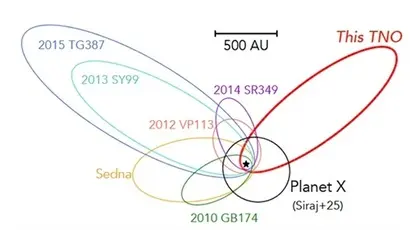
What is interesting is the direction toward which the elliptical orbit of 2017 OF201 is skewed. Unlike other known TNOs, its orbit is skewed in the exact opposite direction. This could be a very embarrassing discovery for astronomers who have argued that the asymmetric orbital distribution of TNOs is the most important evidence for the existence of Planet X. This is because the newly confirmed orbit of 2017 OF201 could dismantle that argument in one fell swoop.
In fact, the astronomers in this paper demonstrate through simple simulations that the existence of 2017 OF201 itself negates the Planet X hypothesis. If one assumes that Planet X exists, the current orbit of 2017 OF201 could never be maintained. In a model applying the mass and orbit of Planet X estimated by Mike Brown and others, adding 2017 OF201 shows that within a few million to at most 200 million years, the orbit of 2017 OF201 would become extremely distorted due to the continuous gravitational influence of Planet X, and it would eventually be kicked out of the Sun's gravitational influence. There is only one case in which 2017 OF201 can maintain its current orbit: if Planet X does not exist. Even if Planet X is hidden somewhere, it should not exist in the orbit currently known to us.
In a situation where we were anticipating the ninth planet, Planet X, this discovery could be quite shocking. This is because a single case serves as the most certain refutation that TNOs might not have orbits skewed in only one direction. If another massive planet, on the scale of Uranus or Neptune, were hiding at a very great distance beyond Pluto's orbit, its gravity would inevitably affect the orbits of small outer celestial bodies. Therefore, the fact that 2017 OF201 has been maintaining a stable orbit for a long time casts a significant doubt on the possibility of the existence of Planet X, which we had been vaguely hoping for.
Of course, it is too early to give up hope. We do not yet know exactly when 2017 OF201 joined the outer solar system as a new member. To keep some "hope alive" from the side that expects Planet X to exist, we cannot yet rule out the possibility that 2017 OF201 entered from the outer solar system relatively recently, or that it shifted from its original orbit due to gravitational perturbations from another adjacent celestial body that recently passed near the solar system.
This argument shows how extremely the image of the universe we form in our minds can change depending on how far we look. If we think that TNOs coincidentally form skewed orbits because we haven't discovered enough of them, we imagine a solar system with one more massive planet hidden on the other side. However, this could be a kind of observational bias resulting from the fact that we have not yet thoroughly examined the entire solar system. As such, the universe appears in completely different forms depending on where and how much we observe.
Is there really a large Planet X hidden in the outer solar system that we haven't found yet and that could proudly take its place as a new planet? Which side do you want to bet on? On the side that Planet X is truly hidden and we will eventually discover it? Or on the side that something like Planet X does not exist?
References
https://www.science.org/content/article/astronomers-searching-planet-nine-find-possible-hints-different-planet
https://www.cambridge.org/core/journals/publications-of-the-astronomical-society-of-australia/article/search-for-planet-nine-with-iras-and-akari-data/4AC94D8DED041495F85F518C286D5284
https://www.sciencenews.org/article/dwarf-planet-solar-system-planet-9-x
https://ui.adsabs.harvard.edu/abs/2025MPEC....K...47C/abstract
About the writer, Ung-bae Ji? He loves cats and the universe. After watching "Galaxy Express 999" in his childhood, he dreamed of sharing the beauty of the universe. He is currently researching galaxy evolution through interactions at the Center for Galaxy Evolution and the Near-Universe Cosmology Laboratory at Yonsei University, and is engaged in various science communication activities such as lectures and writing. He has written books such as "The Observatory Having a Flirt," "Thinking About the Universe All Day," and "Stars, the Science of Light."