

[비즈한국] "You can't get work done on construction sites today without Chinese compatriots. Apartments just wouldn't go up. You know what I mean?"
Early this month, at a basic safety and health training session for the construction industry in Daerim-dong, Yeongdeungpo-gu, Seoul, Mr. A, who stood on the podium as an instructor after working for decades as a construction site safety manager, said this to the trainees. Of the approximately 40 students who attended the class that day, 21 were ethnic Koreans from China. According to the Occupational Safety and Health Act, to work as a daily construction laborer, one must complete safety and health training conducted by a designated training institution.
The presence of foreign laborers at construction sites is growing steadily. According to a construction site report released by the Construction Workers Mutual Aid Association on the 20th, the proportion of foreigners among construction workers in Korea last year was 15%, an increase of about 1 percentage point from the previous year. The proportion of foreign laborers at construction sites has grown from 12% in 2020 (169,340 people) to 12% in 2021 (176,220), 13% in 2022 (201,348), 14% in 2023 (236,549), and 15% in 2024 (229,541). Among foreign construction workers whose nationality was verified last year, 84% were ethnic Koreans from China, commonly referred to as "Joseonjok."
The most common job for foreign construction workers is that of a general laborer, the same as for locals. These are typically called "odd-jobbers" performing simple physical labor. Previous surveys showed that 32.3% of local construction workers and 23% of foreign construction workers are engaged in general labor. Other job roles for foreign construction workers followed in the order of formwork carpenters (21.8%), rebar workers (11.7%), plumbers (6.4%), and interior workers (3.3%), while local workers showed a similar pattern: plumbers (7.6%), formwork carpenters (5.7%), rebar workers (3.3%), and electricians (2.8%).
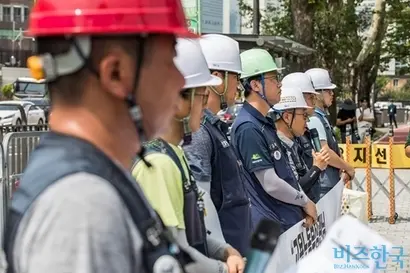
Local construction workers complain about job shortages due to the influx of foreign labor. Lee Dong-ki, policy director at the Federation of Korean Construction Industry Trade Unions, pointed out, "It is true that there are jobs on construction sites that locals avoid, and foreign labor is necessary for those roles. However, in reality, as foreigners enter fields with high demand from Koreans, the shortage of jobs for locals is intensifying. We must prioritize hiring locals for processes where demand for Korean workers is high and strictly monitor illegal foreign employment."
Yoo Jong-eun, secretary-general of the Gwangju-Jeonnam branch of the Korean Construction Workers Union, added, "Young workers who earned professional certifications at their own expense are being pushed out of the competition by unqualified foreign laborers and losing their jobs. While construction sites are being filled with low-wage foreign workers, local workers repeatedly go to manpower agencies only to return empty-handed. We must strictly enforce the Act on Foreign Workers' Employment and prioritize the hiring of our own citizens and local residents."
Of course, in terms of numbers alone, Korea faces a shortage of local construction personnel. According to the "2025 Construction Worker Supply and Demand Outlook" published by the Construction Workers Mutual Aid Association last year, the demand for skilled construction workers in Korea this year is estimated at 1,824,700, while local supply is expected to be only 1,466,091 (80.3%). In this survey, the association projected that foreign laborers would fill the local labor shortage of 358,609. The number of foreign workers employed at construction sites in Korea last year was estimated at approximately 420,000.
An official from the construction industry stated, "General labor, which involves simple tasks at construction sites, has long suffered from labor shortages because it is a field that locals avoid. Recently, as labor shortages have intensified for rebar workers, carpenters, and concrete placers, the necessity of expanding foreign labor employment is being raised."
The problem is that the actual supply of labor at construction sites due to illegal hiring of foreign workers is not properly grasped. In the aforementioned 2025 outlook, it was estimated that 240,000 (57%) of the 420,000 foreign workers expected to replace the domestic labor shortage this year were illegal workers. According to the Act on Foreign Workers' Employment, construction companies must hire foreign workers through the Employment Permit System (E-9) or special employment permits (H-2), excluding visa holders such as F-2 (resident), F-4 (overseas Korean), F-5 (permanent resident), and F-6 (marriage immigrant) status, but a significant number of construction firms currently do not follow this.
Shin Young-chul, director of the Construction Economy Research Institute, said, "Illegal employment of foreign workers is essentially an illegal theft of jobs from locals, and it requires thorough crackdowns and monitoring. As the construction industry is a sector with many new entrants and job seekers in their 40s, it is necessary to restrict the employment of foreign labor to some extent to secure jobs for the working class in the future. In the short term, we need efforts to limit foreign employment in public-sector SOC projects and expand these restrictions to private construction such as apartment complexes and multi-use facilities."