

[비즈한국] The 'missile war' between Israel and Iran, which even drew in the United States, now appears to have abruptly entered a ceasefire. This war, which began on the dawn of June 13 when Israel bombed Iran in an operation dubbed "Operation Rising Lion," led to Iran’s retaliatory "Operation True Promise III." Subsequently, the U.S. bombed Iran on June 21 in "Operation Midnight Hammer," before President Donald Trump suddenly declared a ceasefire on the dawn of the 24th, Korea Standard Time.
If both sides successfully maintain the ceasefire as announced by Trump, the so-called "12-Day War" will conclude with only missile and aerial bombardment, without the deployment of ground troops. How did the missiles and bombers, which serve as the "spear," and the missile defense systems, which act as the "shield," perform in this conflict? Examining the cases of Israel, Iran, and the U.S. offers significant implications for South Korea, which faces the threat of North Korean nuclear weapons.
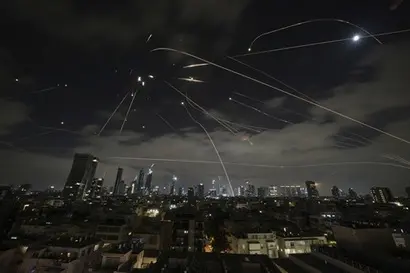
The first subject to examine is the battlefield performance of Israel's vaunted "multi-layered missile defense network." To put it bluntly, Israel's missile defense capabilities revealed distinct limitations in this war. Iran had launched missiles and drones at Israel twice last year. Those attacks occurred over one or two waves in a single night and caused minimal damage. However, this series of attacks has been repeated more than five times since June 14, with over 400 missiles and hundreds of drones deployed, a scale incomparable to last year.
As a result, Israel’s missile interception rate, which once hit 90%, saw performance degradation, dropping to as low as 65% on some days. The structural limitations of its "quadruple missile shield"—comprising THAAD, Arrow, Patriot, David’s Sling, and Iron Dome—were exposed.
The first cause lies in Iran's use of new missiles like the Fattah-1 in this war. The Fattah-1 is equipped with a Maneuverable Reentry Vehicle (MaRV) warhead that changes trajectory in the terminal phase, allowing it to disrupt defense networks. While such maneuverable warhead missiles were in the minority, the majority consisted of the Shahab-series legacy missiles used last year. Missile launches were concentrated on the first and second days, with attacks consisting of dozens of missiles continuing thereafter.
Nevertheless, the reason Israel's damage is compounding is ultimately due to a lack of resources. Most missile defense systems, excluding THAAD and Patriot, are domestically produced in Israel, but the local defense industry has been unable to quickly replenish depleting missile stocks. Furthermore, the personnel operating and controlling these air defense systems are experts who are difficult to train in large numbers, and with no easy way to bring in reinforcements during wartime, fatigue is accumulating. In this way, Israel is trapped in a structure where it inevitably suffers from war costs and manpower shortages as time goes on.
Ultimately, Israel’s lack of capacity led to direct U.S. intervention, with B-2 stealth bombers deployed via "Operation Midnight Hammer." Although Israel neutralized a significant portion of Iran's air defense network early in the war through Mossad operations and stealth fighters, existing combat aircraft like the F-15, F-16, and F-35 were insufficient to destroy underground nuclear facilities.
The U.S. also aimed to avoid a full-scale war with Iran, choosing the non-nuclear GBU-57 MOP (Massive Ordnance Penetrator) over the B61-12 nuclear bunker buster; consequently, it appears to have failed to completely destroy the nuclear facilities. The fact that Israel continues to conduct additional airstrikes is evidence of this.
The Iran-Israel war provides various implications for South Korea’s security strategy, particularly regarding offensive weapons, defensive weapons, and earth-penetrating capabilities.
First, the lesson that offensive weapons are far cheaper and faster to produce than defensive weapons was reaffirmed. It also became clear that for middle-tier nations that are not superpowers, retaliatory capabilities are very limited. The Cheongung-II and L-SAM, the pillars of our KAMD (Korea Air and Missile Defense) system, are excellent in terms of performance. However, if North Korea maintains a large-scale ballistic missile "salvo attack" for more than a week, as in the Israeli case, the interception rate is bound to drop. In particular, if North Korea employs a "mixed fire" strategy using both slow-moving drones and fast ballistic missiles like Iran, the interceptor missiles, which take much time and money to produce, are highly likely to run out quickly.
To compensate for this, it is urgent to develop cheaper yet effective defensive weapons. In the author's opinion, it is necessary to utilize the advancements in suicide drone technology. Recent suicide drones have reached a "technological singularity" where performance is improving while costs are decreasing. By utilizing this to modify attack-oriented suicide drones and accurately identifying the impact points of ballistic missiles, it may be possible to intercept them with relatively slower, cheaper drones.
Another point to watch is the necessity of penetrating weapons capable of neutralizing underground strategic facilities. If Israel had possessed high-strength underground penetrating weapons like the GBU-57 MOP, it could have struck Iran’s nuclear facilities early in the war without U.S. assistance. South Korea is in a better position than Israel. We have a Missile Strategic Command with strong ballistic missile attack capabilities, and the Hyunmoo-5, following the Hyunmoo-2, 3, and 4, can be equipped with an 8-ton class penetrating warhead, which is more than enough to threaten North Korean underground facilities.
However, the Hyunmoo-5 is a high-cost weapon system, making it difficult to maintain in large quantities of hundreds or more. Therefore, we must develop weapons that can be mass-produced by increasing the commonality of parts across the Hyunmoo missile family and miniaturizing and lowering the cost of guidance systems. Additionally, if missiles like the KTSSM (Ure) and Hyunmoo-4 are equipped with sensors to measure impact location and depth of explosion, and if multiple missiles can communicate information to conduct a "stream attack" on the same target, even underground targets dozens of meters deep could be effectively neutralized.
Now that the U.S. has struck Iran's nuclear facilities, it is difficult to say the war is completely over. It remains difficult to predict when, where, and in what manner Iran’s retaliation might occur, and the uncertainty of the global situation is likely to persist. As such, our military and defense industry must quickly analyze the military lessons of this war and begin earnest research on how to effectively develop South Korea's "Three-Axis System."