

[비즈한국] The Korean Art Support Project, which began as an initiative solely to support artists, has continued for 10 years. Keeping our initial promise, we have supported over 230 artists. This was a unique endeavor, never before attempted by any domestic media outlet, cultural organization, or government agency. We take pride in the fact that this decade of persistence has been etched into the 21st-century Korean art scene as a distinct value. Consequently, it is recognized that "the 10-year history of the Korean Art Support Project provides a viewpoint to observe the flow of contemporary Korean art." Now, in Season 11, we aim to pave another path for Korean art.
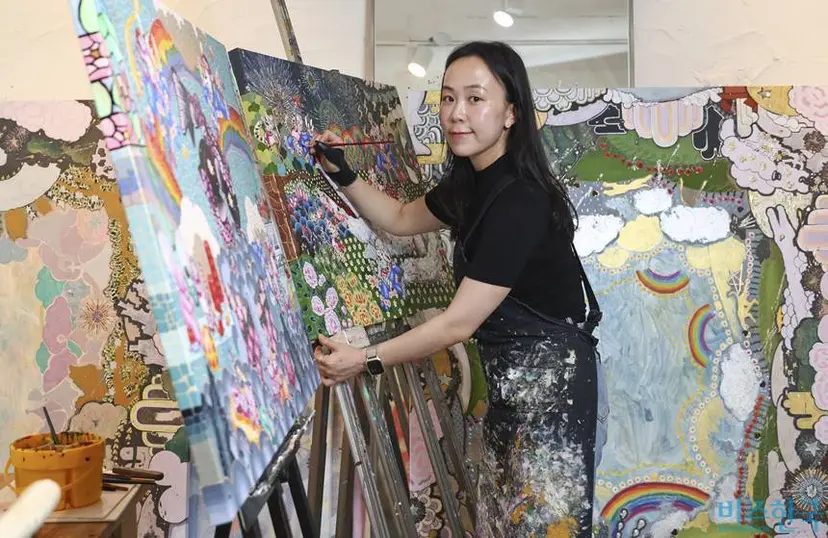
Life is a contradiction. This is because the final destination of the path we walk is death. Even though we are moving toward death, we say we are living our lives day by day.
Because our lives cannot solve the problem of death, humans have created a world beyond their capabilities. In their imagination. To solve problems that cannot be answered by reason. That is God.
God was created by humans, but eventually came to dominate them. Thus, one can predict that a world will come where the computers created by humans will also eventually dominate them.
Humans have also created spaces for God, which is religion. In the world we live in, there are countless gods. While some gods reside in spacious dwellings, far more do not. When a god receives sunlight, it becomes a religion, but when it is stained by moonlight, it remains a cult.
Religion and art both target the human spirit. Therefore, the phenomena that appear within them are difficult to prove. This is because they exist outside the realm of scientific thought.
Even those without faith in religion or art yearn for vague solutions to things that happen in life beyond their control. That is magical belief. Art began from such thoughts. We can confirm these magical beliefs in cave paintings or sculptures from the Paleolithic era. The Venus of Willendorf (a Paleolithic female figurine found in Willendorf, Austria), which appears in the first chapter of Western art history, clearly demonstrates the magical belief in fertility.
Art from Hellenism and Hebraism, which represent Western civilization, both reveal human magical beliefs through God. This belief in art persists even today. One of the major factors in purchasing artwork stems from magical belief. For example, people choose works with a vague belief that blue paintings bring hope or good energy for the future, while yellow brings wealth. Choosing paintings related to Feng Shui is also a case of this.
Among our traditional paintings, *minhwa* (folk painting) is a genre that openly incorporates these magical beliefs. It expressed worldly desires and the overcoming of death through various natural objects, animals, and plants.
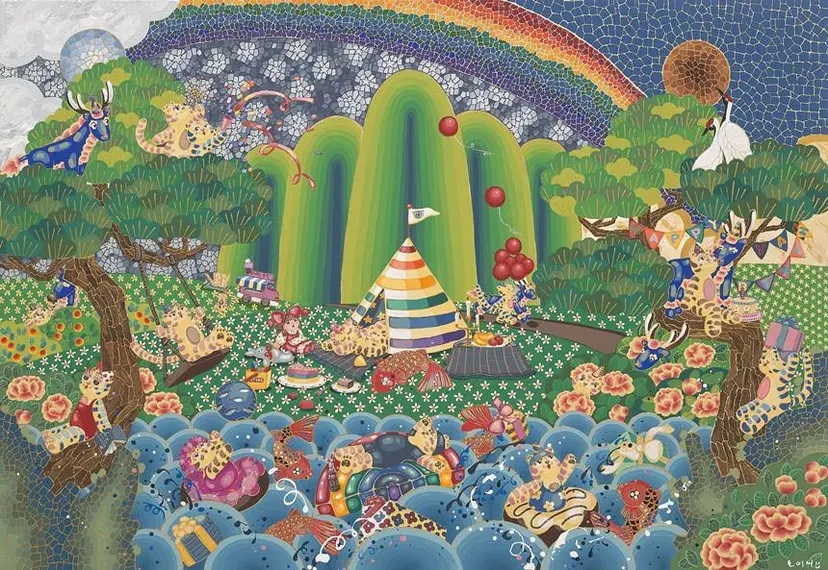
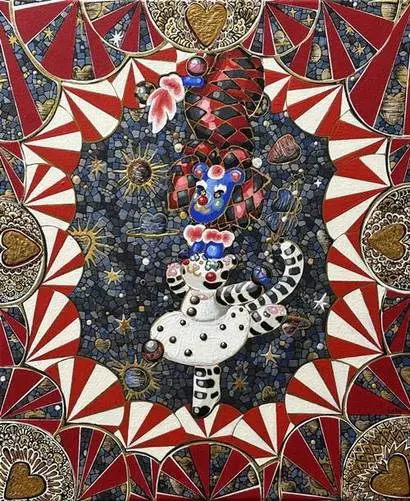
Such intentions can also be read in the paintings of Noh I-seo. She follows the composition of the 'Ten Longevity Symbols' (*Sipjangsaeng*) folk paintings, which best embody the magical beliefs found in Joseon Dynasty folk art. Her intention is to capture immutable values within her paintings. The immutable value the artist speaks of is hope.
The baby tiger that appears like a protagonist in Noh I-seo’s paintings symbolizes the artist herself. A blue giraffe also appears frequently, which she explains is a personification of the people around her who help her. Besides these, pine trees, cranes, rocks, clouds, and fish also appear, all of which she says represent good energy for the future. In this sense, her work can be called a modern version of *minhwa*.