

[비즈한국] On June 21 (local time), the United States launched airstrikes on Iran's nuclear facilities. With the U.S. militarily intervening in the Israel-Iran conflict, military tensions in the Middle East have escalated, drawing close attention to the potential fallout on the global economy. The South Korean government also convened an emergency national security meeting on the 22nd to discuss countermeasures.
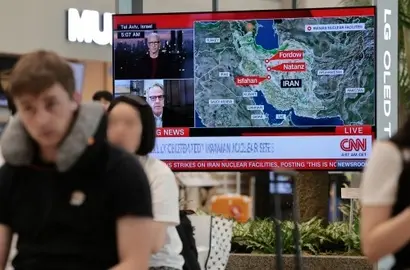
The U.S. has conducted missile attacks on key Iranian nuclear sites. In an address to the nation from the White House at 10 p.m. on the 21st, President Donald Trump stated, "The U.S. military has carried out large-scale, precision strikes on the Iranian regime’s key nuclear facilities in Fordo, Natanz, and Isfahan. America’s goal is to destroy Iran's nuclear facilities and put an end to the nuclear threat from the world's largest state sponsor of terrorism." He added, "The strikes were a staggering military success. Iran's key nuclear facilities have been completely and thoroughly destroyed."
Foreign media outlets, including Reuters and Fox News, reported that the U.S. utilized six GBU-57 bunker buster bombs—capable of obliterating underground facilities—and 30 Tomahawk missiles in the strikes. It is reported that the B-2 stealth bomber, an ultra-modern combat aircraft, was deployed for this operation.
President Trump also hinted at further attacks against Iran. He warned, "Iran must now choose peace. If they do not, future attacks will be larger and easier to carry out. There are many targets remaining. If peace does not come quickly, I will strike the remaining targets with precision, speed, and technical superiority. Most targets can be eliminated in a matter of minutes."
With the U.S. intervening in the Israel-Iran war, military tension in the Middle East has reached new heights, as retaliatory attacks from Iran are expected. Following the airstrikes, an anchor on Iranian state TV remarked, "Every American citizen and soldier has now become a legitimate target." There are no reports of radiation leaks as of yet. On the 22nd, the International Atomic Energy Agency (IAEA) stated on X (formerly Twitter) that "no increase in external radiation levels has been detected in the three areas struck by the U.S."
The Atomic Energy Organization of Iran (AEO) protested the attack, labeling it a violation of international law. According to a statement posted on X by the Iranian Embassy in India on the 22nd, the AEO emphasized, "The national nuclear facilities in Fordo, Natanz, and Isfahan have been the target of a brutal aggression. This is an act that violates international law, specifically the Treaty on the Non-Proliferation of Nuclear Weapons (NPT)." The AEO added, "Despite the malicious conspiracies of our enemies, we will not stop the development of our national industry (nuclear industry)," and signaled that they would pursue legal action.
The UN also issued a message opposing the U.S. attack. UN Secretary-General António Guterres stated, "I express my grave concern regarding the U.S. use of force against Iran," pointing out that "the U.S. attack escalates tensions in an already crisis-ridden region and poses a direct threat to international peace and security." The Secretary-General also emphasized that "there is no military solution; the only path is diplomacy."
As the U.S. has effectively entered a state of war with Iran, the impact on the global economy is being closely monitored. Following Israel's strike on Iranian nuclear facilities on the 13th and the subsequent possibility of U.S. intervention, the won-dollar exchange rate had already risen, reaching the 1,380 won range during intraday trading on the 18th. This is due to a growing preference for safe-haven assets as the risk of war increases. The industrial sector is also viewing the situation with concern, as a deterioration in Middle East stability could lead to disruptions in oil supply, driving up oil prices and freight costs.
The government has also begun preparations. On the 22nd, the Office of the President held an emergency meeting to check the security and economic situation, presided over by National Security Office Director Wi Sung-lac. The Presidential Office stated, "We are assessing the accurate situation while focusing our discussions on how this U.S. attack on Iranian nuclear facilities, following the Israel-Iran conflict, will affect our security and economy." They added, "We have urged close communication and cooperation among relevant ministries to ensure that the impact of this series of events in the Middle East on the security and economy of the Korean Peninsula is minimized."