

[비즈한국] As labor unions at major domestic IT companies intensify collective action, alarm bells are ringing for labor-management relations in Pangyo, once considered a "union wasteland." The Naver035420 union has openly opposed the return of an executive who was previously held responsible for managing a workplace bullying incident, while unions at Kakao035720 Mobility and Hancom030520 have played the "first strike" card to demand better working conditions. With the recent addition of Coupang to this structure, covering both the headquarters and all subsidiaries, the labor-management framework is now complete across the so-called "NeKaRaKuBae" (Naver, Kakao, LINE Plus, Coupang, Baedal Minjok).
While the interests of these companies differ amidst fierce platform competition, IT unions share similar concerns based on commonalities in working environments and treatment. As the IT corporate culture, once defined by flexibility, enters a period of transition and the number of majority unions grows, moves to enhance organizational and negotiation power are becoming visible.
Pangyo Unions Shift to Hardline Stance
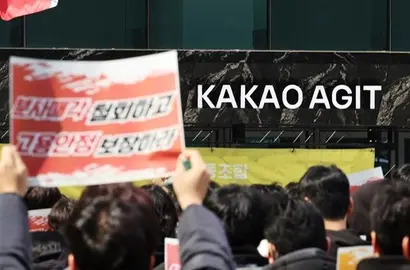
The Kakao union, which launched its first strike in its six-year history, temporarily suspended its phased strike on the 18th and resumed negotiations with the company. The union had staged a two-hour partial strike on the 11th and signaled future phased strikes, claiming that Kakao Mobility offered low-level compensation during wage and collective bargaining despite high performance.
On the 20th, Seo Seung-wook, head of the Kakao branch, said, "We have confirmed the direction with management in broad terms," and added, "We are currently in negotiations." Although a four-hour partial strike and a rally at Pangyo Station were planned for the 18th, along with a full-scale strike on the 25th, labor and management have gathered opinions and resumed efforts to find common ground. Industry observers expect that if negotiations proceed smoothly, results could be reached as early as next week.
While Kakao is resolving strike risks—excluding Kakao VX, which is expected to enter labor committee mediation following the breakdown of wage talks—tensions remain high across Pangyo as a whole.
Strikes to demand improved working conditions are also scheduled at Neople, a development subsidiary of Nexon, and Hancom. If they proceed as planned, both companies will face the first full-scale strikes since their founding. The Neople chapter of the Nexon branch of the Korean Chemical, Textile & Food Workers' Union (KCTU) held a rally on the 18th at the Neople Seoul branch office in Gangnam-gu, Seoul, stating, "We will hold rallies at the Seoul branch and Jeju headquarters on the 24th and 25th, and enter a three-day full-scale strike."
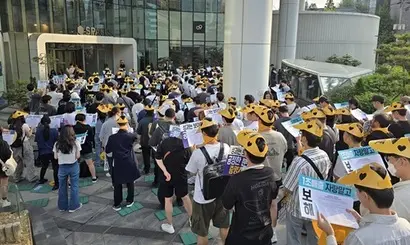
The labor dispute at Neople began with employee backlash over a reduction in performance bonuses. The union claims that while 'Dungeon & Fighter Mobile' achieved record revenue of 1.3783 trillion won in China last year, the GI (New Development Performance Bonus), which had been paid in proportion to net profit, was cut to two-thirds of the previous amount. The union plans to enter rolling strikes by department for one to two weeks starting in July after the full-scale strike ends.
In the case of Hancom, although detailed strike plans such as schedules and methods have not yet been released, the union is solidifying its resolve for a first strike. Industrial action by the union expanded after failing to narrow differences between the union's proposal (7.3%) and the management's offer (2%) regarding wage increases. The increase rates over the past three years were 6.5% in 2022, 6.8% in 2023, and 7.2% in 2024. According to public disclosures, Hancom achieved its highest performance ever last year with 304.7 billion won in revenue and 40.4 billion won in operating profit. The Hancom branch stated, "The company angered employees by reorganizing the personnel management system centered on performance without communicating with them. We have gained overwhelming support for industrial action," explaining the background for pushing for the strike.
Strengthening IT Unions, Continuing to Address 'Common Tasks'
With Coupang also establishing an integrated union, a labor-management landscape has been formed across the IT industry, including major NeKaRaKuBae companies. New unions are being organized one after another, and existing unions are adopting more hardline stances. This is a complex signal that can be read in the period of industrial structural transition, going beyond conflicts over individual issues.
A platform industry official remarked, "It means we have entered a stage where labor and management must think together about organizational stability and sustainability, rather than being 'startups in a growth phase'." Due to the nature of the industry, while corporate culture itself was once centered on speed and performance, it is now shifting toward a culture centered on sustainability through management and distribution.
While traditional manufacturing industries have built up certain negotiation practices over a long period, the IT industry lacks clear standards for labor-management discussions. Some argue that as conflict factors previously hidden by free culture and rapid growth surface all at once, unpredictability may increase. Hwang Yong-seok, a professor of business administration at Sejong University, pointed out, "Unlike other industrial sectors where labor-management conflict has become 'routinized,' the IT industry is only just beginning, so the future impact regarding labor issues could be much greater."
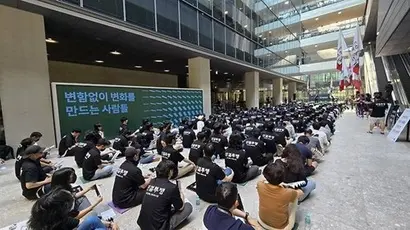
In this regard, there are concerns about a decline in industrial flexibility. Another industry official stated, "Since rapid response to market environments and quick management decisions are important due to the nature of the tech industry, a flexible consultation structure must be maintained in a balanced way."
Moves toward solidarity among unions sharing similar working environments and concerns are expected to continue. The Kakao union is providing backup to the Naver union, which has begun protests against the return of an executive. The Naver union, which belongs to the same IT Committee of the Chemical, Textile & Food Workers' Union as the Kakao union, continues to hold rallies opposing the return of former COO Choi In-hyuk as the head of the Tech Business division, after he stepped down following a workplace bullying-induced employee death in 2021. They plan to continue joint protests during the third rally scheduled for July.
Branch head Seo Seung-wook explained, "Workplace bullying is an issue that resonates deeply with IT workers. We have also put forward joint demands to improve common problems in the IT industry, such as performance evaluation, workplace bullying, and corporate spin-offs," adding, "We will respond in solidarity if necessary."
Professor Hwang pointed out, "The situation is shifting from dissatisfaction with distribution and management to structural issues such as fairness and governance. Companies need to pay close attention to this not as a simple conflict, but as a mid-to-long-term risk factor."