

[비즈한국] For overseas travelers, a power bank has become an essential item. As a result, in-flight power bank fire incidents are steadily increasing. Fires occurred consecutively on Air Busan298690 flights in December 2024 and January 2025, and similar cases were reported in Hong Kong and China in March and May.
In response, the Ministry of Land, Infrastructure and Transport (MOLIT) has been implementing guidelines since March that determine allowable quantities based on the capacity and number of power banks. However, it is pointed out that passengers are experiencing confusion because the units marked on the batteries differ from the MOLIT standards.
Furthermore, because aircraft passengers are of diverse nationalities, it is difficult to guarantee international safety with only Korea’s KC certification. However, the introduction of additional safety certifications faces obstacles such as issues of effectiveness and high costs.
“Can’t they just label both on the product?”
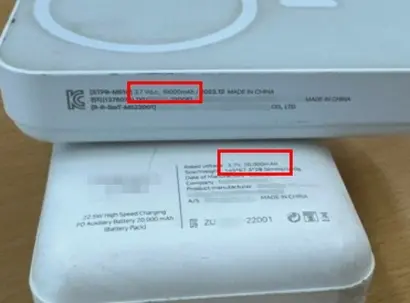
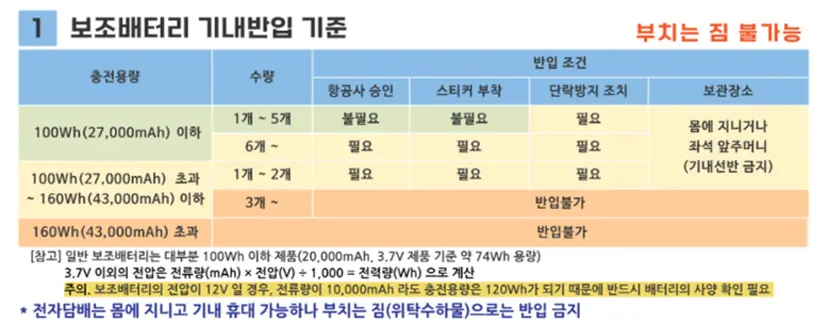
According to MOLIT guidelines, whether a power bank can be brought on board is determined based on the watt-hour (Wh) unit. However, most batteries are only labeled in milliampere-hours (mAh), forcing passengers to perform their own conversion calculations. The conversion formula is (mAh × voltage) ÷ 1000, and while MOLIT provides guidance on this, it remains inconvenient and difficult for general users.
For example, up to 5 batteries of 10,000–20,000 mAh (based on 3.7V) can be brought on board, but only up to 2 for those between 30,000–40,000 mAh. If the voltage is 5V or 12V, separate calculations are required yet again.
The reason MOLIT uses the watt-hour unit is to follow the International Air Transport Association (IATA) Dangerous Goods Regulations (IATA DGR Table 2.3). To ensure the safety of air transport, energy quantity is managed by unifying it into international standard units.
On the other hand, manufacturers typically use the mAh unit. Moreover, the text size on the products is small, making it difficult to verify during the security screening process. Consumers ask if it wouldn't reduce confusion to label both Wh and mAh on the battery from the start, but current regulations and international standards make this difficult.
While domestic KC certification mandates the labeling of model name, rated voltage, and mAh capacity, the dual labeling of Wh is not a requirement. An official from the Korean Agency for Technology and Standards explained, “Since mAh labeling is common internationally, KC certification follows this as well,” adding, “We understand why MOLIT provides guidance in Wh in accordance with IATA standards, but institutional reform is a matter that requires international discussion.”
There are also no separate regulations regarding font size or color, so procedures such as amending notifications would be required to make the battery capacity labeling larger.
Additional safety certification: High necessity but high cost
As in-flight power bank fires continue to occur, the need to strengthen safety certification is being raised. Currently, KC certification undergoes basic safety tests such as compression and overcharging, but it is not premised on the environment of being inside an aircraft.
Some manufacturers voluntarily obtain the additional international certification, UN 38.3. This is a safety test targeting lithium batteries transported as air cargo, evaluating durability against altitude changes, vibrations, and pressure. However, this certification is designed primarily for large cargo batteries, so it differs somewhat from small batteries for in-flight carry-on, and the certification cost is expensive, exceeding $5,000 USD.
Moreover, a significant number of domestic power bank sellers are import distributors, not manufacturers. Since many are small businesses that bring in and sell products manufactured in places like China, it is a reality that they cannot afford the additional certification costs. If additional certification were to be mandated, it would likely lead to an increase in consumer prices.
Aviation security experts point out, “It is time for the government and relevant agencies to seek ways to reduce the confusion experienced by actual consumers and field staff while keeping pace with international standards.” They also agree, saying, “Systems and regulations must be improved first so that information is displayed clearly for everyone to see and safety is verified according to international standards.”