

[비즈한국] A person in their late 30s, surnamed A, who signed a purchase contract for an apartment in Yangcheon-gu, Seoul, last February, inquired with their bank about loan interest rates ahead of the final payment deadline. When they applied for the loan last month, the interest rate was in the 3.7% range, and they had expected the rate to drop slightly following the recent interest rate cut by the Bank of Korea. However, the bank informed them that the rate was actually in the 3.8% range, explaining that bond prices had risen instead.
With the recent increase in real estate transactions, loan applications have surged. The balance of household loans at the five major banks (KB Kookmin, Shinhan, Hana, Woori, and NH NongHyup) increased by a total of 2.7609 trillion won over the eight business days leading up to the 13th of this month. Of this amount, mortgages accounted for 2.1665 trillion won, and credit loans reached 639.7 billion won.
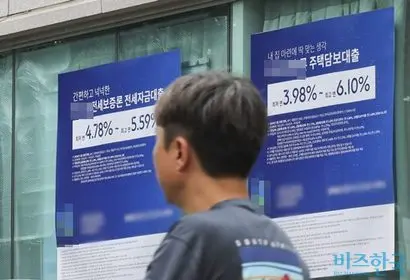
Variable rates are higher than fixed rates...?
According to the Korea Federation of Banks, the COFIX (Cost of Funds Index) for new loans as of the 16th was 2.63%, a 0.07%p drop from the previous month's 2.70%. Naturally, variable mortgage rates in the banking sector fell, but since the majority of borrowers use 5-year fixed-rate products, they do not feel the impact of lower rates. In particular, some explain that banks are "walking on eggshells" as the government’s stance—trying to control household debt by "encouraging fixed-rate loan products"—is being reflected in their policies.
In fact, when A inquired about variable loan rates, expecting potential further rate cuts by the Bank of Korea over the next 2–3 years, they were told that the rates were more than 0.3%p higher than those for fixed-rate products. It has become a structure where variable rates, which should theoretically be lower due to risk factors, are higher than fixed-rate loan products.
As a result, the proportion of borrowers using fixed-rate loan products has reached 90%. Banking industry sources explain that, coupled with expectations of rising home prices, demand has flocked to get loans before the implementation of the third phase of the Stress DSR (Debt Service Ratio), which has driven up rates for fixed-rate products.
Indeed, fixed-rate product interest rates at banks are rising. The fixed mortgage rates at the four major banks (KB Kookmin, Shinhan, Hana, and Woori) fell to between 3.32% and 4.78% in April, but as loan applications surged afterward, they rose to the 3.49%–5.01% range as of June 16. Even though the Bank of Korea’s base rate has been cut in the meantime, borrowers are not feeling the effects of the reduction.
Can the financial authorities' 'crackdown' calm the anxiety?
In response, financial authorities have launched a crackdown. As expectations for rate cuts have intersected with rising housing prices, particularly in the capital region, the Financial Supervisory Service (FSS) summoned major banks on the 16th. The FSS plans to check whether banks have indiscriminately issued loans exceeding their monthly and quarterly supply plans, and intends to impose penalties such as reducing the following year's loan supply plans if any regulatory violations are found.
The goal is to ensure that banks properly manage the proportion of high-DSR loans within 5% and 3% of their total loans, respectively. While auditing banks that have seen significant increases in household debt, authorities also plan to unveil further response measures if the upward trend in lending does not slow down.
In particular, there is talk of imposing higher additional interest rates in the capital region, where real estate buying sentiment is concentrated. Consequently, industry observers predict that banks' self-imposed measures, such as limiting daily loan applications and tightening loan conditions, will continue for the time being.
A bank official expressed concern, stating, "While it is true that loan interest rates should fall due to the base rate cut, the financial authorities have been implementing various measures centered on interest rates to prevent 'panic buying' (yeong-kkeul), which has resulted in 5-year mortgage rates failing to drop, and banks are feeling the pressure from these authorities." They added, "It seems insufficient to curb real estate prices just through mortgage and interest rate restrictions."